The people printed on banknotes can tell us a lot about what a country chooses to remember. Presidents and monarchs have long dominated currency, but writers, scientists, artists, activists, and reformers have earned a place in wallets and cash registers, too. Some of the women honored on money changed laws. Others changed literature, music, medicine, or the way people understood the world.
These portraits also tell a story about whose achievements were overlooked for generations. A few figures here became famous in their own lifetimes. Others received broader recognition only long after their deaths. Some never held public office at all, yet their work made an impact that lasted longer than any political administration.
For this roundup, 24/7 Tempo revisited 55 notable women featured on currency around the world. Most appear on paper or polymer banknotes; Queen Teuta is the single coin example, included with its denomination clearly identified. The selections include current designs, older notes that remain valid, retired notes, and a special commemorative issue. A country honoring someone decades ago does not necessarily mean their portrait is still printed on its newest bills.
We updated the biographical details and denomination information against central-bank records, museum collections, and other historical references where available. The people are presented alphabetically, not ranked by importance. Together, their stories show the many ways women have helped shape history—and how some of that history has been carried around in people’s pockets.
Here are 55 remarkable women who have appeared on world currency.
Agnes of Bohemia (1211-1282)

Agnes was born into the Bohemian royal family, but she became known for what she gave away rather than what she inherited. Instead of pursuing a dynastic marriage, she devoted herself to religious life and charitable work. In Prague, she helped establish a hospital and a convent associated with the Poor Clares, making service to people in need central to her legacy.
Her portrait later appeared on the Czech Republic’s 50-koruna banknote, an unusual tribute to a medieval princess who chose poverty over royal privilege. Pope John Paul II canonized her in 1989. The paper 50-koruna note was withdrawn from circulation on April 1, 2011, leaving a coin in its place, so this is a historic banknote rather than one Czech shoppers use today.
- Recognized for: Princess, religious leader, and philanthropist
- Country: Czech Republic
- Denomination: 50 koruna (banknote withdrawn in 2011)
Astrid Lindgren (1907-2002)

Astrid Lindgren gave generations of children a heroine who refused to behave the way adults expected. Her best-known creation, Pippi Longstocking, made her literary debut in 1945, and Lindgren went on to write beloved books featuring Emil of Lönneberga, the Brothers Lionheart, and other unforgettable characters. Her work balanced mischief, humor, and a deep respect for children’s independence.
Sweden placed Lindgren on its 20-kronor banknote as part of the modern series introduced in the 2010s. The design also evokes Småland, the region where she grew up. It is a fitting choice for a writer whose stories traveled far beyond Sweden without losing the feeling of a particular place and childhood.
- Recognized for: Author of “Pippi Longstocking”
- Country: Sweden
- Denomination: 20 kronor
Birgit Nilsson (1918-2005)

Birgit Nilsson possessed the kind of voice opera lovers rarely forget. The Swedish dramatic soprano became especially renowned for demanding Wagner roles, including Isolde and Brünnhilde, and for singing Richard Strauss with seemingly effortless power. Her long international career carried her from Swedish stages to many of the world’s leading opera houses.
Her portrait appears on Sweden’s 500-kronor note, alongside imagery connected to the southern region of Skåne. The choice places a performing artist next to writers, filmmakers, and other cultural figures on Sweden’s modern banknotes. Unlike some singers on this list, Nilsson has a place on a current Swedish note, not merely a design that disappeared decades ago.
- Recognized for: Opera singer
- Country: Sweden
- Denomination: 500 kronor
Božena Němcová (1820-1862)

Božena Němcová helped give Czech literature one of its most enduring voices. Her novel The Grandmother, published in 1855, offered a richly observed portrait of rural life and became a classic of Czech writing. She also collected and adapted folk tales at a time when Czech language and culture were central to a broader national revival.
The Czech Republic honors Němcová on the 500-koruna banknote. Her presence is a reminder that national identity is shaped by storytellers as well as by political leaders. Although the country has redesigned and upgraded its currency over the years, her portrait remains associated with the 500-koruna denomination. Her books also helped ordinary readers recognize familiar family customs, landscapes, and speech in serious literature.
- Recognized for: Author
- Country: Czech Republic
- Denomination: 500 koruna
Carmen Lyra (1888-1949)

Carmen Lyra was the pen name of María Isabel Carvajal, a Costa Rican author, teacher, and political activist. Her collection Cuentos de mi tía Panchita helped bring traditional stories to a wider audience, while her work in education reflected her belief that children deserved better opportunities. She became a prominent and sometimes controversial voice in Costa Rica’s public life.
Lyra appears on the country’s 20,000-colón banknote. Modern polymer versions retain her portrait and draw on the natural world and stories associated with her work. A quick look at the note reveals how currency can celebrate literature and education, not simply presidents or military victories.
- Recognized for: Author and educator
- Country: Costa Rica
- Denomination: 20,000 colones
Catherine Flon (dates unknown)

Catherine Flon holds a special place in Haiti’s independence story. According to longstanding tradition, she stitched together the first Haitian flag during the struggle against French colonial rule in 1803. Historians note that some details of the account are difficult to verify, but Flon has endured as a powerful symbol of women’s contributions to Haitian independence.
Her image appeared on Haiti’s 10-gourde banknote, carrying that national story into everyday life. The flag itself became a defining emblem of the new country. Whether the familiar sewing story is read literally or as patriotic tradition, Flon’s place on currency reflects how strongly she is associated with Haiti’s founding.
- Recognized for: Creator of the Haitian flag
- Country: Haiti
- Denomination: 10 gourdes
Cesária Évora (1941-2011)

Cesária Évora brought the music of Cabo Verde to audiences around the world. Known as the Barefoot Diva, she became internationally celebrated for singing morna, a style capable of carrying longing and homesickness in a few quiet lines. Songs such as Sodade introduced many listeners to the islands’ musical heritage for the first time.
Cabo Verde honored her on a 2,000-escudo banknote after her death in 2011. Her inclusion is particularly meaningful in a country whose music has long reflected migration, separation, and the ties between island communities. The photograph retained with this entry depicts a sculpture of Évora, rather than the banknote itself. Her influence helped bring Cabo Verdean music to audiences who had never visited the islands.
- Recognized for: Singer-songwriter
- Country: Cape Verde
- Denomination: 2,000 escudos
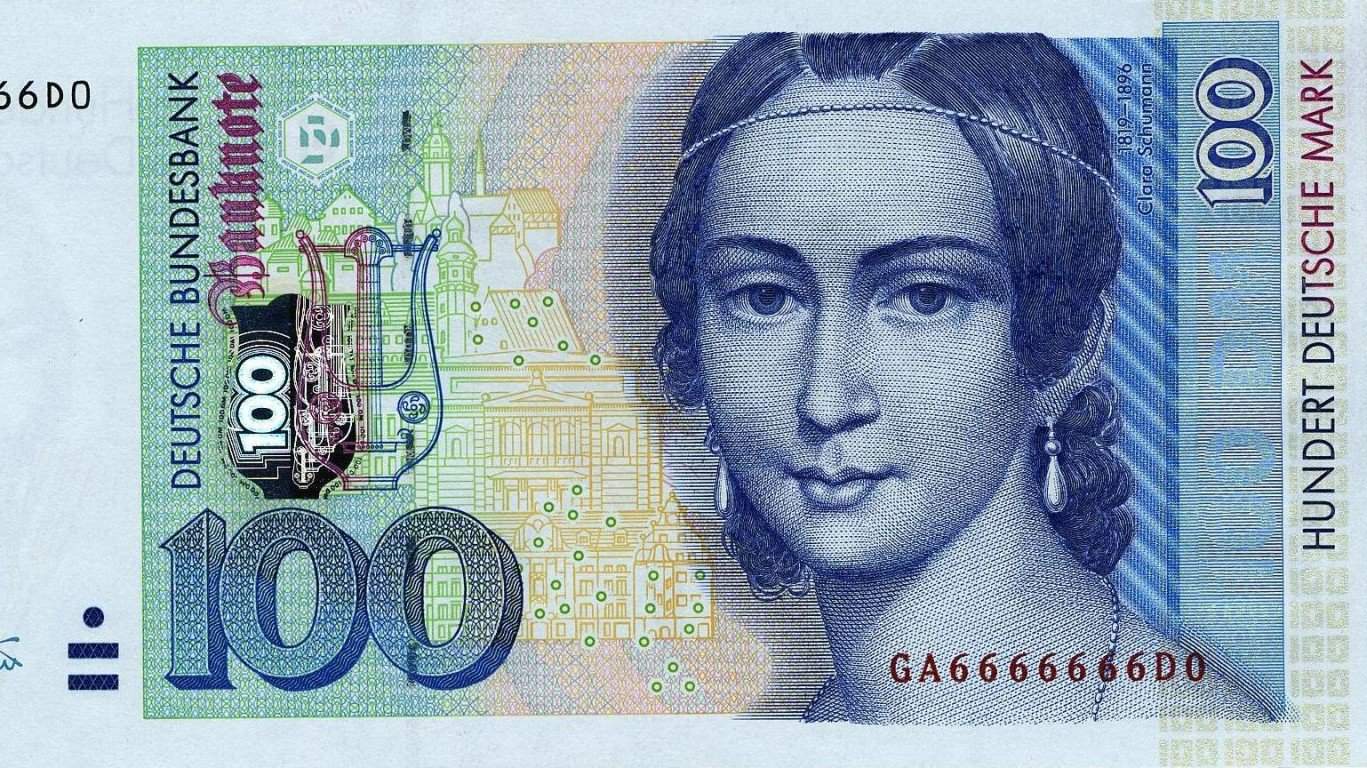
Clara Schumann (1819-1896)

Clara Schumann built a remarkable career in an era when women performers often faced severe limits on their professional lives. A celebrated pianist from childhood, she also composed and championed the music of Robert Schumann, Johannes Brahms, and other contemporaries. Her reputation rested on her own artistry, not only on her marriage to composer Robert Schumann.
Germany featured her on the 100-deutsche-mark banknote before the euro replaced the mark in cash transactions in 2002. For many Germans, that portrait was an everyday reminder of a musician who helped shape the modern concert tradition. The note is now a historic piece of currency, although old Deutsche Mark notes can still be exchanged through Germany’s central bank.
- Recognized for: Pianist and composer
- Country: Germany
- Denomination: 100 Deutsche Mark (historical)
Corazon C. Aquino (1933-2009)

Corazon ‘Cory’ Aquino became the Philippines’ first woman president after the 1986 People Power Revolution helped bring an end to Ferdinand Marcos’s long rule. A former political outsider, she became the public face of a movement demanding democratic change following the assassination of her husband, opposition leader Benigno ‘Ninoy’ Aquino Jr.
The couple appears together on the Philippine 500-peso paper banknote, reflecting their shared place in the country’s democratic history. There is also a newer polymer 500-peso design showing the Visayan spotted deer. The Philippines continues to circulate polymer and paper notes side by side, so the Aquino portrait remains relevant even though it is no longer on every new version of the denomination.
- Recognized for: First woman president of the Philippines
- Country: The Philippines
- Denomination: 500 pesos (paper note; polymer version has different artwork)
Dido

Dido, also called Elissa, is the legendary founder and queen of Carthage in what is now Tunisia. Ancient traditions describe her journey from the Phoenician city of Tyre and the founding of a major Mediterranean power. Much of her biography belongs to legend, and the romantic tragedy told in Virgil’s Aeneid was written centuries after the period in which she was said to have lived.
Her portrait appeared on an earlier Tunisian 10-dinar banknote, linking modern Tunisia to the ancient city whose ruins remain one of its great historic sites. Later currency designs replaced her image, but the note illustrates how countries sometimes choose legendary figures, not just documented historical leaders, to represent their past.
- Recognized for: Queen and founder of Carthage
- Country: Tunisia
- Denomination: 10 dinars (historical note)
Edith Cowan (1861-1932)

Edith Cowan was far more than a campaigner for women’s voting rights. In 1921, she became the first woman elected to an Australian parliament when she won a seat in Western Australia’s Legislative Assembly. She advocated for women, children, education, and social welfare, and she used her brief parliamentary career to press for legal changes that mattered in daily life.
Australia features Cowan on its 50-dollar banknote, opposite Aboriginal writer and inventor David Unaipon. Her portrait gives particular prominence to the long struggle for women’s political representation. It also reminds Australians that winning the vote was only one step toward holding power and shaping public policy.
- Recognized for: First woman elected to an Australian parliament
- Country: Australia
- Denomination: 50 Australian dollars
Elizabeth Fry (1780-1845)

Elizabeth Fry was a Quaker social reformer who campaigned for more humane treatment of prisoners, particularly women incarcerated with young children. Visits to London’s Newgate Prison convinced her that education, basic cleanliness, and meaningful work could transform lives. Her efforts also extended to other causes, including nursing and assistance for people experiencing poverty.
The Bank of England placed Fry on the five-pound note in 2002. Her image remained in the paper-note series until it was replaced by the Winston Churchill design during the move to polymer currency. The note is no longer current, but it captured a striking idea: a reformer who challenged harsh institutions was worthy of the same national recognition as statesmen.
- Recognized for: Quaker prison and social reformer
- Country: United Kingdom
- Denomination: 5 pounds (historical note)
Emmy Destinn (1878-1930)

Emmy Destinn was one of the outstanding operatic voices of her generation. Born Ema Destinnová, the Czech soprano became an international star, singing at major European houses and New York’s Metropolitan Opera. She created the role of Minnie in the Metropolitan Opera’s 1910 world premiere of Puccini’s La fanciulla del West.
Her portrait is featured on the Czech Republic’s 2,000-koruna banknote. It is a particularly visible honor for a performer whose career connected Prague with the wider world of opera. Destinn also became associated with Czech patriotic and cultural life, making her a natural figure for a banknote meant to reflect the country’s artistic identity. Her career shows how a national artist could have an international reach long before the era of recordings and streaming.
- Recognized for: Opera singer
- Country: Czech Republic
- Denomination: 2,000 koruna
Eva Perón (1919-1952)

Eva Perón, often called Evita, became one of the most recognizable women in Argentina’s political history. As the wife of President Juan Domingo Perón, she used her public position to advocate for workers and support charitable programs. She was also an important figure in the campaign that led to Argentine women gaining the vote in 1947.
Her portrait appeared on Argentina’s commemorative 100-peso banknotes, a tribute that reflected both her popularity and her divisive political legacy. Changes to Argentina’s currency have produced multiple designs over the years, so an Evita note should be identified by its particular issue rather than treated as the only current 100-peso design.
- Recognized for: Political figure and former first lady
- Country: Argentina
- Denomination: 100 pesos (earlier commemorative design)
Fatma Aliye Topuz (1862-1936)

Fatma Aliye Topuz was a pioneering Ottoman novelist, translator, and advocate for women’s education. Her 1892 novel Muhadarat helped establish her literary reputation, and she wrote about marriage, family life, and the place of women in society. Although she is often called Turkey’s first woman novelist, other women had published fiction earlier, making that label a little too absolute.
Turkey placed her portrait on the reverse of its 50-lira banknote when a new series debuted in 2009; Mustafa Kemal Atatürk appears on the front. The choice honors a writer who challenged the expectation that women remain outside public intellectual life. It also gives the note an unusually literary subject.
- Recognized for: Pioneering Ottoman novelist and advocate for women
- Country: Turkey
- Denomination: 50 Turkish lira
Florence Nightingale (1820-1910)

Florence Nightingale became a defining figure in the development of modern nursing. Her work during the Crimean War brought attention to conditions faced by wounded soldiers, while her later research used statistics to argue for better sanitation and hospital practices. Her achievements went well beyond the familiar image of a nurse carrying a lamp.
Nightingale appeared on the Bank of England’s ten-pound note from the 1970s until the 1990s. The design has long since been retired, but it remains a well-known example of British currency celebrating public service rather than royal or political power. Her continuing influence is visible in nursing education and public-health reform around the world.
- Recognized for: Nurse, medical reformer
- Country: United Kingdom
- Denomination: 10 pounds (historical note)
Frida Kahlo (1907-1954)

Frida Kahlo turned deeply personal experiences into some of the most instantly recognizable paintings of the 20th century. Her self-portraits explored pain, disability, relationships, and Mexican identity, and her work later became central to discussions of art and gender. She was also married to muralist Diego Rivera, though their careers and artistic styles were distinct.
The two artists shared an older Mexican 500-peso banknote, with Rivera on one side and Kahlo on the other. Mexico introduced a redesigned 500-peso bill featuring Benito Juárez in 2018, so the Kahlo design belongs to an earlier banknote family. Even so, it remains a memorable pairing of two major Mexican artists on national currency.
- Recognized for: Painter
- Country: Mexico
- Denomination: 500 pesos (earlier design)
Gabriela Mistral (1889-1957)

Chilean poet Gabriela Mistral wrote about love, grief, childhood, and the social responsibilities of education. She also worked as a teacher and diplomat, building an international career that extended well beyond literature. In 1945, she became the first Latin American writer to receive the Nobel Prize in Literature.
Mistral’s portrait appears on Chile’s 5,000-peso banknote. For a country with an extraordinary literary tradition, recognizing her on money is both a cultural statement and a practical history lesson. Her poems still attract readers, while her work on education helped give her a public legacy beyond the page. Her portrait also places a woman educator alongside the poets and public figures celebrated in Chile’s national memory.
- Recognized for: Nobel Prize-winning author
- Country: Chile
- Denomination: 5,000 pesos
Golda Meir (1898-1978)

Golda Meir served as Israel’s prime minister from 1969 to 1974, becoming one of the world’s best-known women in government. Born in Kyiv and raised partly in the United States, she was active in the Zionist movement before Israel’s establishment. Her premiership included the 1973 Yom Kippur War, a defining and contested episode in the country’s history.
Israel featured Meir on a historical ten-new-shekel banknote introduced in 1985. The reverse referred to her visit to Moscow’s synagogue, recalling an episode in which she became a symbol for Soviet Jews. The series was canceled in 2000, so this is a former banknote rather than a present-day design. As with many political leaders, her time in office remains a subject of debate and historical reassessment.
- Recognized for: Prime minister
- Country: Israel
- Denomination: 10 new shekels (historical note)
Greta Garbo (1905-1990)

Greta Garbo helped define the mystique of Hollywood stardom. Born in Stockholm, she became an international star in silent films before successfully moving into talking pictures. Roles in Grand Hotel, Queen Christina, and Ninotchka secured her reputation, while her decision to step away from the spotlight only added to the legend.
Sweden chose Garbo for its 100-kronor banknote, which also features imagery associated with Stockholm. Her inclusion places cinema alongside literature and music among the country’s cultural contributions. Unlike many vintage Hollywood collectibles, this honor is not confined to a museum; her portrait is part of Sweden’s modern banknote series. Her stage name became nearly synonymous with screen elegance and carefully guarded privacy.
- Recognized for: Actress
- Country: Sweden
- Denomination: 100 kronor
Higuchi Ichiyō (1872-1896)

Higuchi Ichiyō wrote some of Japan’s most enduring short fiction despite a life cut short at just 24. Her work explored the pressures of poverty, class, and social expectations in the rapidly changing Meiji era. Stories such as Growing Up, also known as Takekurabe, established her reputation as a writer with unusual insight into lives overlooked by polite society.
Her portrait appeared on the 5,000-yen banknote introduced in 2004. Japan issued a redesigned 5,000-yen note featuring educator Umeko Tsuda on July 3, 2024, but Higuchi’s older note remains valid legal tender. That distinction matters: she has been replaced as the face of newly issued bills, not erased from Japan’s monetary history.
- Recognized for: Novelist and short-story writer
- Country: Japan
- Denomination: 5,000 yen (2004 series; still valid)
Jane Austen (1775-1817)

Jane Austen never lived to see her novels become global classics. Through books such as Pride and Prejudice, Sense and Sensibility, and Emma, she examined marriage, money, class, and the limits placed on women with a wit that has lost little of its edge. Her influence can be seen in everything from literary criticism to modern romantic comedy.
The Bank of England introduced a ten-pound note featuring Austen in 2017. The polymer design includes a portrait and references to her fiction. For a writer whose characters were constantly concerned about fortunes and financial security, appearing on everyday money seems almost too fitting. The note remains one of Britain’s most recognizable celebrations of a woman writer.
- Recognized for: Author
- Country: United Kingdom
- Denomination: 10 pounds
Jenny Lind (1820-1887)

Jenny Lind was known throughout Europe and the United States as the Swedish Nightingale. The opera singer became an international celebrity in the 19th century, and her American concert tour was famously promoted by showman P. T. Barnum. Her reputation combined an extraordinary voice with a public image of modesty and charitable giving.
Sweden once featured Lind on its 50-kronor banknote. That portrait belonged to an earlier banknote series, before the newer 50-kronor design honoring singer-songwriter Evert Taube arrived in the 2010s. Lind’s old note remains a reminder that Sweden has been celebrating performers on its currency for decades, not just since its most recent redesign.
- Recognized for: Opera singer
- Country: Sweden
- Denomination: 50 kronor (historical note)
Josefa Llanes Escoda (1898-1945)

Josefa Llanes Escoda helped establish the Girl Scouts of the Philippines and worked for the welfare of women and children. During World War II, she supported humanitarian and resistance activities under Japanese occupation. She was arrested and is believed to have been executed in 1945, becoming one of the country’s remembered wartime heroines.
Escoda shares the front of the Philippine 1,000-peso paper banknote with José Abad Santos and Vicente Lim, two other figures associated with wartime sacrifice. A newer polymer 1,000-peso note features the Philippine eagle instead. Both designs circulate alongside one another, making this a useful example of how a country can change its banknote artwork without immediately retiring the people shown on the older notes.
- Recognized for: Girl Scouts founder and wartime resistance figure
- Country: Philippines
- Denomination: 1,000 pesos (paper note)
Juana de Ibarbourou (1892-1979)

Juana de Ibarbourou earned the nickname ‘Juana de América’ because her poetry resonated far beyond her native Uruguay. Her early collections celebrated love, nature, and sensual experience with a direct, vivid voice. Later work grew more reflective, but she remained a major literary figure across the Spanish-speaking world.
Uruguay put Ibarbourou on its 1,000-peso banknote, giving a poet an everyday place in the nation’s public life. For anyone unfamiliar with her work, that image offers an invitation to discover a writer whose fame once stretched across a continent. Her inclusion is also a reminder that banknote portraits are a form of cultural memory as well as a security feature.
- Recognized for: Poet
- Country: Uruguay
- Denomination: 1,000 pesos
Kate Sheppard (1847-1934)

Kate Sheppard was a driving force behind New Zealand’s campaign for women’s suffrage. Organizing petitions and rallying public support, she helped achieve a landmark victory in 1893 when the country became the first self-governing nation to grant women the right to vote in parliamentary elections. The achievement inspired campaigners far beyond New Zealand.
Sheppard has appeared on New Zealand’s ten-dollar note since 1993, the centenary of that historic reform. The present design also includes a white camellia, a symbol closely associated with the suffrage movement, and a blue duck on the reverse. Her portrait is therefore not simply an honor for one activist; it marks an event that changed the political rights of women.
- Recognized for: Suffragette
- Country: New Zealand
- Denomination: 10 New Zealand dollars
Kirsten Flagstad (1895-1962)

Kirsten Flagstad became one of Norway’s greatest international performers. The soprano was especially famous for singing Wagner, whose long and demanding roles require immense vocal power and stamina. She rose to prominence at New York’s Metropolitan Opera in the 1930s and later served as the first director of the Norwegian National Opera.
Her image appeared on Norway’s former 100-kroner banknote, part of a series that honored major cultural figures. Norway subsequently introduced a maritime-themed series of notes, replacing the older portraits. Flagstad’s appearance on the earlier currency still speaks to the country’s pride in an artist whose career reached audiences on both sides of the Atlantic.
- Recognized for: Opera singer
- Country: Norway
- Denomination: 100 kroner (historical note)
Kurmanjan Datka (1811-1907)

Kurmanjan Datka was a powerful political leader in 19th-century Central Asia. Often called the Queen of Alai, she played a major role in the affairs of the Kyrgyz people and is remembered for navigating a difficult period of regional conflict and expanding Russian imperial influence. Her story complicates the idea that women had no public authority in the region’s history.
Kyrgyzstan features Kurmanjan Datka on the 50-som banknote. Her portrait places a woman known for diplomacy and leadership on currency often dominated elsewhere by generals and heads of state. The note also reflects the importance of historical memory in a country that regained independence after the breakup of the Soviet Union.
- Recognized for: Stateswoman
- Country: Kyrgyzstan
- Denomination: 50 som
Ladi Kwali (1925-1984)

Ladi Kwali was a Nigerian potter whose work helped bring the ceramic traditions of the Gwari, or Gbagyi, people to international attention. She learned pottery through local traditions and later experimented with new glazing and firing techniques while keeping the distinctive shapes and decorative patterns that defined her work. Her vessels have been exhibited and studied far beyond Nigeria.
Kwali appears on the reverse of Nigeria’s 20-naira banknote; former head of state Murtala Mohammed appears on the front. That placement is easy to miss, but it gives a craft artist an important place on national money. The banknote recognizes that cultural skill and artistic innovation can be as significant to national identity as a political career.
- Recognized for: Master potter
- Country: Nigeria
- Denomination: 20 naira (reverse side)
Lesya Ukrainka (1871-1913)

Lesya Ukrainka, born Larysa Kosach, was a Ukrainian poet, playwright, and intellectual whose writing helped shape modern Ukrainian literature. Her drama The Forest Song remains especially celebrated for blending folklore and questions about human freedom. Despite serious health problems, she traveled widely, wrote extensively, and became a prominent cultural voice.
Her portrait appears on Ukraine’s 200-hryvnia banknote. The choice reflects literature’s role in preserving language, identity, and a sense of historical continuity. In a country whose cultural heritage has long been central to debates over independence and self-determination, honoring Ukrainka on currency carries particular meaning beyond the note’s face value.
- Recognized for: Poet and author
- Country: Ukraine
- Denomination: 200 hryvnias
Luisa Cáceres de Arismendi (1799-1866)

Luisa Cáceres de Arismendi became a national heroine of Venezuela’s struggle for independence from Spain. As a teenager, she was imprisoned by royalist authorities during the conflict, in part because of her husband’s role in the independence movement. Her story has since been remembered as one of personal courage and sacrifice amid the upheaval of war.
Venezuela depicted her on an earlier 20-bolívar-fuerte banknote, with hawksbill turtles on the reverse. Subsequent inflation and currency redenominations have replaced that monetary system, so the old denomination should not be mistaken for a current 20-bolívar note. The image remains part of Venezuela’s banknote history even though the paper itself is obsolete.
- Recognized for: Heroine of War of Independence
- Country: Venezuela
- Denomination: 20 bolívares fuertes (historical note)
Maria Montessori (1870-1952)

Maria Montessori trained as a physician and developed an educational approach that emphasized observation, hands-on learning, and children’s growing independence. Her first Children’s House opened in Rome in 1907, and the method that carries her name spread to schools around the world. Montessori education is still widely discussed, adopted, and debated more than a century later.
Italy honored Montessori on a 1,000-lira banknote before joining the euro’s cash system in 2002. The note offered an unusually everyday tribute to an educator whose influence was international. It is now a piece of historical Italian currency, but her name continues to appear on schools and educational programs far beyond her home country.
- Recognized for: Educator
- Country: Italy
- Denomination: 1,000 lire (historical note)
Marie Curie (1867-1934)

Marie Skłodowska-Curie transformed the scientific study of radioactivity. Born in Warsaw, she carried out much of her groundbreaking work in France and became the first person to win Nobel Prizes in two different scientific disciplines: physics in 1903 and chemistry in 1911. Her research also helped lay the foundations for important developments in medicine and nuclear science.
Poland honored her with a special 20-złoty commemorative banknote issued in 2011 to mark the centenary of her second Nobel Prize. This was a limited collector issue rather than an ordinary 20-złoty note handed out in shops. That distinction makes her inclusion especially interesting: the banknote was designed specifically to celebrate a scientific achievement.
- Recognized for: Two-time Nobel Prize-winning scientist
- Country: Poland
- Denomination: 20 złoty (2011 commemorative banknote)
Martha Washington (1731-1802)

Martha Washington helped manage the Mount Vernon household and estate while her husband, George Washington, pursued a public career that ultimately made him the nation’s first president. Her life included periods of extraordinary upheaval, from the Revolutionary War to the creation of the new federal government. The title ‘first lady’ was applied to her retrospectively.
Her portrait appeared on the front of the 1886 U.S. one-dollar silver certificate and again on later issues. The 1896 dollar certificate even placed Martha and George together on the reverse. These notes are long retired, but their designs are important in the history of women represented on American paper currency.
- Recognized for: Historical first lady and wife of George Washington
- Country: United States
- Denomination: 1 U.S. dollar (historic silver certificate)
Mary Gilmore (1865-1962)

Dame Mary Gilmore was an Australian poet, journalist, and social reformer whose writing often addressed ordinary people, labor, and national identity. Her wartime poem No Foe Shall Gather Our Harvest became a widely quoted expression of resilience during World War II. She remained an influential literary and public figure well into old age.
Australia features Gilmore on the ten-dollar banknote, opposite fellow writer Banjo Paterson. The pairing is a reminder that poetry can shape how a nation sees itself, not only how it entertains readers. Her portrait on modern currency gives an enduring place to someone whose work once reached Australians through newspapers, books, and public debate.
- Recognized for: Poet and journalist
- Country: Australia
- Denomination: 10 Australian dollars
Mary Slessor (1848-1915)

Mary Slessor was a Scottish missionary who spent decades working in what is now southeastern Nigeria. She became closely associated with Calabar, where she worked with local communities and advocated for women and children. Accounts of her life emphasize her efforts to protect vulnerable people, although her story also belongs to the complicated history of European missionary activity in Africa.
Clydesdale Bank featured Slessor on an earlier Scottish ten-pound note, including special versions issued around the turn of the millennium. The original article incorrectly listed a 50-pound denomination. Scotland has since introduced different note designs, making her portrait an example of historic Scottish banknote art rather than a current issue.
- Recognized for: Scottish missionary and social reformer
- Country: Scotland (United Kingdom)
- Denomination: 10 pounds (historic Scottish banknote)
The Mirabal Sisters (died 1960)

Patria, Minerva, and María Teresa Mirabal became symbols of resistance to Rafael Trujillo’s dictatorship in the Dominican Republic. The sisters were involved in opposition activity and were murdered in 1960, an act that shocked the country and deepened outrage at the regime. Their story remains central to the nation’s remembrance of political repression and the fight for freedom.
The Mirabal sisters appear together on the Dominican Republic’s 200-peso banknote. Their deaths also helped inspire the designation of November 25 as the International Day for the Elimination of Violence against Women. The currency design honors all three sisters and their collective legacy, not just one prominent member of the family.
- Recognized for: Opponents of the Trujillo dictatorship
- Country: Dominican Republic
- Denomination: 200 pesos
Nadežda Petrović (1873-1915)

Nadežda Petrović helped introduce modernist ideas into Serbian painting at the beginning of the 20th century. Her bold colors and expressive approach stood apart from more conventional art of the period. She was also active in public causes and volunteered as a nurse during wartime, dying of typhus in 1915 while caring for wounded soldiers.
Serbia placed Petrović on its 200-dinar banknote. It is an appropriate tribute to a woman whose public life combined visual art, activism, and service. The portrait also helps introduce her to people who may not have visited a gallery or studied the development of modern painting in southeastern Europe. She lived through an age of artistic experimentation and the upheavals that changed the Balkans in the early 20th century.
- Recognized for: Painter
- Country: Serbia
- Denomination: 200 dinars
Nanny of the Maroons (c. 1686-c. 1733)

Nanny of the Maroons is honored as one of Jamaica’s national heroes. She is associated with the leadership of Maroon communities that resisted British colonial forces in the 18th century. Although many details of her life are preserved through oral history rather than surviving documents, her role in Jamaican memory is unmistakable.
Nanny appeared alone on Jamaica’s older 500-dollar paper banknote. Since 2023, a redesigned polymer 500-dollar note has featured her alongside Samuel Sharpe, another national hero. Jamaica demonetized its older cotton-based banknote series in July 2025, making the newer design an important update to this entry. The portrait remains, but she now shares the note.
- Recognized for: Maroon resistance leader and Jamaican national hero
- Country: Jamaica
- Denomination: 500 Jamaican dollars (historic paper and newer polymer issues)
Nellie Melba (1861-1931)

Dame Nellie Melba, born Helen Porter Mitchell, became one of Australia’s first truly international performing stars. The soprano sang at prestigious opera houses in Europe and elsewhere, building a reputation for vocal brilliance and commanding stage presence. Her fame reached far beyond music; both Peach Melba and Melba toast were named in her honor.
She appears on Australia’s 100-dollar banknote, alongside engineer and military leader Sir John Monash. The choice reflects how Australians have used their modern currency to recognize achievements in the arts as well as public life. Melba’s portrait is especially fitting for an artist who made an Australian name familiar in concert halls around the world.
- Recognized for: Opera singer
- Country: Australia
- Denomination: 100 Australian dollars
Pocahontas (c. 1596-1617)

Pocahontas was a Powhatan woman whose life became intertwined with the early English settlement at Jamestown. She later converted to Christianity and married English settler John Rolfe. Popular accounts of her rescuing John Smith are disputed by historians, and her story is considerably more complex than the familiar romance presented in films and schoolbooks.
She appears in a historical scene titled The Baptism of Pocahontas on the reverse of certain American 20-dollar National Bank notes from the 1860s and 1870s. The design was not a modern portrait of Pocahontas on a current twenty-dollar bill. Instead, it reproduced a historical painting, offering a rare example of an Indigenous woman depicted on early U.S. paper currency.
- Recognized for: Native American said to have saved John Smith’s life
- Country: United States
- Denomination: 20 U.S. dollars (historical National Bank note)
Policarpa Salavarrieta (1795-1817)

Policarpa Salavarrieta, often known as La Pola, played an important role in Colombia’s independence struggle against Spanish rule. She gathered intelligence for patriot forces while working as a seamstress and was executed in Bogotá in 1817. Her death made her an enduring symbol of courage and resistance in Colombian history.
She appeared on an earlier 10,000-peso Colombian banknote. A redesigned 10,000-peso note introduced in 2016 instead features anthropologist Virginia Gutiérrez de Pineda, another notable Colombian woman. That change does not lessen Salavarrieta’s place in history; it simply means collectors and travelers may encounter different female figures depending on the banknote series.
- Recognized for: Seamstress and spy
- Country: Colombia
- Denomination: 10,000 pesos (earlier design)
Queen Elizabeth II (1926-2022)

Queen Elizabeth II was one of the most widely recognized faces on money during her 70-year reign. As monarch of the United Kingdom and head of state of several other countries, she appeared on banknotes issued by governments and monetary authorities across multiple continents. Some portraits showed her as a young queen, while later designs reflected the passing decades.
Her death in 2022 did not cause all of those banknotes to disappear at once. The Bank of England began issuing notes with King Charles III in 2024, while existing Elizabeth II designs continued to circulate. Other countries and territories have followed their own schedules. The variety of portraits makes her an unusual case: one person appeared on many different national banknote designs, not just a single denomination.
- Recognized for: Queen and longtime monarch
- Countries: United Kingdom and numerous other countries and territories
- Denomination: Various denominations and issuing authorities
Queen Tamar (1160-1213)

Queen Tamar ruled Georgia during the late 12th and early 13th centuries, a period often remembered as a golden age of Georgian political and cultural influence. She exercised authority in her own right, and Georgian tradition sometimes uses the title ‘king’ to emphasize the nature of her rule. Her reign is closely associated with the country’s medieval expansion and artistic achievements.
Modern Georgia features Tamar on its 50-lari banknote, whose imagery also draws on Georgian religious and artistic heritage. The redesigned note was introduced in 2016. For a nation with a long and often turbulent history, her portrait connects present-day money with an era that remains central to the country’s sense of identity.
- Recognized for: Queen regnant of Georgia
- Country: Georgia
- Denomination: 50 lari
Queen Teuta (3rd century BCE)

Teuta was an Illyrian queen who ruled in the third century BCE and became involved in conflicts with the expanding Roman Republic. Surviving accounts were largely written from the Roman perspective, which makes many details of her character and actions difficult to assess fairly. She nevertheless remains one of the best-known women from the ancient history of the western Balkans.
Albania honors Teuta on the reverse of its 100-lekë coin, introduced in 2000 and issued in later versions. The original article incorrectly called this a 100-lekë banknote. It is the one coin included in this otherwise banknote-focused roundup, which is why the article has been framed around world currency rather than paper money alone.
- Recognized for: Illyrian queen
- Country: Albania
- Denomination: 100-lekë coin (not a banknote)
Ragnheiður Jónsdóttir (1646-1715)

Ragnheiður Jónsdóttir was an Icelandic woman of the 17th and early 18th centuries who became known for her skill in embroidery and the instruction she provided to other women. At a time when comparatively little of women’s work entered official histories, her textile artistry preserved a distinctive form of creativity and craftsmanship.
Iceland features her on its 5,000-krónur banknote. The design celebrates a type of cultural achievement rarely represented on paper money: needlework and the passing of practical artistic skills between generations. Her presence also reflects Iceland’s interest in honoring figures who contributed to daily cultural life, rather than exclusively its rulers and writers.
- Recognized for: Textile artist and embroidery teacher
- Country: Iceland
- Denomination: 5,000 krónur
Rose Lomathinda Chibambo (1928–2016)

Rose Lomathinda Chibambo was a prominent participant in Malawi’s independence movement and an advocate for women in public life. She organized and campaigned in the years before the country gained independence from Britain in 1964, and later entered government. Her political career also reflected the tensions and setbacks of Malawi’s post-independence history.
Chibambo appears on Malawi’s 200-kwacha banknote, honoring her role in national politics and the independence struggle. For people encountering the note without knowing her story, the portrait is a reminder that women were involved in building the modern nation even when their contributions were often overshadowed by better-known male leaders.
- Recognized for: Independence activist and politician
- Country: Malawi
- Denomination: 200 kwacha
Rose of Lima (1586-1617)

Rose of Lima, born Isabel Flores de Oliva, was a religious figure in colonial Peru remembered for her austere life, charity, and devotion. Canonized in 1671, she is widely recognized as the first Catholic saint born in the Americas. Her reputation spread well beyond Lima, making her an important figure in the religious history of Latin America.
Her portrait appeared on Peru’s 200-sol banknote. A new 200-sol design introduced in December 2023 instead features painter Tilsa Tsuchiya, although the earlier notes were allowed to circulate alongside the new issue. Rose’s banknote therefore belongs to an older design rather than the latest portrait selected for the denomination.
- Recognized for: First Catholic saint of the Americas
- Country: Peru
- Denomination: 200 soles (earlier design)
Salomé Ureña (1850-1897)

Salomé Ureña was a Dominican poet and educator whose writing spoke to questions of national identity, progress, and the role of women in society. She also helped establish educational opportunities for girls and young women in a period when advanced study was often denied to them. Her work as a teacher remains central to how she is remembered in the Dominican Republic.
Her image appeared on the country’s 500-peso banknote, carrying a literary and educational legacy into ordinary transactions. Ureña’s presence demonstrates how banknotes can honor people who helped build institutions and expand opportunity, not simply those who held public office. The note provides an accessible introduction to a figure whose writings and schools helped shape Dominican cultural life.
- Recognized for: Poet and pedagogist
- Country: Dominican Republic
- Denomination: 500 pesos
Shin Saimdang (1504-1551)

Shin Saimdang was a Korean artist and poet of the Joseon period who is especially admired for her delicate paintings of plants, insects, and other natural subjects. She was also the mother of the scholar Yi I, though her recognition as an artist goes well beyond her family role. Her life has become part of wider conversations about women’s education and achievement in Korean history.
South Korea introduced its 50,000-won note featuring Shin in 2009. It was the country’s first regularly issued banknote of that denomination and brought a prominent woman artist to the front of a widely used design. The currency is denominated in won, not ‘wones,’ as the original entry mistakenly stated.
- Recognized for: Artist and poet
- Country: South Korea
- Denomination: 50,000 won
Sigrid Undset (1882-1949)

Norwegian novelist Sigrid Undset received the Nobel Prize in Literature in 1928. She is especially remembered for Kristin Lavransdatter, a trilogy that uses the life of a medieval Norwegian woman to explore faith, family, and human choices. Undset also took strong public positions against fascism and spent part of World War II in exile.
Norway once featured her on the 500-kroner banknote, a fitting recognition for a writer whose books helped bring Norwegian literature to a worldwide audience. That older design was replaced during Norway’s transition to a newer maritime-themed banknote series. Her portrait is no longer the one travelers are likely to see on a newly issued note.
- Recognized for: Nobel Prize-winning author
- Country: Norway
- Denomination: 500 kroner (historical note)
Sophie Taeuber-Arp (1889-1943)

Sophie Taeuber-Arp was a Swiss artist whose work moved freely among painting, sculpture, textiles, dance, and design. Associated with the Dada movement and geometric abstraction, she helped challenge conventional divisions between fine art and craft. Her contributions were long less widely known than those of some male contemporaries, including her husband, artist Jean Arp.
Switzerland featured Taeuber-Arp on an earlier 50-franc banknote. The country’s newer series uses different imagery, so her portrait is part of a retired design. Her inclusion was nevertheless a major recognition of an artist whose innovative approach to form and pattern has become increasingly influential in modern art history.
- Recognized for: Artist
- Country: Switzerland
- Denomination: 50 francs (historical Swiss series)
Sor Juana Inés de la Cruz (1648-1695)

Sor Juana Inés de la Cruz was a 17th-century Mexican nun, poet, and scholar who became one of the outstanding intellectual figures of New Spain. Her writing addressed theology, literature, and the education of women, often questioning why women had so few opportunities to study. She remains a powerful symbol of intellectual independence in Mexican culture.
Sor Juana appeared for years on Mexico’s 200-peso banknotes, but the modern 100-peso note introduced in 2020 now honors her. The newer design reflects Mexico’s colonial-era history and incorporates a changing landscape on the reverse. Both denominations are part of her long banknote story; simply repeating ‘200 pesos’ without mentioning the newer design would be outdated.
- Recognized for: Nun, writer, and scholar
- Country: Mexico
- Denomination: 100 pesos (modern note); formerly 200 pesos
Viola Desmond (1914-1965)

Viola Desmond became a landmark figure in Canada’s civil-rights history after refusing to leave a whites-only seating area at a Nova Scotia movie theater in 1946. She was arrested and fined, and her challenge to racial segregation later gained national recognition. Her case occurred years before many of the better-known civil-rights protests in the United States.
Canada introduced a vertical ten-dollar banknote featuring Desmond in 2018. She became the first Canadian woman, other than royalty, to be the primary subject of a regularly circulating Bank of Canada note. The design gives a place on everyday currency to a woman whose story was not fully recognized during her lifetime.
- Recognized for: Civil rights leader
- Country: Canada
- Denomination: 10 Canadian dollars
Zenobia (3rd century CE)

Zenobia ruled the Palmyrene Empire in the third century CE and became one of the most memorable challengers to Roman authority. Based in the city of Palmyra, her regime expanded its influence across parts of the eastern Mediterranean before Emperor Aurelian defeated it. Ancient writers shaped her image in different ways, so some details of her life remain uncertain.
Syria placed Zenobia on a 500-pound banknote dated 1998, alongside images of Palmyra. That is a historic note, not the newly redesigned 500-pound denomination introduced after Syria began replacing its old currency in 2026. The distinction is especially important because the latest currency reform removed two zeros from banknote values. Her old portrait remains a noteworthy artifact of Syrian monetary history.
- Recognized for: Ruler of the Palmyrene Empire
- Country: Syria
- Denomination: 500 Syrian pounds (1998 historical series)