
Missing attribution

Kanawa_Studio / Getty Images

statephotos / Flickr

jopoe / Flickr

kevinmgill / Flickr

faircompanies / Flickr

derejeb / Getty Images

pedrosz / Flickr

Public Domain / Wikimedia Commons

demerzel21 / Getty Images

Alexander Van Driessche / Wikimedia Commons

AranchaOro / Getty Images

PromesaArtStudio / Getty Images

CNaene / Getty Images

dennisvdw / Getty Images

Ken seghers / Flickr / CC BY-NC-ND 2.0

chanawin88 / Getty Images
kavram / Getty Images

MBPROJEKT_Maciej_Bledowski / Getty Images

DennyThurstonPhotography / Getty Images

Public Domain / Wikimedia Commons

Petroos / Getty Images

mtnorton / Flickr

giuseppemilo / Flickr

javarman3 / Getty Images

Estelle Mitchum / Getty Images

jarcosa / Getty Images

faircompanies / Flickr

brostad / Flickr

pfassina / Flickr

400tmax / Getty Images

Preto_perola / Getty Images

manx_in_the_world / Getty Images

cnash / Flickr

Wolfgang_Steiner / Getty Images

Gilitukha / Getty Images

cliving / Flickr

mbbirdy / Getty Images

Conan-Edogawa / Getty Images

tihomir_todorov / Getty Images

ErgoSum88 / Wikimedia Commons

Vinoth Chandar / Flickr

bee32 / Getty Images

rusm / Getty Images

lightsamples / Flickr


44 Incredible Places Around the World That Look Almost Unreal
Some places on Earth look as though they belong on another planet. Others owe their unusual appearance to people who had an impressive amount of imagination and, in a few cases, perhaps a little too much free time.
From a waterfall in Antarctica that looks like it's bleeding to a house covered in thousands of beer cans, these remarkable locations are scattered across all seven continents. Some are popular tourist attractions, while others are protected, remote, or off-limits to visitors. Fortunately, you don't have to travel halfway around the world to appreciate them.
Zhangye Colorful Hills, China
The hills in China's Gansu province look as though someone took a paintbrush to the landscape. Iron-bearing minerals give the layers of sedimentary rock their reds, yellows, and grays, while geological folding and erosion have shaped the dramatic ridges. The colorful hills are part of the Zhangye UNESCO Global Geopark and were added to China's tentative World Heritage list in 2025.
Blood Falls, Antarctica
A streak of crimson flowing from the face of Taylor Glacier looks rather alarming against the surrounding white ice. The culprit is iron-rich brine that turns red as its iron reacts with oxygen. Research published in 2026 also identified evidence of a marine-derived microbial community, offering a fascinating glimpse into Antarctica's distant past. This is a remote scientific research site, not a conventional tourist stop.
Beer Can House, Houston, Texas
Retired railroad upholsterer John Milkovisch got tired of mowing his lawn in 1968. His solution was a little unconventional. After covering the yard with decorative materials, he spent years transforming his house with flattened aluminum beer cans. An estimated 50,000 cans adorn the property, which is now preserved as an unusual work of folk art.
Richat Structure, Mauritania
From orbit, this enormous formation in the Sahara Desert looks like a giant bull's-eye. Known as the Eye of the Sahara, it measures roughly 25 miles across. Once suspected to be an impact crater, it is now understood to be an uplifted geological dome whose layers have been exposed through erosion. It is much easier to appreciate its enormous scale from above.
Treehotel, Harads, Sweden
Forget the wooden platforms and rope ladders of your childhood. In northern Sweden, a collection of architect-designed hotel rooms takes the treehouse concept to another level. Guests can stay in accommodations resembling a flying saucer, a giant bird's nest, or a mirrored cube that nearly disappears into the surrounding forest.
Lake Natron, Tanzania
This highly alkaline lake can take on dramatic shades of red and pink thanks to microorganisms adapted to its salty waters. Although conditions are hostile to many species, Lake Natron is an exceptionally important breeding ground for lesser flamingos. The lake's mineral-rich water can preserve the remains of dead animals, but it doesn't instantly turn living creatures to stone.
Caño Cristales, Colombia
For part of the year, this river in Colombia's Sierra de la Macarena region puts on an extraordinary display of reds, greens, yellows, and blues. Much of its color comes from aquatic plants growing beneath the clear water, with the intensity depending on seasonal conditions. Access is managed to protect the fragile ecosystem, and swimming is restricted to designated areas when permitted.
Paper House, Rockport, Massachusetts
Mechanical engineer Elis F. Stenman began building a summer home in 1922 and decided to experiment with an unlikely construction material: newspaper. Layered, glued, and varnished paper eventually formed the walls and an assortment of furnishings, including tables and chairs. The house survives as a museum and a rather impressive example of creative recycling.
Reynisfjara Black Sand Beach, Iceland
Near the village of Vík, black volcanic sand, striking basalt columns, and offshore sea stacks create one of Iceland's most dramatic coastal landscapes. Powerful sneaker waves make this beach particularly dangerous, and severe erosion in 2026 has limited access at times. Visitors should obey current restrictions and enjoy the scenery from designated safe viewing areas.
Cave of the Crystals, Naica, Mexico
Miners working beneath Naica in 2000 stumbled upon a cavern filled with enormous gypsum crystals, some longer than a school bus. The crystals developed in exceptionally stable, mineral-rich underground conditions over a very long period. Extreme heat and humidity made even scientific visits hazardous, and the cave is not open to the public.
Lake Retba, Senegal
Just northeast of Dakar lies a salty lake better known as Lac Rose. Under the right conditions, microscopic algae produce pigments that turn the water pink. Flooding in 2022 diluted the lake and stripped away much of its famous color, but restoration efforts helped bring back its characteristic hues and salt-harvesting activities in 2026. The exact shade varies with conditions.
Rakotzbrücke (Devil's Bridge), Germany
Built in the 19th century in Kromlau's landscaped park, this slender stone bridge forms an almost perfect circle when reflected in the water below. Its dramatic stonework and woodland setting make it a photographer's dream. The bridge is a decorative monument rather than a pedestrian crossing, and walking across it is prohibited.
Abraham Lake, Alberta, Canada
Winter transforms this artificial lake in the Canadian Rockies into an unusual natural art installation. As methane released by decomposing organic matter rises through the water, bubbles can become trapped in successive layers of ice. The resulting stacks of white discs look almost otherworldly. The ice can be unpredictable, so photographs are not a reason to venture onto unsafe surfaces.
Avenue of the Baobabs, Madagascar
Near Morondava, enormous baobab trees line a dirt road, their thick trunks and sparse crowns creating a silhouette unlike anything else on Earth. These native trees can live for centuries, and the surviving grove offers a glimpse of a landscape that has lost much of its original woodland. The avenue is protected and especially striking at sunrise and sunset.
Weldon Spring Disposal Cell, Missouri
A giant rock-covered mound outside St. Louis holds the remnants of a former explosives and uranium-processing site. Completed in 2001, the engineered disposal cell contains about 1.48 million cubic yards of waste. The U.S. Department of Energy maintains the site, where visitors can climb designated stairs to the top and learn about the cleanup at an interpretive center.
Kawachi Fujien Wisteria Garden, Japan
For a short period each spring, two long tunnels in this private garden near Kitakyushu are draped in hanging clusters of purple, blue, and white wisteria. The garden also opens during the autumn foliage season. Spring blooms vary by year, and advance timed tickets are required during the busiest portion of the flowering season.
Perito Moreno Glacier, Argentina
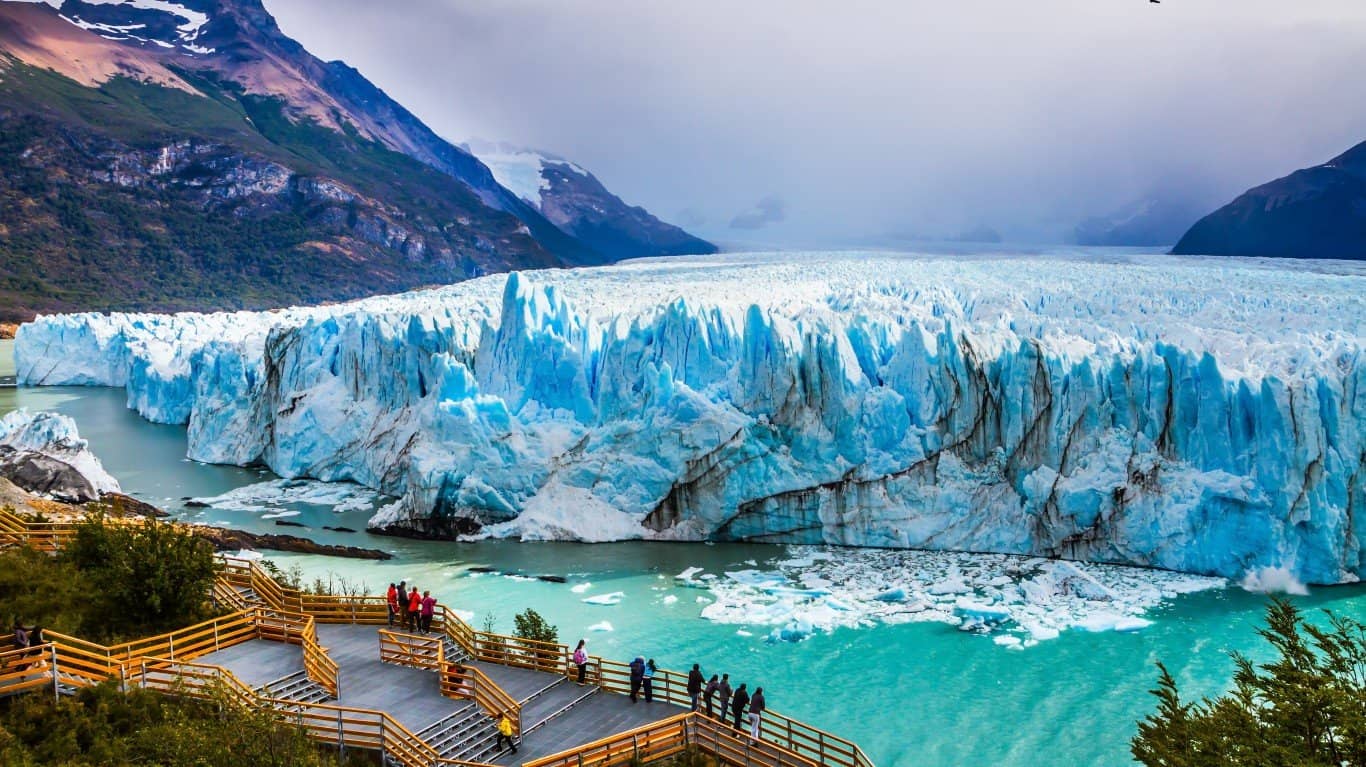
One of Patagonia's most recognizable glaciers towers above the waters of Lake Argentino. Huge chunks of ice periodically break off its face, creating a spectacular sight for anyone watching from established viewpoints. Once famous for its relative stability, Perito Moreno has entered a period of retreat. Recent satellite research documents substantial changes to the glacier's front through 2026.
Crooked Forest, Poland
Near Gryfino, a grove of pine trees bends sharply at the base before straightening toward the sky. The unusual curves look almost too uniform to be an accident. One popular explanation is that people deliberately shaped the young trees to produce curved timber, although no definitive account of how the forest acquired its unusual appearance has been established.
Fly Geyser, Nevada
An unsuccessful geothermal drilling operation in the 1960s helped create this colorful formation in Nevada's Black Rock Desert region. Mineral-rich hot water has built up the striking terraces, while heat-loving microorganisms contribute to their vibrant colors. Fly Geyser sits on private land at Fly Ranch, where access is generally available through organized nature walks rather than independent sightseeing.
Banaue Rice Terraces, Philippines
Carved into the mountains of northern Luzon, these rice terraces are a remarkable example of Ifugao agricultural engineering. Generations of farmers have maintained intricate irrigation systems and steep, stepped fields. The terraces are often described as 2,000 years old, but archaeological research suggests that some developed much more recently. Many remain part of a living agricultural landscape.
Ramla Bay, Gozo, Malta
Much of Gozo's shoreline is rocky, which makes the reddish-orange sand at Ramla Bay especially distinctive. The broad beach lies between green hills on the northern coast of Malta's second-largest island. Its unusually warm sand color and clear Mediterranean waters make for a particularly striking contrast, even if the beach is hardly a secret among locals.
Darvaza Gas Crater, Turkmenistan
For decades, a burning natural gas crater in the Karakum Desert earned the nickname Door to Hell. The precise circumstances and date of its origin are disputed, despite the familiar story involving Soviet drilling. Efforts to reduce the escaping gas have greatly diminished its flames, with reports in 2025 describing only scattered fires where an enormous blaze once burned.
The Racetrack, Death Valley National Park, California
The long trails etched into this remote dry lakebed were a mystery for generations. Researchers finally observed the rocks moving in December 2013, when thin floating ice sheets pushed them across wet ground in light winds. The fragile playa is protected: driving on it, moving the stones, and walking on muddy surfaces can damage the landscape.
Socotra, Yemen
The dragon's blood trees of Socotra look like umbrellas designed for a completely different planet. The island is part of an archipelago whose isolation has produced remarkable biodiversity; roughly 37% of its plant species occur nowhere else. Despite its extraordinary natural heritage, the U.S. State Department advises against travel to Yemen, explicitly including Socotra.
Glass Beach, Fort Bragg, California
What was once used as a dumping ground along California's northern coast eventually became famous for its colorful sea glass. Waves and sand gradually smoothed fragments of discarded glass into rounded, translucent pieces. The area is now protected as part of MacKerricher State Park, and visitors are prohibited from taking sea glass home. The amount visible varies.
Laguna Colorada, Bolivia
At roughly 14,000 feet above sea level, this shallow, mineral-rich lake in southwestern Bolivia can appear deep red thanks to pigments associated with algae and microorganisms. White mineral deposits and snow-dusted peaks contrast sharply with the water. The lake also supports several flamingo species, including the relatively uncommon James's flamingo.
Free Spirit Spheres, Vancouver Island, Canada
Suspended among the trees of Vancouver Island's coastal forest, these handcrafted spherical guest rooms resemble giant ornaments. Guests climb into compact, carefully designed interiors surrounded by the canopy. The resort offers three distinct spheres, including the wooden Eryn and the brightly colored Melody, proving that overnight accommodations don't necessarily need to have corners.
Reed Flute Cave, Guilin, China
Named for reeds growing outside its entrance that can be used to make flutes, this limestone cavern is best known for what lies within. Stalactites, stalagmites, and stone columns fill its chambers, illuminated by colorful lighting. Historical inscriptions also show that people were visiting the cave centuries before it became a modern tourist attraction.
Mount Roraima, Venezuela, Brazil, and Guyana
Rising above the surrounding landscape at the meeting point of three countries, Mount Roraima is an enormous flat-topped mountain, or tepui. Sheer cliffs enclose a summit of unusual rock formations, pools, and specialized plant life. Its ancient sandstone landscape and isolated ecosystems are every bit as remarkable as the mountain's distinctive shape.
Market Theater Gum Wall, Seattle, Washington
What began with theatergoers sticking their chewing gum to a wall in Post Alley in the 1990s turned into one of Seattle's strangest attractions. Layers of colorful gum have accumulated outside the theater, despite periodic cleanings. Whether you see it as a peculiar piece of public art or something that desperately needs a pressure washer is entirely up to you.
Kuang Si Falls, Luang Prabang, Laos
Water tumbles over a series of limestone terraces and into turquoise pools at this waterfall complex outside Luang Prabang. The mineral-rich water and pale rock give the pools their distinctive appearance, although rainfall can change the color considerably. Swimming is allowed only in designated pools, while other areas are protected or closed for safety.
Nazca Lines, Peru
Scattered across the arid desert of southern Peru are enormous ancient designs depicting animals, plants, and geometric shapes. Some are best appreciated from the air, while smaller figures are far less obvious. A 2024 study using artificial intelligence to guide fieldwork identified 303 previously undocumented figurative geoglyphs, demonstrating just how much remains to be learned about this extraordinary landscape.
Kaihalulu (Red Sand Beach), Maui, Hawaii
Rust-colored volcanic cliffs surround this secluded cove near Hāna, creating a dramatic contrast with the deep blue Pacific. Its red sand comes from the weathering of iron-rich volcanic material. As beautiful as it is, the Hawaii Tourism Authority's official media guidance advises against hiking there because the route crosses private property. It is best appreciated through photographs rather than an unauthorized visit.
Skeleton Coast, Namibia
Where the Namib Desert meets the Atlantic Ocean, fog, powerful surf, and shifting sands have contributed to the wrecks that give this coastline its haunting reputation. The region is far from lifeless, however. Seals gather along parts of the shore, while desert-adapted elephants and other wildlife inhabit inland river valleys and surrounding desert landscapes.
Kolukkumalai Tea Estate, India
High in the mountains near the border of Kerala and Tamil Nadu, this tea estate sits at roughly 8,000 feet above sea level. Steep slopes and sweeping views make the plantation as remarkable as its tea. It is widely regarded as one of the world's highest tea estates and is known for its traditional processing methods.
Corn Palace, Mitchell, South Dakota
Mitchell's original Corn Palace was built in 1892 to showcase the region's agricultural bounty. The current building continues the tradition, with elaborate exterior murals assembled from colorful ears of corn and other crops. The decorations are regularly renewed, giving this unusual civic and entertainment venue a distinctive appearance year after year.
Zlatni Rat, Brač, Croatia
This distinctive spit of pale pebbles extends into the clear Adriatic Sea near the town of Bol. Despite its sandy appearance from above, Zlatni Rat is primarily a pebble beach. Currents, waves, and winds continually reshape its tip, meaning even photographs taken at different times can show a slightly different coastline.
Tunnel of Love, Klevan, Ukraine
A railway corridor near Klevan has become famous for the dense greenery that arches over its tracks, forming a seemingly endless natural tunnel. Local folklore has made it a favorite subject of romantic photographs, but it is a railway rather than a purpose-built pedestrian trail. Given the ongoing war and current travel advisories, this is not a recommended trip.
Seven Rila Lakes, Bulgaria
High in Bulgaria's Rila Mountains, a series of glacial lakes occupies different levels of a rugged alpine landscape. Each has its own name and distinctive shape, including the Kidney and the Eye. Streams connect the lakes, and hiking trails provide views of the surrounding peaks. Weather conditions and trail choice can make the outing considerably more demanding than it appears in photographs.
Dole Plantation's Pineapple Garden Maze, Oahu, Hawaii
Getting lost has rarely looked this tropical. The maze at Dole Plantation in Wahiawa covers more than three acres and contains nearly 2.5 miles of pathways lined with thousands of plants. It was recognized as the world's largest maze in 2008. A giant pineapple-shaped design at its center adds a little extra personality to the challenge.
Malabar Coast, India
Stretching along southwestern India, the Malabar Coast is known for its lush landscapes, tropical beaches, and interconnected waterways. In Kerala, backwaters wind through coconut groves, villages, and agricultural land, creating a landscape best appreciated at a slower pace. The wider coast encompasses a diverse collection of communities and habitats rather than a single attraction.
Arashiyama Bamboo Grove, Kyoto, Japan
Towering bamboo stalks create a remarkable green corridor in western Kyoto's Arashiyama district. The sound of bamboo moving in the breeze has earned recognition as one of Japan's notable soundscapes. Although photographs often make the grove look wonderfully secluded, it is actually one of Kyoto's most popular attractions and can become extremely crowded.
Moravia, Czechia
Prague tends to get much of the attention from international visitors, but the historical region of Moravia has plenty of character of its own. Rolling agricultural hills, vineyards, medieval towns, castles, and distinctive architecture make up a remarkably varied landscape. Southern Moravia's gently undulating fields are especially striking when photographed in the changing light of the seasons.
The Palouse, Washington and Idaho
The rolling hills of the Palouse in the inland Pacific Northwest resemble enormous waves frozen in place. Much of the landscape developed from windblown silt deposited over long periods, and today its fertile soils support vast agricultural fields. Depending on the season, the hills transform from brilliant green to golden brown, creating a remarkably beautiful patchwork of farmland.