
chanawin88 / Getty Images
Wikimedia

Marin0110, CC BY-SA 4.0 , via Wikimedia Commons

PromesaArtStudio / Getty Images

MAHFUZ AHMED / Wikimedia Commons

en:User:Razum, CC BY-SA 3.0 , via Wikimedia Commons

Alena Tučímová, CC BY-SA 4.0 , via Wikimedia Commons

manx_in_the_world / Getty Images

Basile Morin, CC BY-SA 4.0 , via Wikimedia Commons

knowlesgallery / iStock via Getty Images

dennisvdw / Getty Images

Byelikova_Oksana / Getty Images

javarman3 / Getty Images
chanawin88 / Getty Images

M M from Switzerland, CC BY-SA 2.0 , via Wikimedia Commons

NASA, Public domain, via Wikimedia Commons

kenlund / Flickr

bee32 / Getty Images

Jjm2311, CC BY-SA 4.0 , via Wikimedia Commons

pabradyphoto / iStock via Getty Images

derejeb / Getty Images

Jose carlos Zapata flores / Getty Images



21 Stunning Places Around the World That Barely Look Real
The world is full of places that barely look real. Some were shaped over millions of years by geology, water, wind, and climate. Others came from human imagination, from bridges designed to form perfect circles in their reflections to treehouses suspended high above the forest floor.
To compile this list, 24/7 Tempo looked at natural landmarks, unusual landscapes, historic sites, and one-of-a-kind destinations around the world. Some are famous. Others are considerably farther off the usual tourist trail. All 21 prove there are still plenty of places capable of making you stop and stare.
This post was updated on September 10, 2026 to reflect current information about the destinations, conservation status, visitor access, and other details.
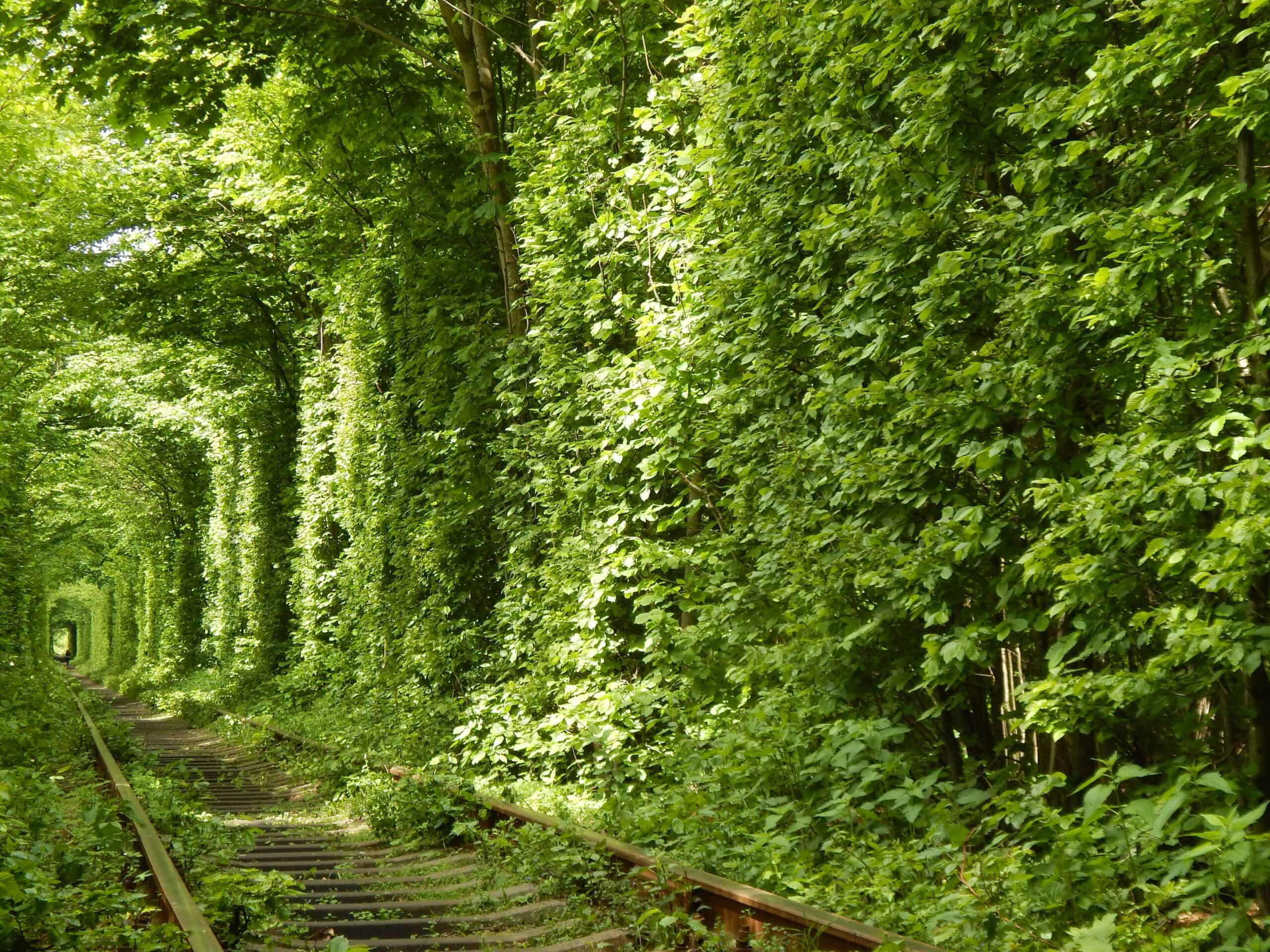
Tunnel of Love, Klevan, Ukraine
Near the western Ukrainian town of Klevan, trees and shrubs have grown around a roughly three-kilometer stretch of railway to form an almost perfectly shaped green tunnel. The appropriately named Tunnel of Love has become famous among photographers and couples, and local legend says lovers who make a sincere wish here will see it come true. The railway itself is very real, even if the scenery looks like something somebody dreamed up for a movie.
Zlatni Rat, Croatia
Zlatni Rat, often translated as the Golden Horn or Golden Cape, juts into the Adriatic Sea near Bol on the Croatian island of Brač. Despite what its appearance from above might suggest, this is a beach of fine pebbles rather than sand. The narrow spit extends as much as 500 meters into the sea, and its tip regularly changes shape as winds, waves, and currents move the pebbles around. It is one of those rare landmarks that can literally look different from one visit to the next.
Rakotzbrücke Devil’s Bridge, Gablenz, Germany
Rakotzbrücke was built in Kromlau Park in Saxony during the 19th century, primarily between 1866 and 1875. Its steep semicircular arch was designed as a decorative landscape feature, and when the water in Rakotzsee is calm, the bridge and its reflection appear to form a nearly perfect circle. The bridge underwent a major restoration that was completed in 2021. Visitors can admire it from the surrounding paths, but walking across the protected structure is prohibited.
Free Spirit Spheres, Vancouver Island, Canada
Part treehouse, part giant ornament, Free Spirit Spheres offers spherical accommodations suspended among the trees near Qualicum Beach on Vancouver Island. The unusual lodging concept has welcomed guests since 2006, with the spheres supported by a system of ropes and cables attached to surrounding trees. They include electricity, heat, and sleeping areas, turning what looks like a piece of forest art into an actual place to spend the night.
Seven Rila Lakes, Bulgaria
The Seven Rila Lakes sit high in Bulgaria's Rila Mountains, surrounded by steep slopes and alpine scenery. These glacial lakes lie mostly between about 2,100 and 2,500 meters above sea level and are connected by small streams. Each has a name inspired by its shape or another distinguishing characteristic. They are among the most visited glacial lakes in Rila National Park, although visitors are asked to stay on marked trails to help protect the fragile mountain environment.
Moravia, Czech Republic
Moravia is not a single town but a historic region covering much of the eastern Czech Republic. Its long history includes Celtic, Germanic, and Slavic settlement, as well as the influential Great Moravian realm of the ninth century. Today the region includes historic cities, castles, vineyards, and preserved cultural landscapes. One standout is the Lednice-Valtice Cultural Landscape in South Moravia, a UNESCO World Heritage Site shaped by the Liechtenstein family between the 17th and 20th centuries.
The Nazca Lines, Peru
Spread across the dry coastal plain of southern Peru, the Nazca and Palpa geoglyphs cover an enormous landscape. UNESCO dates their creation to roughly 500 B.C. through A.D. 500. The designs include animals, plants, other living creatures, and enormous geometric patterns, with some straight lines stretching for several kilometers. Their exact purposes remain debated, although researchers have connected them to ritual and ceremonial activities. From ground level they can be difficult to appreciate. From above, their scale becomes obvious.
Kuang Si Falls, Luang Prabang, Laos
About 30 kilometers from Luang Prabang, Kuang Si Waterfall tumbles through a series of cascades and striking turquoise pools. The water can take on a vivid blue appearance during the dry season because of minerals in the water, while wetter conditions can turn it a deeper green. Swimming is permitted in designated pools, with signs marking the appropriate areas. The surrounding forest and layered waterfalls make the site look almost suspiciously well designed for something nature made on its own.
The Palouse - Idaho and Washington
The Palouse stretches across parts of eastern Washington and northern Idaho, where smooth rolling hills ripple across the landscape like waves. Much of that distinctive terrain is made from loess, fine windblown sediment deposited over thousands of years, including material associated with the Ice Age. Today the fertile hills are heavily farmed, particularly for crops such as wheat, barley, and lentils. Depending on the season, the same hills can shift from brilliant green to shades of gold and brown.
Avenue of the Baobabs, Morondova, Madagascar
Near Morondava in western Madagascar, enormous Grandidier's baobab trees line a dusty road through what was once a much denser forest. Madagascar's tourism authority says many of the trees here are more than 800 years old. Baobabs can reach roughly 30 meters, or close to 100 feet, in height, with massive trunks that make even mature trees look slightly unreal. The surviving giants have become one of Madagascar's most recognizable landscapes and the focus of ongoing conservation efforts.
Laguna Colorada, Bolivia
Laguna Colorada sits about 4,300 meters, or 14,100 feet, above sea level in the Bolivian Andes. The shallow saline lake is famous for its red-brown color, produced largely by algae and other microorganisms living in the salty water. Its average depth is only about half a meter. The lake is also an important flamingo habitat, particularly for James's flamingo, a species currently classified as Near Threatened. Huge colonies can gather here during the breeding season, adding another layer of color to an already bizarre landscape.
Socotra, Yemen
Socotra looks unusual because much of its natural life genuinely is unusual. The Yemeni archipelago sits in the northwest Indian Ocean near the Horn of Africa and has been isolated long enough for an extraordinary number of species to evolve there. UNESCO reports that 37% of its plant species occur nowhere else on Earth. Among the most recognizable is the dragon's blood tree, Dracaena cinnabari, with its dense umbrella-shaped crown. The archipelago's biodiversity earned it UNESCO World Heritage status in 2008.
Wisteria Flower Tunnel, Kitakyushu, Japan
Kawachi Fuji Garden in Kitakyushu turns into a canopy of purple, pink, and white during its spring wisteria season. The private garden has 22 types of wisteria and two famous flower tunnels measuring about 80 and 110 meters long. Blooming generally peaks between late April and early May, depending on the weather. The 2026 wisteria season ended on May 6, and the garden operates seasonally rather than remaining open year-round.
Mount Roraima, Venezuela, Brazil, Guyana
Mount Roraima rises along the borders of Venezuela, Guyana, and Brazil like an enormous stone table. This type of flat-topped mountain is known as a tepui, and Roraima's summit plateau is surrounded by sheer cliffs hundreds of meters high. Its highest point reaches roughly 2,810 meters, or 9,220 feet. The surrounding Guiana Shield contains rock formations approaching two billion years in age, while the long isolation of the summit has helped support plant and animal species found nowhere else.
Richat Structure, Mauritania
The Richat Structure, better known as the Eye of the Sahara, is a roughly 40-kilometer-wide, or 25-mile-wide, formation on Mauritania's Adrar Plateau. Its enormous concentric rings are so distinctive that the feature is easy to recognize from space.
Scientists once considered whether the circular formation might be an impact crater, but geological research showed that it is an eroded dome created by uplift associated with underground igneous activity. Erosion gradually exposed different layers of rock, producing the giant bullseye visible today. The International Union of Geological Sciences recognizes the Richat Structure as an important geological heritage site.
Fly Geyser, Nevada
Fly Geyser looks natural, but people accidentally helped create it. A geothermal exploration well drilled in 1964 was abandoned after it proved unsuitable for the project, and the well's seal ultimately failed. Hot mineral-rich water continued escaping, gradually building the brightly colored formations visible today.
The water can emerge at around 200 degrees Fahrenheit and spray roughly five feet into the air. Fly Geyser sits on private Fly Ranch, which the Burning Man Project purchased in 2016. It is not simply open for unrestricted wandering, but Fly Ranch currently offers public nature walks on Saturdays from March through November.
Sagano Bamboo Forest, Kyoto, Japan
Kyoto's famous Arashiyama Bamboo Grove surrounds visitors with towering stalks of blue-green bamboo and narrow walking paths. Light filtering through the dense grove can give the entire place a surreal appearance, particularly early in the day.
The secret, unfortunately, is very much out. Kyoto's official tourism organization describes Arashiyama's bamboo forest as one of the city's most popular and frequently crowded attractions, and the city now publishes congestion forecasts and live-camera information to help visitors avoid the busiest periods.
Lake Retba, Senegal
Lake Retba, also known as Lac Rose or Pink Lake, lies northeast of Dakar and gets its famous color from salt-loving microorganisms including the green alga Dunaliella salina. Under highly saline and sunny conditions, the algae produce reddish-orange pigments that can turn the water shades of pink.
The lake temporarily lost much of that color after severe flooding in 2022 brought in large amounts of fresh water and disrupted its salinity. By 2025 the pink began returning, and in 2026 salt harvesting officially resumed as the lake recovered. Lake Retba has also remained on Senegal's tentative list for UNESCO World Heritage consideration since 2005.
The Racetrack, Death Valley National Park, California
For decades, the stones scattered across Racetrack Playa in Death Valley baffled visitors by apparently moving across the dry lakebed on their own, leaving long trails behind them. The rocks could remain still for years, making the phenomenon extremely difficult to observe directly.
Researchers finally witnessed the process during the winter of 2013 and 2014. After water collected on the playa and froze overnight, sunlight caused extremely thin sheets of ice to begin breaking apart. Light winds then pushed those floating ice panels across the shallow water, slowly nudging rocks over the soft mud. The first direct scientific observations were published in 2014, finally explaining one of Death Valley's strangest mysteries.
Lake Natron, Monduli, Tanzania
Lake Natron in northern Tanzania is one of the more extreme lakes on Earth. Its highly alkaline water can reach temperatures of around 60 degrees Celsius, or 140 degrees Fahrenheit, in some areas, while microorganisms thriving in the harsh conditions can give parts of the lake vivid red and orange colors.
Those conditions are inhospitable to many animals, but they make Lake Natron enormously important to lesser flamingos. Ramsar identifies it as the only lake in East Africa where the region's enormous lesser flamingo population breeds regularly. The difficult environment also helps isolate nesting areas from many predators, turning one of the region's harshest landscapes into a crucial wildlife refuge.
Caño Cristales, Colombia
Caño Cristales runs through Colombia's Sierra de la Macarena and is famous for suddenly appearing to turn red, yellow, green, and other colors. Much of the effect comes from the aquatic plant Rhyncholacis clavigera, commonly known as macarenia, whose appearance changes dramatically depending on water levels, sunlight, and seasonal conditions.
Because the plant and river ecosystem are sensitive, access is carefully managed and conditions can change throughout the season. Colombia's national parks authority asks visitors not to use sunscreen, creams, makeup, or insect repellent before entering Caño Cristales because chemicals from those products can harm the aquatic plants. It may look like somebody colored the river by hand, but this one is entirely nature's work.