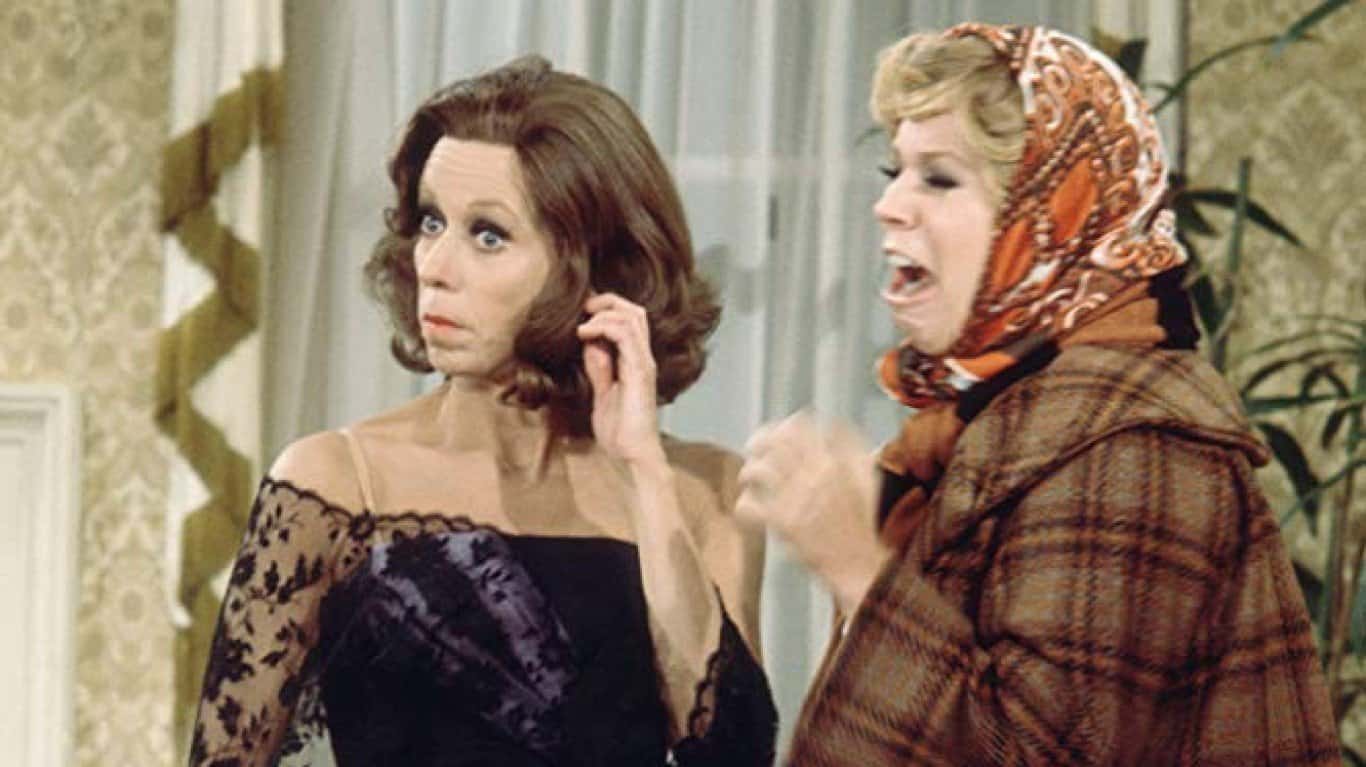
Courtesy of CBS Television Distribution

Courtesy of Paramount Pictures

Joe Seer / Shutterstock.com

Baron / Getty Images

Courtesy of American Broadcasting Company (ABC)

Courtesy of United Artists

Courtesy of United Artists

Courtesy of American Broadcasting Company (ABC)

Courtesy of Warner Bros.

Courtesy of Columbia Pictures

Courtesy of National Broadcasting Company (NBC)

Courtesy of Warner Bros.

Justin Sullivan / Stringer / Getty Images News

Courtesy of United Artists

Fox Photos / Hulton Archive via Getty Images

Courtesy of Twentieth Century Fox

Courtesy of CBS

Courtesy of Universal Pictures

Courtesy of CBS

Courtesy of United Artists

Courtesy of Cinema 5 Distributing


20 Classic Comedy Movies and TV Shows to Revisit
Some comedies are funny the first time you watch them. Others become the movies and TV shows you return to whenever you need a good laugh, even when you already know every punchline.
Classic comedy comes in all shapes and sizes. There's the physical chaos of Charlie Chaplin and the Three Stooges, the sharp social commentary of All in the Family, and the wonderfully ridiculous humor of movies like Airplane! and Monty Python and the Holy Grail. They don't all have the same style, and some jokes have aged better than others. But each helped shape what audiences found funny, whether on the big screen or in their living rooms.
These 20 classic comedy movies and TV shows cover nearly six decades of entertainment, from Hollywood's silent era to the family favorites of the 1990s. Some earned Academy Awards, others became television staples, and a few were considered downright outrageous when they premiered. They're all worth another look, whether you're revisiting an old favorite or discovering what earlier generations were laughing about.
Airplane! (1980)
Few movies have managed to squeeze so many jokes into such a short running time. Airplane! follows Ted Striker (Robert Hays), a former fighter pilot who boards a commercial flight hoping to win back his ex-girlfriend, flight attendant Elaine Dickinson (Julie Hagerty). When food poisoning incapacitates the pilots, Striker becomes the passengers' unlikely hope for survival. Leslie Nielsen, Robert Stack, Lloyd Bridges, and Kareem Abdul-Jabbar help deliver an almost nonstop barrage of deadpan dialogue, ridiculous visual gags, and completely unexpected punchlines. The movie brilliantly parodies the disaster films that were popular during the 1970s. It also helped establish Nielsen, previously known for serious dramatic roles, as a comedy legend. Even after multiple viewings, it's easy to catch jokes you missed the first time.
The Carol Burnett Show (1967–1978)
Carol Burnett had an extraordinary gift for bringing talented people together and then making it nearly impossible for them to keep a straight face. Her long-running variety show featured regulars Harvey Korman, Vicki Lawrence, and Tim Conway, whose unpredictable performances frequently sent the other actors into fits of laughter. The show's sketches ranged from domestic disasters to elaborate movie parodies, including the unforgettable Gone With the Wind spoof "Went with the Wind!" The recurring "Family" sketches eventually inspired the sitcom Mama's Family. Burnett's opening question-and-answer sessions with the studio audience gave viewers a glimpse of her natural warmth and quick wit. More than anything, the series demonstrated that great comedy often depends on chemistry between performers who clearly enjoy working together.
Some Like It Hot (1959)
Director Billy Wilder turned a gangster story into one of Hollywood's greatest comedies. Tony Curtis and Jack Lemmon play two struggling Chicago musicians who witness a mob killing and need to disappear immediately. Their solution is to disguise themselves as women and join an all-female band headed to Florida. Unfortunately for them, the band includes Sugar Kane (Marilyn Monroe), and keeping their identities secret becomes considerably more complicated. The movie's combination of mistaken identities, romantic misunderstandings, and increasingly desperate improvisation gives all three stars room to shine. Lemmon is particularly hilarious as his character gets tangled in an unexpected romance. Despite its outrageous premise, the film also manages to be surprisingly clever about the expectations society places on men and women.
Barney Miller (1975–1982)
Most police shows focus on dramatic car chases and dangerous criminals. Barney Miller found its comedy in the paperwork, strange arrests, and everyday frustrations of running a New York City police precinct. Hal Linden played the patient captain trying to manage a collection of detectives who were often more entertaining than the people they arrested. The ensemble included Abe Vigoda, Max Gail, Ron Glass, and Jack Soo, each bringing a distinct personality to the squad room. One particularly memorable episode is "Hash," which aired in December 1976. After Detective Wojo brings brownies baked by his girlfriend to work, several officers unknowingly get high while trying to carry out their duties. It's a perfect example of the show's restrained, character-driven humor.
City Lights (1931)
By 1931, talking pictures had already transformed Hollywood, but Charlie Chaplin wasn't ready to abandon the silent style that made him famous. In City Lights, he returned as the Little Tramp, a penniless wanderer who falls in love with a blind flower seller. She mistakenly believes he's wealthy, and he desperately tries to help her afford an operation that could restore her sight. Complicating matters is his friendship with a millionaire who recognizes him when drunk but barely knows him when sober. The film combines elaborate physical comedy with genuine emotional depth, building toward one of cinema's most celebrated endings. Its largely silent storytelling proves that a well-timed expression or simple gesture can communicate more than pages of dialogue.
Modern Times (1936)
Charlie Chaplin took aim at industrialization, unemployment, and the pressures of modern life in this Depression-era masterpiece. His Little Tramp works on a relentless factory assembly line, where the machinery moves faster than any human being reasonably can. After suffering a nervous breakdown, he finds himself bouncing between jobs, jail, and a series of increasingly absurd situations. Along the way, he befriends a homeless young woman played by Paulette Goddard, and the pair struggle to build a better life. Although sound films were firmly established by 1936, Chaplin kept Modern Times largely silent, relying on music, sound effects, and physical comedy. The factory sequences are especially memorable, and the film's concerns about technology replacing workers remain remarkably recognizable today.
Three's Company (1977–1984)
John Ritter turned stumbling, falling, and getting caught in embarrassing situations into something close to an art form. In Three's Company, he played Jack Tripper, an aspiring chef sharing a Santa Monica apartment with two women, originally Janet Wood (Joyce DeWitt) and Chrissy Snow (Suzanne Somers). To satisfy their conservative landlord, Jack pretends to be gay, setting up years of misunderstandings and elaborate excuses. The premise reflects the attitudes of its time, but Ritter's physical comedy remains the show's biggest attraction. Whether he was hiding in a closet, misunderstanding an innocent conversation, or trying to talk his way out of trouble, his timing was exceptional. Don Knotts later joined the series as the unforgettable landlord Ralph Furley.
Arsenic and Old Lace (1944)
Imagine discovering that your sweet, elderly aunts have been quietly murdering lonely men because they believe they're doing them a favor. That's the situation facing Mortimer Brewster (Cary Grant), a theater critic whose wedding-day plans quickly fall apart. His aunts, played by Josephine Hull and Jean Adair, seem perfectly harmless until Mortimer discovers the family secret. Things get even stranger when his criminal brother Jonathan returns home and another relative insists he's Theodore Roosevelt. Based on Joseph Kesselring's successful stage play, Arsenic and Old Lace is a wonderfully twisted blend of farce and dark comedy. Grant's increasingly frantic reactions are a major part of the appeal. The film also proves that audiences were laughing at some pretty grim subjects long before modern black comedies came along.
Ghostbusters (1984)
Three unemployed parapsychologists starting a ghost-removal business sounds like the setup for a low-budget horror movie. Instead, it became one of the defining comedies of the 1980s. Bill Murray, Dan Aykroyd, and Harold Ramis play Peter Venkman, Ray Stantz, and Egon Spengler, who discover that New York City has a much bigger supernatural problem than anyone expected. Ernie Hudson later joins the crew as Winston Zeddemore, while Sigourney Weaver and Rick Moranis help make the supporting cast just as memorable. The movie's special effects were impressive for their time, but the real magic comes from Murray's dry humor and the group's chemistry. Between Slimer, the Stay Puft Marshmallow Man, and the increasingly ridiculous paranormal emergencies, there's plenty to enjoy beyond the famous theme song.
The Red Skelton Show (1951–1971)
Red Skelton was already an established radio and film comedian when he brought his variety show to television in 1951. For the next two decades, audiences tuned in to watch his sketches, pantomime routines, musical guests, and recurring characters, including the lovable tramp Freddie the Freeloader and the country bumpkin Clem Kadiddlehopper. The program expanded to an hour in 1962 and was renamed The Red Skelton Hour, a title it retained until 1970. After CBS canceled it, Skelton returned to NBC for one final season. The show welcomed an impressive collection of guests, including John Wayne, Johnny Carson, and the Rolling Stones. Skelton's humor leaned heavily on expressive faces, silly voices, and physical performances, making him an important bridge between vaudeville entertainment and modern television comedy.
Blazing Saddles (1974)
Mel Brooks wasn't interested in making a traditional Western. He wanted to take the genre apart, expose its ridiculous conventions, and deliver as many outrageous jokes as possible along the way. In Blazing Saddles, a corrupt politician schemes to drive residents out of the town of Rock Ridge so a railroad can come through. His plan involves appointing Bart (Cleavon Little), a Black sheriff he assumes the prejudiced townspeople will reject. Instead, Bart proves considerably smarter than the people plotting against him. Gene Wilder is equally entertaining as the Waco Kid, a washed-up gunslinger who becomes his ally. The movie deliberately uses offensive language and racial stereotypes to ridicule racism, and some material can be jarring today. Its sharp satire earned three Academy Award nominations and a Writers Guild Award.
The Bugs Bunny Show (Debuted 1960)
Bugs Bunny, Daffy Duck, Porky Pig, and the rest of the Looney Tunes gang were entertaining audiences long before Saturday morning cartoons became a childhood tradition. Many of their most famous adventures were originally theatrical shorts shown in movie theaters. The Bugs Bunny Show brought those cartoons to television in 1960, initially as a prime-time program on ABC. It later became a Saturday morning staple, appearing in different formats and under various titles for decades. The humor ranged from clever wordplay and elaborate musical gags to Wile E. Coyote's never-ending supply of disastrous inventions. Not every old cartoon reflects modern sensibilities, but the animation, comic timing, and memorable characters helped influence generations of television animators.
The Apartment (1960)
Jack Lemmon plays C.C. "Bud" Baxter, a lonely insurance employee who lets company executives borrow his Manhattan apartment for their extramarital affairs. He hopes the arrangement will help him climb the corporate ladder, but things get complicated when he develops feelings for elevator operator Fran Kubelik (Shirley MacLaine). Directed by Billy Wilder, The Apartment balances sharp office comedy with much darker themes, including loneliness, workplace exploitation, and emotional despair. It's considerably more serious than the average romantic comedy, which makes its funny moments feel especially human. The film won five Academy Awards, including Best Picture, Best Director, and Best Original Screenplay. More than six decades later, its observations about ambition and the compromises people make to get ahead remain surprisingly relevant.
The Three Stooges (1934–1959 Shorts)
The Three Stooges became television favorites through reruns, but their most famous work actually began in movie theaters. Moe Howard, Larry Fine, and Curly Howard made a series of wildly popular comedy shorts for Columbia Pictures beginning in 1934. Their signature style involved elaborate slapstick routines, exaggerated reactions, and an impressive number of pies, pratfalls, and eye pokes. Curly's health problems led to his replacement by brother Shemp in 1946, followed by Joe Besser in the late 1950s. The team eventually completed 190 Columbia shorts, with the final releases arriving in 1959. Moe, Larry, and Curly-Joe DeRita later appeared in feature films, including The Three Stooges Meet Hercules in 1962. Their physical comedy influenced countless performers, even if the violence is best left on the screen.
Home Alone (1990)
Most eight-year-olds would panic after discovering their entire family had accidentally left for Christmas vacation without them. Kevin McCallister (Macaulay Culkin) initially treats it like a dream come true. That changes when two burglars, Harry and Marv (Joe Pesci and Daniel Stern), target his suburban Chicago home. Kevin responds by turning the house into a collection of increasingly elaborate traps, many of which would probably require an ambulance in real life. Director Chris Columbus brought John Hughes' screenplay to life with a mix of holiday sentiment, physical comedy, and memorable performances. Culkin makes Kevin resourceful without losing the mischievous personality that gets him into trouble. Decades later, Home Alone remains a Christmas favorite, even if its burglars somehow survive an astonishing amount of punishment.
All in the Family (1971–1979)
Few sitcoms changed American television as dramatically as All in the Family. Carroll O'Connor played Archie Bunker, a stubborn, outspoken Queens resident whose prejudices regularly collided with the views of his liberal son-in-law Mike (Rob Reiner) and daughter Gloria (Sally Struthers). Jean Stapleton provided the show's emotional center as Archie's patient wife Edith. Rather than avoiding controversial issues, the series confronted racism, sexism, politics, and social change through arguments that felt uncomfortably familiar to many families. Archie's offensive remarks were meant to expose his ignorance, although some scenes can still be difficult to watch. The famous 1972 episode "Sammy's Visit," featuring Sammy Davis Jr., is a classic example of the show's ability to combine uncomfortable social commentary with a memorable comedic payoff.
My Man Godfrey (1936)
Hollywood's screwball comedies frequently put wealthy characters in ridiculous situations, and My Man Godfrey does it better than most. William Powell plays Godfrey, a homeless man who becomes involved in a society scavenger hunt after two rich sisters encounter him. One sister, Irene Bullock (Carole Lombard), decides to hire him as the family's butler, introducing him to an eccentric household with almost no understanding of life outside its privileged bubble. The resulting comedy involves mistaken assumptions, romantic complications, and a surprising amount of social criticism. Powell and Lombard's chemistry makes the whole thing work, while the film's observations about wealth and inequality give it more substance than its silly premise suggests. It earned six Academy Award nominations, including recognition in all four acting categories.
M*A*S*H (1972–1983)
Set during the Korean War, M*A*S*H followed the doctors, nurses, and support staff of the fictional 4077th Mobile Army Surgical Hospital. Alan Alda starred as Hawkeye Pierce, a brilliant surgeon who relied on practical jokes and relentless wisecracks to cope with the horrors unfolding around him. The series was adapted from the 1970 film directed by Robert Altman, but developed its own identity during an extraordinary 11-season television run. As the years passed, it became increasingly comfortable mixing humor with grief, moral dilemmas, and criticism of war. Characters such as B.J. Hunnicutt, Colonel Potter, Margaret Houlihan, and Radar O'Reilly gave the show a memorable ensemble. Its 1983 finale remains one of the most-watched scripted television broadcasts in American history.
It's a Mad, Mad, Mad, Mad World (1963)
What happens when a group of otherwise ordinary people discovers there's $350,000 in stolen money buried somewhere in California? In this comedy, almost everyone immediately loses their mind. The adventure begins when dying criminal Smiler Grogan (Jimmy Durante) tells several motorists about the money, supposedly hidden beneath a giant "W" at Santa Rosita State Park. Instead of cooperating, the strangers become rivals in a frantic race filled with reckless driving, airplane mishaps, shouting matches, and spectacular property damage. Directed by Stanley Kramer, the movie features an enormous cast of comedians and character actors, including Spencer Tracy, Milton Berle, Sid Caesar, Ethel Merman, and Jonathan Winters. Its lengthy running time and increasingly chaotic action might test some modern attention spans, but the sheer scale of the comedy remains impressive.
Monty Python and the Holy Grail (1975)
Most movies about King Arthur treat medieval legends with at least a little dignity. The Monty Python comedy troupe had absolutely no interest in doing that. Monty Python and the Holy Grail follows Arthur and his knights as they search for the legendary relic, encountering bizarre obstacles that have very little to do with traditional Arthurian storytelling. There's a Black Knight who refuses to surrender despite losing all his limbs, a terrifying rabbit, and a group of knights with exceptionally unreasonable demands. Written and performed by the British comedy team, the film mixes absurd dialogue, visual gags, and jokes about filmmaking itself. Its intentionally cheap-looking production has become part of the charm. The movie also inspired the Tony Award-winning Broadway musical Spamalot, introducing its ridiculous world to another generation.