American history is full of stories that stick because they are simple: one explorer “discovered” a continent, one inventor created the lightbulb, and one famous seamstress designed the flag. The record is usually messier—and more interesting. Some of these familiar claims are flatly wrong. Others contain a piece of truth that has been stretched, polished, or stripped of context over generations.
For this article, we checked primary records and historical collections from the National Archives, the Library of Congress, the National Park Service, the Smithsonian Institution, state archives, presidential libraries, and museums devoted to the people and events involved. Here are 19 common myths and misconceptions about American history, along with what the surviving evidence can actually tell us.
Christopher Columbus Discovered America

Columbus did not arrive in an empty world waiting to be discovered. Millions of Indigenous people already lived across the Americas, with their own nations, trade networks, governments, and histories. His first voyage reached islands in the Caribbean in 1492. On later voyages he traveled along parts of the South and Central American coasts, but he never set foot in what is now the United States.
He was not even the first known European to reach North America. Archaeological evidence places Norse seafarers at L’Anse aux Meadows in present-day Newfoundland around the year 1000. Columbus still mattered enormously: His voyages opened the period of sustained contact, conquest, colonization, and exchange between Europe and the Americas. That is a major historical turning point, but it is not the same thing as “discovering” a place already inhabited.
Niña, Pinta, and Santa María Were the Ships’ Formal Names

The famous list is not imaginary, but it leaves out how 15th-century ships were named. Niña was a nickname for the caravel formally known as Santa Clara, probably playing on the surname of its owner, Juan Niño. Pinta also appears to have been a nickname, while the vessel’s formal name has been lost. Columbus’s flagship was commonly called Santa María and was also known as La Gallega, a reference to Galicia.
So it is fair to say Columbus crossed the Atlantic with the Niña, Pinta, and Santa María; those are the names by which the vessels were known. The myth is that this tidy trio gives us three certain, official names. The surviving record is simply not that neat.
John Smith and Pocahontas Fell in Love

There is no evidence of a romance between Pocahontas and John Smith. Pocahontas was a nickname; she was born Amonute and also had the more private name Matoaka. She was roughly 10 or 11 when she met the adult English colonist in 1607. Calling her a “princess” is also European shorthand that does not neatly describe her place as a daughter of Wahunsenaca, the paramount chief of the Powhatan people.
Smith later wrote that she had saved him from execution, but historians still debate whether he described a literal rescue, misunderstood a ceremony, or embellished the episode years afterward. Whatever happened, the surviving accounts do not support a love story. Pocahontas later married tobacco planter John Rolfe, traveled to England, and died there in 1617, probably at about age 20.
People Were Burned at the Stake During the Salem Witch Trials

No one was burned for witchcraft in the Salem proceedings of 1692 and 1693. Nineteen people—women and men—were convicted and hanged. Giles Corey was pressed to death with heavy stones after refusing to enter a plea, and other accused people died in jail. The victims were not “witches” in any proven sense; they were people caught in a legal and religious panic fueled by rumor, local conflict, and unreliable evidence.
Burning was used in some European witch prosecutions, which may help explain why the image became attached to Salem. English law treated witchcraft as a felony punishable by hanging, and that practice carried into the English colonies.
Paul Revere Shouted, “The British Are Coming!”

Paul Revere did ride on the night of April 18, 1775, but the famous shout is not supported by his own account. Many Massachusetts residents still considered themselves British, so “The British are coming” would have sounded odd. Revere warned that British regular troops were moving out, and he did it as part of an organized alarm system rather than by racing alone through every village.
William Dawes also rode from Boston, Samuel Prescott joined them, and many local messengers carried the warning onward. Revere reached Lexington and warned John Hancock and Samuel Adams, but a British patrol captured him before he made it to Concord. Henry Wadsworth Longfellow’s 1860 poem turned that larger network into one unforgettable midnight ride.
George Washington Had Wooden Teeth

Washington suffered serious dental problems, but his dentures were not carved from wood. His different sets used an uncomfortable mix of materials that included ivory, human and animal teeth, lead, brass, silver, gold, and other metals. Stained ivory and the fine fractures running through it may have helped create the wooden appearance remembered in popular lore.
The fuller story is less quaint. Washington’s financial records show that people enslaved at Mount Vernon were paid for teeth obtained for dentist Jean Pierre Le Mayeur in 1784. It is possible that teeth from enslaved people were used in a denture for Washington, but the evidence does not establish that any teeth in the surviving sets came from that transaction. By his 1789 inauguration, Washington had only one natural tooth left.
Thomas Edison Single-Handedly Invented the Lightbulb

Electric lamps existed decades before Thomas Edison began working on them. What Edison and his Menlo Park team accomplished in 1879 was different: They developed a long-lasting, high-resistance incandescent lamp that could work as part of a practical electrical system. Their project also involved generators, wiring, switches, fuses, meters, and the business plan needed to deliver power to customers.
That makes “Edison invented the lightbulb” useful shorthand, but poor history. He improved earlier work and helped turn electric lighting into a commercial system. Claims that he simply stole the invention go too far in the other direction; invention is often cumulative, and Edison’s patent covered specific improvements rather than the basic idea of electric light.
Slavery Happened Only in the South

Slavery was legal and practiced in every one of the 13 British mainland colonies at some point. Massachusetts legally recognized slavery in 1641, and Northern merchants, shipowners, lenders, and consumers also profited from the Atlantic slave economy. After the Revolution, Northern states began ending slavery through court decisions, state constitutions, and gradual-abolition laws, often leaving people enslaved for years or decades during the transition.
By the eve of the Civil War, however, slavery had become overwhelmingly concentrated in the South and a handful of border states. The 1860 federal census recorded enslaved people in 15 slave states, the District of Columbia, and Utah Territory. So “only in the South” erases the North’s history, while saying there was no meaningful regional difference by 1860 would erase another important part of the record.
Every Delegate Signed the Declaration of Independence on July 4

July 4 deserves its place on the calendar: That is when the Continental Congress adopted the final text of the Declaration of Independence. The familiar parchment covered in signatures came later. Congress ordered an engrossed copy on July 19, and most delegates signed it on August 2—not two months later, but just under a month after adoption.
Even August 2 was not a single, complete signing ceremony. Several delegates added their names later, and some who supported independence never signed the parchment. The first printed copies, known as the Dunlap broadsides, carried the names of Congress President John Hancock and Secretary Charles Thomson in type. The dramatic scene of every founder signing together on July 4 is patriotic art, not a literal snapshot.
The Declaration of Independence Was Written on Hemp Paper
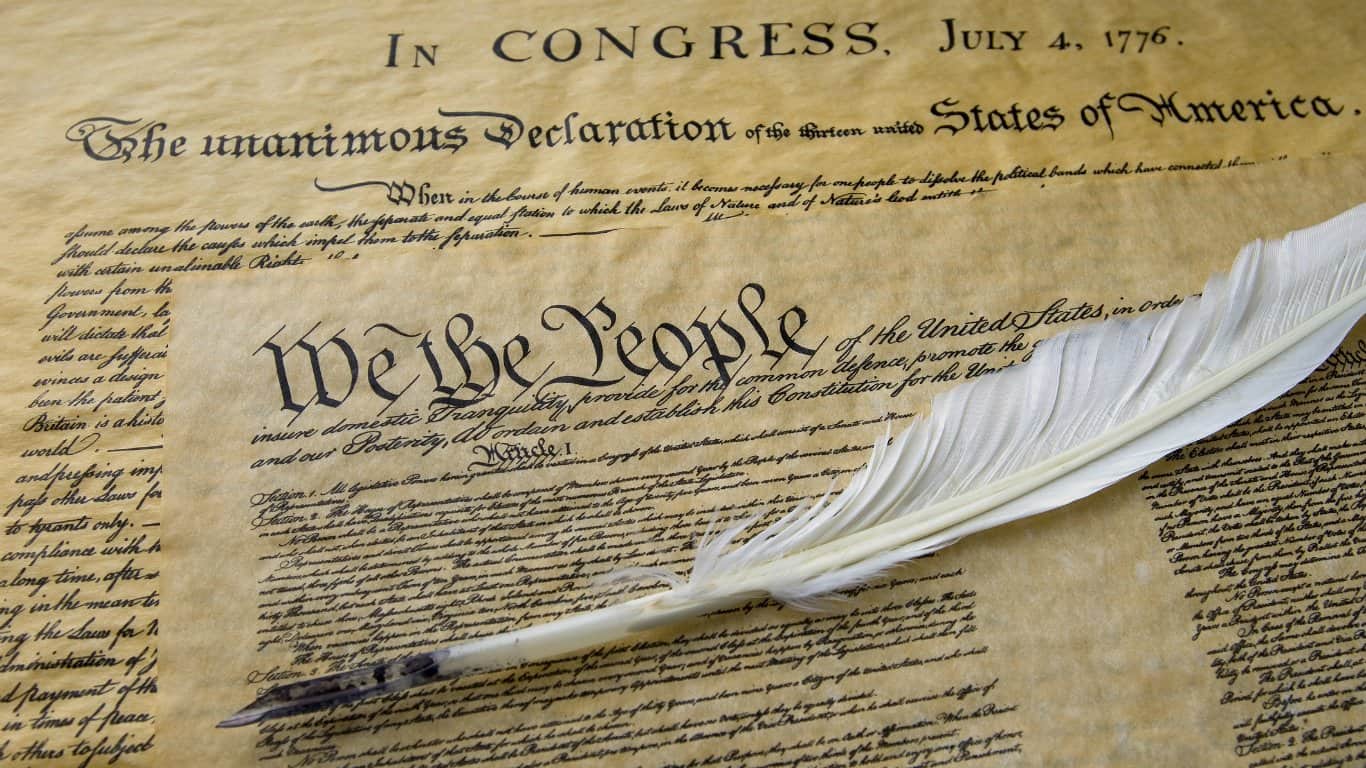
The signed Declaration preserved at the National Archives is written on parchment—specially prepared animal skin—not hemp paper. Congress explicitly ordered the text to be “fairly engrossed on parchment” on July 19, 1776. Jefferson’s drafts and the printed broadsides were made on paper, but there is no solid evidence that the famous signed document or those working copies were made from hemp.
Hemp was a familiar and useful crop in colonial America, so the claim can sound plausible. That does not make it true. In this case, the material survives, the congressional order survives, and both point to parchment.
The First Thanksgiving Happened Exactly Like the Familiar Story

A shared harvest gathering really did take place at Plymouth in 1621, and the surviving English account describes three days of feasting. Ousamequin, whom the English called Massasoit, arrived with about 90 Wampanoag men, and the group contributed five deer. The event appears to have been peaceful. What the record does not give us is the tidy school-pageant scene of two equal groups formally creating the modern Thanksgiving holiday.
The Wampanoag and English had formed a strategic alliance months earlier. The gathering took place after European disease had devastated Native communities and on Wampanoag land at Patuxet, where the English established Plymouth. The relationship involved diplomacy and mutual aid, but later colonization brought dispossession and war. Calling the meal pure friendship is incomplete; calling it a fabrication is also inaccurate.
The Emancipation Proclamation Ended Slavery Everywhere in the United States

Lincoln’s Emancipation Proclamation declared enslaved people free in the states and parts of states still in rebellion on January 1, 1863. It did not apply to the loyal slaveholding border states, and it exempted several Confederate areas already under Union control. Its reach also depended on Union military success, so freedom expanded on the ground as federal forces advanced.
That limitation does not make the proclamation “only symbolic.” It changed the Union’s official war aims, committed the federal government to recognizing freedom in the designated areas, and authorized Black men to serve in the U.S. Army and Navy. Nearly 200,000 Black soldiers and sailors ultimately served. The 13th Amendment, ratified in December 1865, ended legal slavery nationwide, except as punishment for a crime.
The Civil War Was About States’ Rights, Not Slavery

Arguments about state and federal power were part of the secession crisis, but the right Confederate leaders were trying to protect was overwhelmingly the right to preserve and expand slavery. Mississippi’s declaration of secession said its position was “thoroughly identified with the institution of slavery.” Other seceding states complained about resistance to fugitive-slave laws and the threat posed by restricting slavery in the territories.
Individual soldiers fought for many personal reasons, and the Union initially described its central goal as preserving the nation. Those facts do not change why the crisis became irreconcilable. “States’ rights” names a constitutional argument; it does not identify the issue that made Southern secession urgent in 1860 and 1861. The secession documents themselves repeatedly identify slavery.
Only Japanese Americans Were Confined by U.S. Authorities During World War II

More than 120,000 people of Japanese ancestry were forcibly removed from the West Coast and incarcerated under Executive Order 9066, and roughly two-thirds were U.S. citizens. That mass, ancestry-based program was distinct in its scale and operation. It should not be blurred together with every wartime detention under the single label “internment,” especially because citizens cannot technically be enemy aliens.
The Justice Department also ran an Enemy Alien Control Program that detained and sometimes interned individual Japanese, German, and Italian nationals, generally after hearings of sharply varying fairness. More than 15 Latin American countries also deported over 6,600 people of Japanese, German, and Italian ancestry to the United States for internment, including more than 2,000 people of Japanese ancestry. These programs overlapped in time, but they were not identical.
The Pilgrims Came Straight From England for Religious Freedom

The Pilgrims really had faced religious persecution in England, but they did not sail directly from there to an unknown shore. The Separatist congregation moved to the Dutch Republic beginning in 1608 and lived in Amsterdam and Leiden, where members could worship with far greater freedom. They remained in Leiden for roughly 11 or 12 years before deciding to establish a colony across the Atlantic.
Their reasons for leaving Holland were mixed. William Bradford described exhausting work and poverty, worries about children losing their English identity, and a desire to advance their faith. Economic opportunity and community survival mattered alongside religion. The familiar story gets the starting point right—the group had fled persecution—but skips the long Dutch chapter and the more complicated reasons for the Mayflower voyage.
Ronald Reagan Negotiated the Iran Hostages’ Release

The 52 American hostages in Iran were released on January 20, 1981, minutes after Ronald Reagan took the presidential oath. That unforgettable timing helped attach the release to Reagan’s inauguration, but the agreement had been negotiated by the Carter administration through Algerian intermediaries. The United States and Iran signed the Algiers Accords on January 19, Carter’s final full day in office.
Reagan welcomed the hostages home as president, but he did not negotiate the deal that freed them. The Carter team, including Deputy Secretary of State Warren Christopher, worked until its final hours to complete the arrangements. Iran controlled the timing of the departure, which turned a diplomatic achievement by an outgoing administration into the first dramatic news event of the next one.
The Liberty Bell Cracked on Independence Day

The original State House bell cracked during a test after it arrived in Philadelphia in 1752, so local founders melted it down and recast it. The bell on display today dates to 1753. No record shows it cracking on July 4, 1776—or even definitively ringing that day. It may have helped summon people for a public reading of the Declaration on July 8.
The current bell developed a thin crack after decades of use, most likely in the early 1840s. Workers widened that crack in an attempted 1846 repair, creating the familiar gap, but another fissure formed when the bell was rung for George Washington’s birthday. Abolitionists had begun calling it the Liberty Bell in the 1830s, transforming an old government bell into a national symbol.
Betsy Ross Designed the First American Flag

Betsy Ross was a real Philadelphia upholsterer who made flags during the Revolutionary era. What historians cannot verify is the famous scene in which George Washington visited her shop and she designed the first Stars and Stripes. That story entered the public record in 1870, when her grandson William Canby presented a family account nearly a century after the supposed meeting.
Congress’s 1777 flag resolution specified 13 alternating red and white stripes and 13 white stars on blue, but it did not name a designer or arrange the stars in a circle. Francis Hopkinson later sought payment from Congress for designing the flag, giving him a documented claim, although the full design process remains uncertain. Ross deserves recognition as a working flag maker; the evidence does not establish her as the flag’s sole designer.
The United States Is a Republic, Not a Democracy

This familiar correction creates a false choice. The United States is a constitutional federal republic and a representative democracy. “Republic” describes a system without a monarch in which public authority is exercised through representatives and law. “Democracy” describes the public’s role in choosing leaders and shaping government. A country can be both, and the United States is commonly described that way.
James Madison did distinguish a republic from what he called a “pure democracy,” meaning a small society whose citizens governed in person. The Constitution instead created representative institutions, divided powers, and checks on simple majority rule. Voting rights were also severely limited at the founding and expanded over time. Those qualifications matter, but they do not prove that the United States “has never been a democracy.” They explain the particular form its democracy takes.