
Photo by General Photographic Agency/Getty Images

clu / Getty Images

Public Domain / Wikimedia Commons

Public Domain / Wikimedia Commons

sphraner / iStock via Getty Images

Public Domain / Wikimedia Commons

Public Domain / Wikimedia Commons

Hulton Archive/ Getty Images

Fotosearch / Archive Photos via Getty Images

kreicher / Getty Images
bonniej / Getty Images

Public Domain / Wikimedia Commons

Public Domain / Wikimedia Commons

Rischgitz / Hulton Archive via Getty Images

Woodkern / iStock via Getty Images

Keystone / Hulton Archive via Getty Images

dszc / Getty Images

Hulton Archive / Getty Images

Getty Images


18 American History Myths Most People Still Get Wrong
American history is packed with dramatic stories, larger-than-life figures, and famous moments that many of us first learned about in school. But some of the most familiar stories have been repeated, simplified, or exaggerated so many times that the myth has become better known than the truth.
From legendary founding-era tales to misunderstood events that still show up in popular culture, these myths reveal how easily history can get reshaped over time. Some began as harmless shortcuts. Others were passed down because they made a complicated story easier to remember. Either way, they continue to influence how Americans understand the country’s past.
To separate fact from folklore, 24/7 Tempo reviewed 18 common American history myths that many people still assume are true. Using reputable sources, including Time, History.com, Mount Vernon, and other historical references, we looked at where each myth came from, what actually happened, and why these stories have endured for so long.
Christopher Columbus Discovered America
Although we’ve been told Columbus discovered America our entire lives, he did not. Yes, Columbus made four trips across the Atlantic to North America, but those trips only took him to the Caribbean Islands like the Bahamas and Hispaniola (now Haiti and the Dominican Republic), and eventually to Central and South America. It could be said that he was the first European to make it to North America, but even that is stretching it. Evidence suggests that Norse explorer Leif Erickson made it to North America some four hundred years earlier than Columbus. Even still, this untrue fact is still commonly taught to American children in school.
Christopher Columbus Sailed on the Nina, Pinta, and Santa Maria
It has long been told that when Columbus set sail for the Americas on his famed transatlantic voyage, he and his men were on the Nina, the Pinta, and the Santa Maria. However, the names of two of the ships were actually La Santa Clara and La Santa Gallega. Pinta was likely the correct name of the third ship, but even that remains unknown.
John Smith and Pocahontas Fell in Love
John Smith arrived in Virginia to establish the Jamestown settlement in 1607 when he was 27. He met Pocahontas when she was 11 years old. Her real name was Amonute, and she was called Matoaka in private, but it is her nickname that has been passed down throughout history. Smith wrote in his diaries that Amonute saved his life when her family tried to execute him. He also mentions that they formed a friendship while he was in captivity, even teaching each other their respective languages.
There is no mention of a romance. It is believed that Pocahontas was married twice. First in 1610, to a tribal member named Kocoum, and later in 1614, when she converted to Christianity, was renamed Rebecca, and married John Rolfe.
Witches Were Burned at the Stake in the Salem Witch Trials
The famous New England Salem Witch Trials in 1692 were responsible for the demise of numerous women, who were killed for their alleged practice of witchcraft. However, none of the victims were burned; this was a practice used in Europe during medieval times. The majority of them were hanged, not from platforms with trap doors but from ladders to prolong their deaths.
“The British are Coming!”
Paul Revere’s famous ride to warn of the incoming British is an often-repeated historical tidbit, but it is partly false. While Revere did indeed ride through towns to warn of impending invasion, he did so rather discreetly for fear of already installed British forces. What’s more, some forty men joined him in his raising the alarm. The untrue version of this story can be attributed to Henry Wadsworth Longfellow’s poem “Paul Revere’s Ride.”
George Washington Had Wooden Teeth
George Washington was notorious for having serious dental issues, but his false teeth were made of an ivory, lead, and gold mixture. It is thought the wooden claim is due to his worn-down dentures taking on a grainy appearance much like wood.
Thomas Edison Invented the Lightbulb
Thomas Edison is often credited with the invention of the lightbulb, but he wasn’t the first or only one to develop this technology. Rather, he was the first to patent the idea in 1879. Nearly 80 years prior, it was Italian inventor Alessandro Volta who, in 1800, successfully developed the method for electricity. In 1802, inventor Humphrey Davy developed the first electric lamp, known as the electric arc lamp. Several others followed suit, each improving on the current model.
Slavery Happened Only in the South
Slavery was confined to the Southern States only after a certain point in American history. Some of the earliest adopters of slavery were in northern states like Massachusetts, and numerous founding fathers including Thomas Jefferson and George Washington owned slaves.
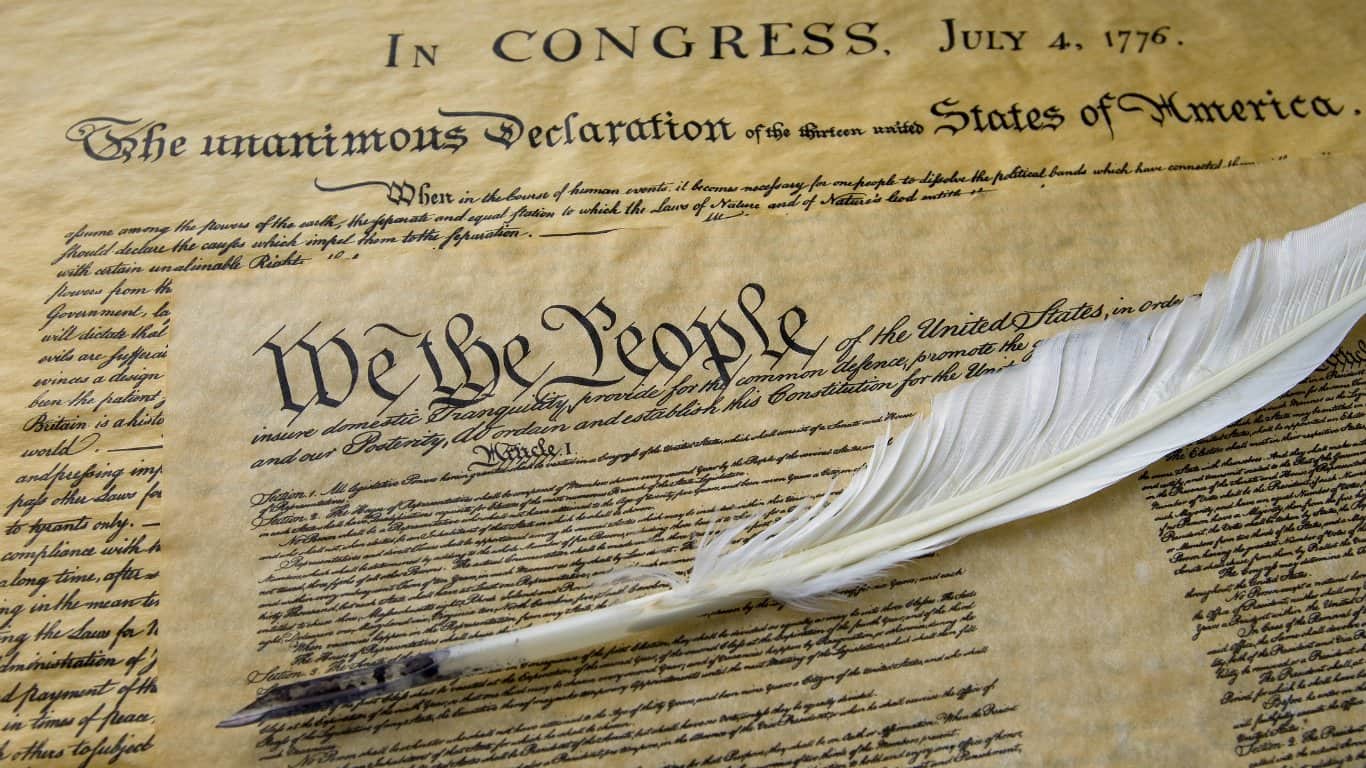
The Declaration of Independence was signed on July 4th
Independence Day celebrates the signing of the Declaration of Independence, when our nation first became a country in 1776. But July 4th wasn't actually the day the famous document was signed but rather marks the day the final edition of the declaration was agreed upon. It would not be officially signed until two months later in August of 1776.
The Declaration of Independence was Signed on Hemp Paper
The Declaration of Independence was said to have been signed on hemp paper but this was not the case. The famous document was made of parchment, a type of animal skin, typically made from sheepskin. Ironically, the hemp paper myth might have originated from the classic stoner movie “Dazed and Confused.”
The First Thanksgiving was a Peaceful Collaboration Between Native Americans and Colonists
It has always been thought that the first Thanksgiving was a peaceful union between Colonists and early Native Americans but the history regarding this event remains murky. Some say there was a shared three-day feast between the two groups, while others say the Native Americans weren’t even invited. Either way, the relationship between the two peoples was already shaky due to invasion, violence, and the spread of smallpox. It was far from a happy celebration among friends.
The Emancipation Proclamation Freed the Slaves
While the Emancipation Proclamation technically freed the slaves living in the Southern States, it was issued amid the Civil War. Southern states were already in active rebellion, so the idea of them adhering to an enemy proclamation wasn’t likely. Meanwhile, the non-Confederate, slave-owning states like Delaware or Missouri were completely unaffected. The Emancipation Proclamation was more of a symbol than an actionable change.
The Civil War was Fought Over States Rights
The Civil War wasn’t solely fought over one specific issue but was an accumulation of various factors. After decades of tension between the Northern and Southern states, the election of President Abraham Lincoln brought it all to a head. Major factors were slavery (mainly the economic policies and practices associated with slavery), states’ rights (namely, slavery), and Westward expansion, with the North's main goal being to preserve the Union.
Only Japanese Americans Were Interned During World War II
Over 100,000 Japanese Americans were forced into Internment Camps during World War II. But they were not the only ethnic victims of the war. Other prisoners included over 11,000 German Americans, several thousand Japanese Latin Americans, and 250 Italian Americans.
Ronald Reagan Freed the Iran Hostages
Ronald Reagan freed the hostages in Iran, or so history states. Though the hostages were released upon his inauguration as president, it was former-president Jimmy Carter who negotiated their successful release, which took place over a period of months before it was finally agreed upon. Some believed former Texas governor John B. Connally, Jr., in his resolve to help elect then-Republican nominee Reagan, told Iran that they would get a better deal if they held the release until after Reagan's election.
The Liberty Bell Cracked on Independence Day
The famous Liberty Bell in Philadelphia is said to have cracked on Independence Day. But the bell, once known as the State House bell, began to crack in the early 1840s, which affected its sound. In 1846, after the bell was repaired, the city rang it for George Washington’s birthday, which is when it obtained its fatal infamous crack and has never been rung since.
Betsy Ross Designed the American Flag
One of the biggest U.S. history facts we’ve been taught is that Betsy Ross designed the American Flag. However, some historians now believe that it was designed by New Jersey Congressman, and founding father, Francis Hopkinson. The flag was “created” in a sense by Betsy Ross simply because she was the one who sewed it.
The United States Is a True Democracy
In a true democracy, power is exercised solely by the people. But this isn't the case for the United States. The founding fathers thought the best form of governance for the new country was a mixture of democracy, aristocracy, and monarchy. Technically, the United States is far closer to a constitutional republic than a true democracy.