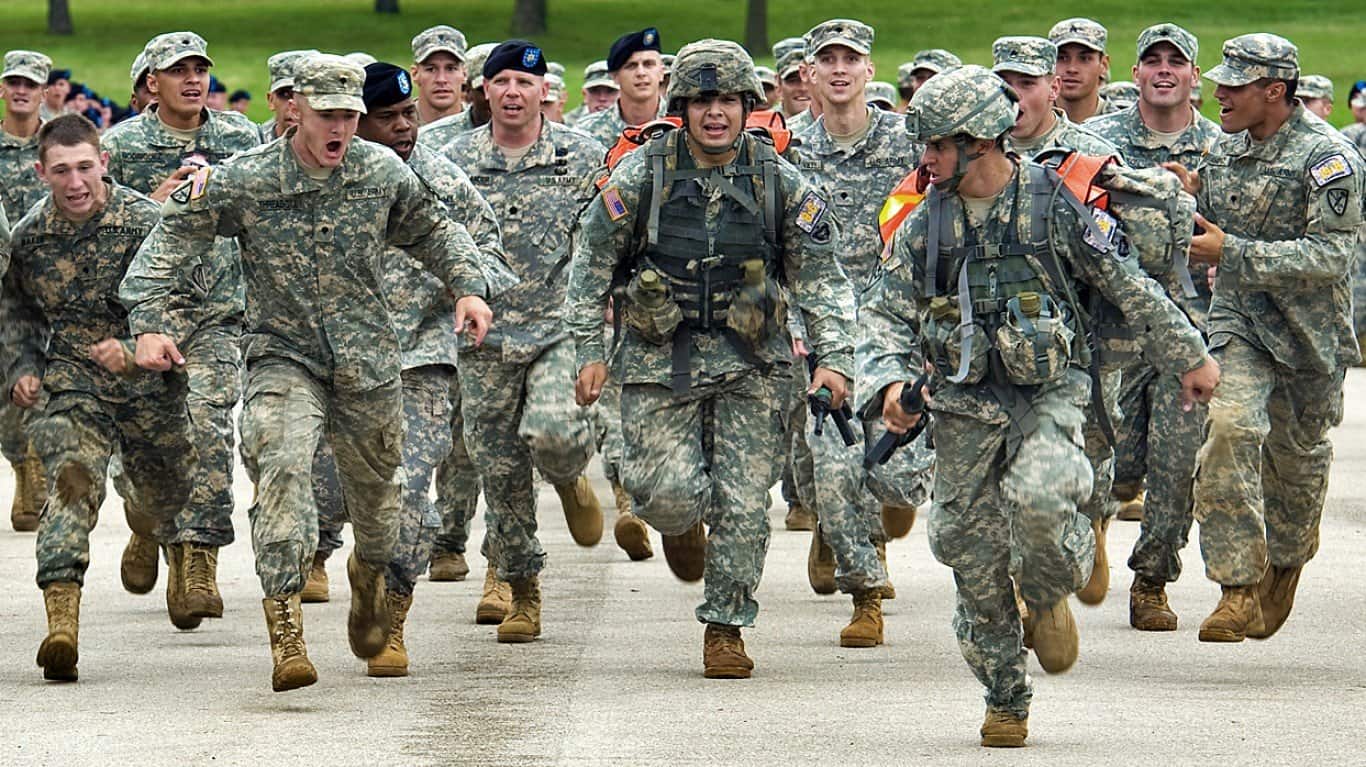
soldiersmediacenter / Flickr

smolaw / Shutterstock.com

G-Stock Studio/Shutterstock

Public Domain / Wikimedia Commons

Three Lions / Hulton Archive via Getty Images

Public Domain / Wikimedia Commons

Thinkstock / Stockbyte via Getty Images

Pixel-Shot / Shutterstock.com

Carlo Allegri / Getty Images Entertainment via Getty Images

Fox Photos / Hulton Archive via Getty Images

Lennart Preiss / Getty Images News via Getty Images

Andrea Izzotti / Shutterstock.com

Bert Hardy / Picture Post via Getty Images

NICKY1841 / Shutterstock.com

Ira Wyman / Sygma via Getty Images


14 Interesting Facts About the U.S. Army
The U.S. Army has been around longer than the United States itself, and more than 250 years of history have produced a few stories that are easy to miss. Some involve famous people, some come down to curious inventions, and others are facts that have been repeated so often that the details have gotten a little muddled.
Take the origins of Ray-Ban sunglasses, the daring Revolutionary War experiment with a one-person submarine, or the woman who served as a soldier while disguised as a man. Then there are the numbers: how many people the modern Army is actually authorized to have, how rare a five-star general really is, and what military musicians and working dogs contribute.
For these 14 facts, 24/7 Tempo reviewed historical and military records and corrected some common misconceptions. The result is a closer look at the Army's people, history, and unexpected connections to everyday life.
The Army Song Has Roots Going Back to 1908
If you have ever heard "The Army Goes Rolling Along," you have heard a melody that is considerably older than its official title. Army artillery officer Edmund L. Gruber wrote the original "Caisson Song" in 1908, and John Philip Sousa adapted it into a march in 1917. It took several more decades for the Army to settle on the song we know today.
With revised lyrics by Harold W. Arberg, the song was formally dedicated by the secretary of the Army on Veterans Day, November 11, 1956. It remains a familiar part of Army ceremonies, and soldiers are expected to stand and sing when it is played.
Army Aviators Helped Inspire Ray-Ban Sunglasses
That pair of aviator sunglasses in your car has a connection to the early days of military flight. Army aviator John A. Macready worked with Bausch & Lomb on protective eyewear to help pilots deal with glare at high altitudes. The goal was simple: improve visibility without making life harder for someone flying an aircraft.
Bausch & Lomb developed anti-glare eyewear in the 1930s, and the Ray-Ban name followed in 1937. The Army did not create the brand, but the needs of its pilots helped shape a style that went on to become a civilian fashion staple.
Deborah Sampson Served Disguised as a Man
Women served the Revolutionary cause in many roles, but Deborah Sampson went a step further. In 1782, she enlisted in the Continental Army under the name Robert Shurtliff and served in the 4th Massachusetts Regiment. She managed to conceal her identity even after being wounded, reportedly treating part of the injury herself.
Her secret came out after she developed a serious fever in 1783 and was treated by a physician. Sampson received an honorable discharge that October and later sought compensation for her service. She is one of the best-documented early examples of a woman serving as a soldier in the Continental Army, though not the first woman to support the force.
The Army Was Founded Before Washington Took Command
The U.S. Army traces its birthday to June 14, 1775, more than a year before the Declaration of Independence. That was when the Continental Congress created the Continental Army, bringing colonial forces together under a common command during the Revolutionary War.
George Washington was chosen as commander in chief the following day, June 15. He went on to become the face of the army and the revolution, but it was Congress, not Washington acting alone, that established the force. The distinction matters when looking back at how the Army began.
World War I Changed the Draft, but Did Not Invent It
The United States had a federal military draft long before World War I. During the Civil War, the Enrollment Act of 1863 allowed some drafted men to avoid service by paying a commutation fee or hiring a substitute. Unsurprisingly, that system sparked anger over who could afford to stay out of uniform.
When Congress passed the Selective Service Act in May 1917, it created a different system built around local draft boards and prohibited hired substitutes. More than 2.8 million men were inducted through the World War I draft. Calling 1917 the beginning of the draft misses an important, and controversial, chapter of American history.
The Army Has Nearly a Million Authorized Positions Across Its Components
The Army is much bigger than its active-duty ranks alone. For fiscal year 2026, Congress authorized an active-duty Army strength of 454,000, alongside 328,000 in the Army National Guard and 172,000 in the Army Reserve. Add those figures together and you get 954,000 authorized positions across the three components.
That is roughly the population of a major American city, but there is an important distinction: authorized end strength is a staffing target, not a real-time count of people in uniform. It is also inaccurate to describe the full number as active-duty soldiers.
The Army Has Four-Legged Specialists
Not everyone doing an Army job wears boots. Military working dogs and their handlers help protect installations, search for explosives or narcotics, and carry out patrol and security missions. They work as trained teams, with a handler responsible for reading the dog and making decisions in the field.
These dogs are not simply assigned a task and left to figure it out. Army working-dog teams train regularly and undergo proficiency evaluations, including annual certification. Rather than relying on an old, military-wide dog count, the more interesting fact is how specialized this partnership has become.
Some Famous Entertainers Once Wore Army Uniforms
Before some celebrities became household names, they spent time in the U.S. Army. Tony Bennett was drafted in 1944 and served in Europe during World War II. Elvis Presley served from 1958 to 1960, including duty in Germany. Clint Eastwood was drafted during the Korean War era and served at Fort Ord, California.
Their military experiences were very different, which is worth remembering when these names get lumped together on celebrity-veteran lists. For some, the Army meant training and stateside assignments. For others, including Bennett, it meant serving in a war zone before building a career in entertainment.
An Army Division Changed Its Shoulder Patch in 1939
The 45th Infantry Division once used a swastika-shaped symbol on its shoulder insignia. The design had been chosen in connection with Native American symbolism in the Southwestern states from which the division drew many of its soldiers. That history is distinct from the Nazi Party's use of the same shape.
By 1939, however, the association with Nazi Germany had made the original insignia inappropriate. The division adopted a gold thunderbird on a red diamond instead. The change is a reminder that a symbol's historical meaning can be overtaken by what happens in the world around it.
Army Soldiers Serve Far Beyond the United States
The Army has a presence well beyond American borders. U.S. Army garrisons and assigned personnel can be found in countries such as Germany, Italy, Poland, South Korea, and Japan. Some support training and logistics, while others help maintain readiness and work with allied forces.
That does not mean the Army alone operates every overseas U.S. military installation. Figures commonly quoted for hundreds of foreign bases generally refer to the Department of Defense as a whole, not just the Army. Keeping the services separate makes the global footprint easier to understand.
A Revolutionary War Submarine Tried to Attack a British Ship
Long before modern submarines, inventor David Bushnell designed a small, one-person underwater craft called the Turtle. With encouragement and support from the Continental Army, it was sent against the British warship HMS Eagle in New York Harbor in September 1776.
Sergeant Ezra Lee operated the vessel by hand and foot power, but he could not attach its explosive charge to the ship. The mission failed, though not because he simply panicked and quit, as some retellings suggest. The Turtle is remembered as a pioneering attempt to use a submarine in combat, even if it never sank an enemy ship.
Only Five Officers Have Held the Army's Five-Star Rank
The five-star rank of General of the Army is extraordinarily rare. It was established in December 1944, during World War II, and has been held by only five officers: George C. Marshall, Douglas MacArthur, Dwight D. Eisenhower, Henry H. Arnold, and Omar Bradley.
Bradley was the last to receive the rank, in 1950. Arnold later became the first and only General of the Air Force when the services separated. There is also a different, historically senior grade called General of the Armies, associated with John J. Pershing and George Washington, so the two should not be confused.
You Can Make a Military Career Out of Playing Music
An Army career does not necessarily involve driving a tank or carrying a rifle in combat. The service employs professional musicians who play in military bands, perform at ceremonies, give concerts, and represent the Army at public events. Their jobs cover everything from brass and percussion to guitar, keyboards, and vocals.
Army musician is a recognized enlisted specialty, known as 42R. These performers are soldiers with military responsibilities as well as musical ones. The Army has a substantial band program, although claims that it is the single largest employer of musicians in the world are difficult to verify reliably.
Army Veterans Have Gone on to Lead in Politics
A number of prominent American political figures entered public life after Army service. Former senator Bob Dole, for example, fought with the 10th Mountain Division in Italy during World War II. He was seriously wounded in April 1945 and spent years recovering before building a career in Congress.
Presidents Harry S. Truman and Dwight D. Eisenhower also served in the Army, though in very different roles. Service does not tell you everything about a leader's politics, but for many veterans it became an important part of their public biography and the experience they carried into government.