Aphelleon/Shutterstock.com

Allexxandar / Shutterstock.com

Dr. Juergen Bochynek / Shutterstock.com

Nithi clicks / BY 2.0

roger4336 / BY-SA 2.0

ralph and jenny / BY 2.0

Thomas Quine / BY 2.0

Alones / Shutterstock.com

clevercupcakes / BY 2.0

Rebecca Schreiner / Shutterstock.com

f11photo / Shutterstock.com

YanatSowki / BY-SA 4.0

StormyDog / BY 2.0

Victoria Kondysenko/Shutterstock.com

nodstrum / BY 2.0

Bluedharma / BY-ND 2.0

Dmytro Buianskyi / Shutterstock.com

Manuel Fernandez Martinez / Shutterstock.com



17 Unusual Facts About History, Science, and Nature
History has a funny way of messing with our sense of time. We tend to imagine ancient civilizations, prehistoric animals, and modern technology existing in completely separate eras. But when you actually look at the dates, some of those assumptions fall apart. Nintendo, for example, was already in business during the 1800s, and early fax technology existed when thousands of American pioneers were traveling west in covered wagons.
Nature has its own collection of unusual facts. Some animals have biological abilities that sound almost impossible, familiar foods aren't always what we think they are, and even the distance between Earth and the Moon can be difficult to appreciate.
We've collected 17 unusual facts from history, science, technology, and the natural world. Some involve surprising overlaps in history, while others reveal how things we encounter every day actually work. And unlike the stories that get passed around online without much explanation, there's real science or documented history behind each one.
Octopuses Have Three Hearts and Blue Blood
As if having eight arms wasn't unusual enough, octopuses also have three hearts. Two pump blood through the gills, where it picks up oxygen, while the third circulates oxygen-rich blood throughout the rest of the body. Their blood is blue because it uses hemocyanin, a copper-containing protein, to transport oxygen instead of the iron-based hemoglobin found in human blood. There's another interesting detail: the heart responsible for circulating blood through the body can temporarily stop pumping during jet-propelled swimming. That's one reason crawling is generally more energy-efficient for an octopus than swimming. Between their unusual circulatory systems, problem-solving abilities, and remarkable camouflage, octopuses are among the more fascinating animals living in our oceans.
Early Fax Technology Dates Back to the Oregon Trail Era
Fax machines might seem like something that belongs in an office from the 1980s, but the underlying technology goes back much further. Scottish inventor Alexander Bain received a British patent in 1843 for an electrical system capable of transmitting images. That same year, the Great Migration brought roughly 1,000 settlers westward along the Oregon Trail. The trail itself existed before 1843, and Bain's invention was an early precursor rather than the modern office fax machine. Still, the historical overlap is interesting. While pioneers were crossing the American West in covered wagons, inventors were already experimenting with ways to send images electronically. Commercially practical fax systems would take additional decades to develop, but the basic idea was around long before telephones became common household devices.
Sunlight Can Make the Eiffel Tower Move
The Eiffel Tower might look perfectly stationary, but its iron structure responds to changes in temperature throughout the day. When sunlight heats one side of the tower more than the other, the warmer metal expands, causing the upper portion to shift slightly away from the sun. According to the tower's official website, that movement can reach approximately 15 centimeters, or nearly six inches. That doesn't mean the structure becomes six inches taller, a distinction often lost when this fact makes the rounds online. Temperature changes can also cause small variations in its overall height. These movements are normal consequences of thermal expansion and were considered in the tower's engineering. It's a useful reminder that even enormous steel and iron structures aren't quite as motionless as they appear.
Harvard Was Founded Before Modern Calculus Was Developed
Harvard was established in 1636, making it the oldest institution of higher education in the United States. Interestingly, that's several decades before Isaac Newton and Gottfried Wilhelm Leibniz independently developed the foundations of modern calculus during the second half of the seventeenth century. Of course, mathematicians had been studying geometry, motion, areas, and related concepts for centuries before either man was born. Ancient Greek mathematicians, among others, had developed methods that anticipated parts of calculus. What Newton and Leibniz contributed was the systematic mathematical framework that would eventually become essential to modern science and engineering. So while Harvard students were already attending classes in colonial Massachusetts, one of the mathematical disciplines now taught at virtually every major university was still being developed.
Bananas Are Berries, but Strawberries Aren't
Most people wouldn't hesitate to call a strawberry a berry. Botanists, however, use a more specific definition. A true botanical berry develops from a single flower's ovary and typically has a fleshy interior surrounding its seeds. Bananas qualify under that definition, even though most commercially grown bananas contain only tiny, undeveloped seeds. Strawberries are different. The red, fleshy portion develops largely from the flower's receptacle rather than its ovary, making a strawberry an aggregate accessory fruit. Those little dots covering the outside aren't actually exposed seeds, either. They're tiny individual fruits called achenes, each containing a seed. None of this changes how either fruit tastes, but it does explain why everyday food names don't always line up with scientific classifications.
Woolly Mammoths Were Still Alive When Egypt Built Its Pyramids
Woolly mammoths usually bring to mind Ice Age landscapes and prehistoric humans. But not every mammoth disappeared when the last ice age ended. Isolated populations survived on islands long after mammoths vanished from most of their former range. On Wrangel Island, north of Siberia, woolly mammoths survived until approximately 4,000 years ago. Meanwhile, Egypt's Great Pyramid of Giza was constructed around 2560 BCE, several centuries before the last known Wrangel Island mammoths disappeared. That means there was a period when ancient Egyptians were building monumental stone structures while mammoths were still living elsewhere on Earth. They certainly weren't roaming around Egypt, but the overlap is real. It's a good example of why prehistoric extinction dates don't always line up neatly with our mental picture of ancient history.
Astronauts Have Reported a Metallic Smell After Spacewalks
Space is a vacuum, so astronauts can't simply remove their helmets and take a sniff. But after returning from spacewalks, several astronauts have described an unusual odor associated with equipment brought back inside their spacecraft. The smell has been compared to hot metal, welding fumes, and even seared steak. The reports have inspired several scientific explanations involving chemical reactions and materials exposed to the space environment, although the precise cause isn't completely settled. The important distinction is that astronauts are smelling something inside a pressurized spacecraft after a spacewalk, not detecting an odor traveling through the vacuum of space. It's still a fascinating detail about working beyond Earth's atmosphere, and one that doesn't usually appear in the more familiar descriptions of life aboard the International Space Station.
Nintendo Was Founded in 1889
Most people associate Nintendo with Mario, Zelda, and decades of video game consoles. But the Japanese company existed long before electronic gaming became a business. Nintendo traces its founding to September 23, 1889, when Fusajiro Yamauchi began producing handmade hanafuda playing cards in Kyoto, Japan. Hanafuda cards were used in traditional Japanese card games, and playing cards remained an important part of Nintendo's business for many years. The company experimented with other products and industries before entering electronic entertainment during the twentieth century. Its early video game products appeared in the 1970s, with the Nintendo Entertainment System eventually becoming a defining part of the home gaming industry. So Nintendo isn't just older than the first video game console. It was established in the same century as the American Civil War, the telephone, and the earliest motion pictures.
One Jellyfish Can Return to an Earlier Stage of Life
The jellyfish Turritopsis dohrnii has earned the nickname "immortal jellyfish," although that description needs a little explanation. Under certain conditions, including stress or physical damage, the animal can reverse part of its development and return from its adult medusa stage to an earlier polyp stage. From there, it may develop into adult jellyfish again. This process is unusual because most animals cannot reverse their life cycle in anything approaching the same way. Scientists are particularly interested in the cellular changes that make the transformation possible. However, it doesn't mean an individual jellyfish is guaranteed to live forever. Predators, disease, and environmental conditions can still kill it. The species has a remarkable ability to reset its developmental stage, but biological immortality isn't the same thing as being impossible to kill.
Teaching at Oxford Predates the Aztec Empire
The University of Oxford has no single recorded founding date, but teaching was taking place there by 1096. That puts its educational history several centuries before the formation of the Aztec Empire. The Mexica founded Tenochtitlan, which would become the empire's capital, around 1325. The Aztec Triple Alliance that established the empire itself emerged in 1428. In other words, Oxford had already been a center of learning for hundreds of years before that political alliance was formed. Of course, complex civilizations had existed throughout Mesoamerica long before the Aztecs, so this doesn't mean Oxford is older than every major society in the region. It does illustrate how easy it is to misjudge historical timelines when one institution feels modern and another belongs to a chapter of history we usually study alongside ancient civilizations.
A Human Cell Can Contain About Six Feet of DNA
DNA is packed into cells on a scale that's difficult to imagine. If you stretched out all the DNA in the nucleus of a typical human cell, it would measure approximately two meters, or about six and a half feet, from end to end. Yet that material fits inside a nucleus only a few micrometers across. The trick involves an elaborate system of packaging, with DNA wrapping around proteins called histones and forming structures that can be organized into chromosomes. Not every human cell has a nucleus; mature red blood cells, for example, don't contain nuclear DNA. But in cells that do, the amount of genetic material packed into such a tiny space is remarkable. This is a more accurate comparison than the often-repeated claim that humans share exactly 60% of their DNA with bananas, which oversimplifies how scientists compare genes and DNA sequences.
Shark Ancestors Existed Before the First Trees
Sharks have an evolutionary history stretching back hundreds of millions of years, long before dinosaurs appeared. Fossil evidence places early shark relatives more than 400 million years ago, while some of the earliest recognizable trees evolved around 385 million years ago. That means shark ancestors were already swimming through ancient oceans before forests resembling anything familiar existed on land. There is one important distinction: modern shark species haven't remained unchanged for 400 million years. Sharks have evolved considerably, and many familiar species appeared relatively recently in geological terms. What makes the comparison interesting is the age of their broader evolutionary lineage. These predators developed in a world with very different continents, climates, and ecosystems, and their descendants continue occupying oceans around the globe today.
Properly Stored Honey Can Last for Years
Honey has a reputation for lasting almost indefinitely, and there's real science behind its unusually long shelf life. Its high sugar concentration, low available moisture, and acidity make it difficult for many microorganisms to grow. When honey is properly processed, sealed, and stored in suitable conditions, it can remain usable for years without spoiling in the way many other foods do. It may darken, crystallize, or change in flavor over time, but crystallization alone doesn't mean it has gone bad. However, the claim that honey can never spoil is too absolute. Excess moisture can allow fermentation, and improper storage can affect its quality and safety. Honey also shouldn't be given to infants younger than one year because it may contain Clostridium botulinum spores. The preservation properties are impressive enough without suggesting that every jar will remain edible forever.
Facebook Had More Users in 2023 Than Earth Had People in 1960
The scale of modern social media becomes easier to appreciate when you compare it with historical population figures. According to Meta, Facebook had approximately 3.07 billion monthly active users in December 2023. The world's total population in 1960 was roughly 3.02 billion people, according to international population estimates. That means Facebook's reported monthly audience at the end of 2023 was slightly larger than the entire human population of Earth in 1960. There are some obvious differences between those figures, including the fact that monthly active users are platform accounts rather than a perfect count of unique individuals. Still, the comparison provides a useful sense of how much global communication and population have changed over several decades. The original claim using 1975 was incorrect, since Earth's population had already reached approximately 4 billion by then.
The Other Seven Planets Can Fit Between Earth and the Moon at Certain Distances
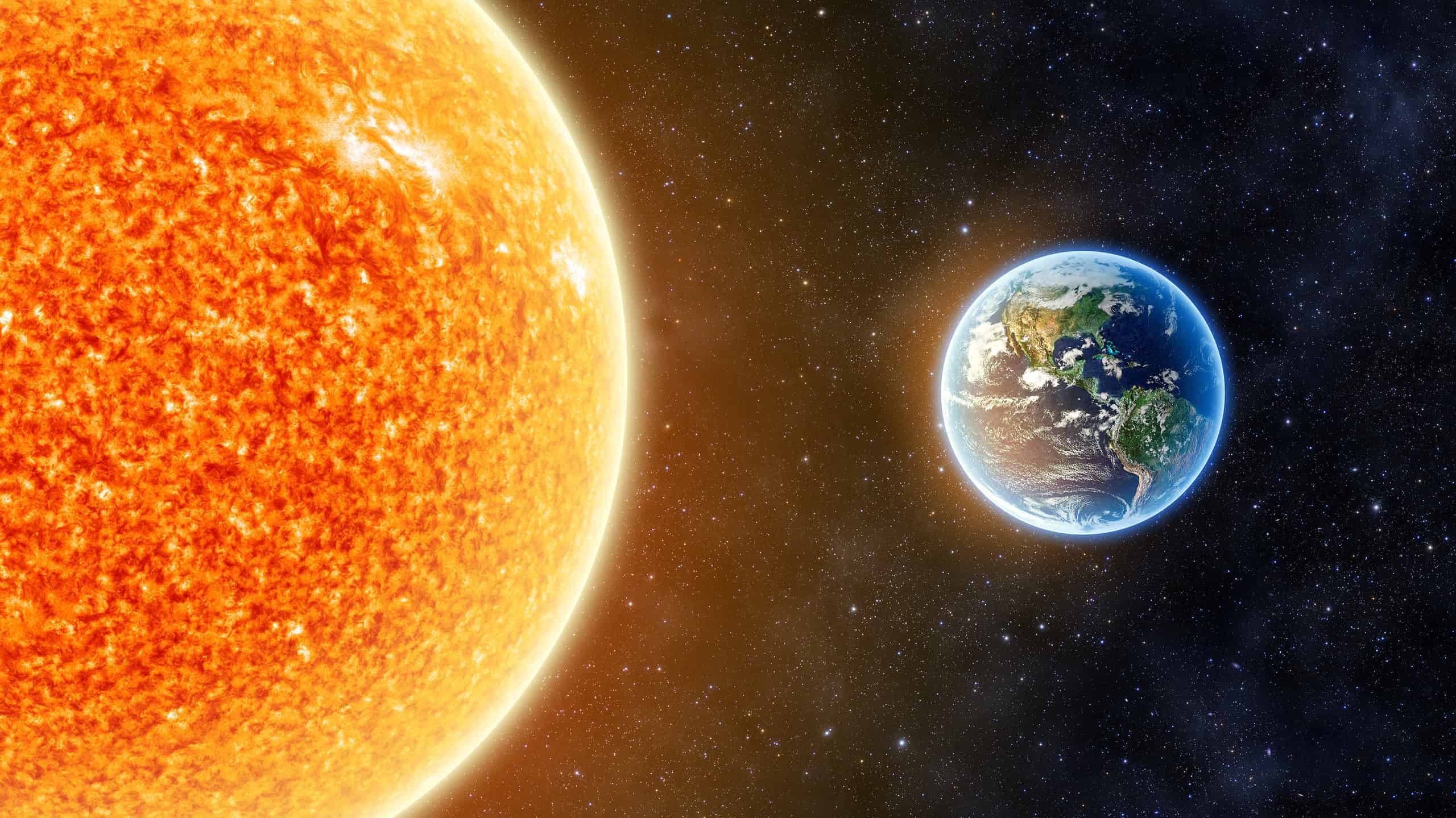
Earth's Moon looks close when it's hanging in the night sky, but the distance separating the two is enormous. On average, the Moon orbits about 384,400 kilometers from Earth's center, although its distance varies throughout the month. If you added together the approximate diameters of Mercury, Venus, Mars, Jupiter, Saturn, Uranus, and Neptune, the total would be around 380,000 kilometers. That's slightly too large to fit between Earth's and the Moon's surfaces at their average separation. However, when the Moon is near apogee, its farthest point from Earth, the available space is large enough for the seven planetary diameters to fit side by side in a purely mathematical comparison. Obviously, lining up seven planets would be physically impossible without dramatically altering the solar system. But as a demonstration of the scale of space, it's an interesting way to picture the Earth-Moon distance.
Cleopatra Lived Closer to the iPhone Than to the Great Pyramid
Cleopatra VII is one of the best-known figures from ancient Egyptian history, which makes it easy to associate her with the construction of the pyramids. But the timelines are surprisingly far apart. The Great Pyramid of Giza was completed around 2560 BCE, while Cleopatra died in 30 BCE, a gap of roughly 2,530 years. Apple's first iPhone arrived in 2007 CE, approximately 2,036 years after her death. That puts Cleopatra closer in time to the release of the first iPhone than to the building of Egypt's most famous pyramid. The comparison doesn't mean Cleopatra lived in anything resembling the modern world, of course. It simply reflects how extraordinarily old the pyramids already were during her lifetime. By the time she ruled Egypt, those massive monuments had been standing for more than two millennia.
Stegosaurus Lived Farther From T. Rex Than T. Rex Lived From Us
Movies and museum exhibits sometimes make it seem like all dinosaurs lived together in one enormous prehistoric world. In reality, the age of dinosaurs lasted for more than 160 million years, and some familiar species never came close to encountering each other. Stegosaurus lived during the Late Jurassic Period, roughly 150 million years ago. Tyrannosaurus rex didn't appear until the Late Cretaceous, approximately 68 million years ago, and disappeared during the mass extinction event around 66 million years ago. That puts roughly 80 million years between Stegosaurus and T. rex, compared with approximately 66 million years between the last T. rex and modern humans. So despite both being dinosaurs, Stegosaurus and T. rex were separated by more time than T. rex and people are today. That's a useful reminder of just how long dinosaurs dominated life on land.