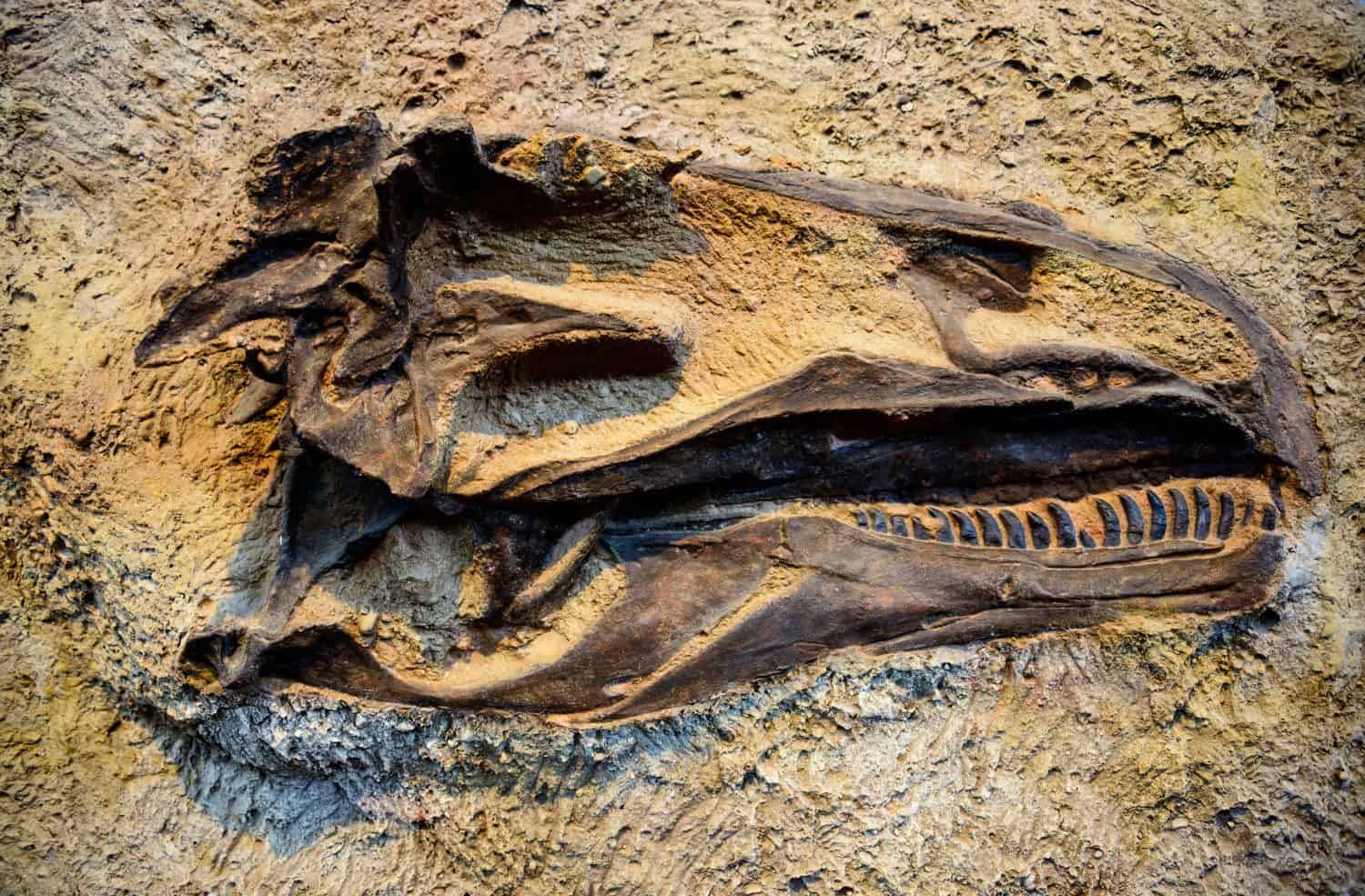
Zack Frank / Shutterstock.com

ps50ace / iStock via Getty Images


EcoPic / iStock via Getty Images


flyingrussian / iStock via Getty Images


Kneonlight / iStock via Getty Images


Orla / iStock via Getty Images

Public Domain via U.S. Fish & Wildlife Service / Wikimedia Commons


Elenarts108 / iStock via Getty Images

CoreyFord / iStock via Getty Images

leonello / iStock via Getty Images

Betty4240 / iStock via Getty Images


The Best U.S. States For Digging Up Dinosaur Fossils, Ranked
Dinosaurs may have vanished from the planet over 65 million years ago, but their remains continue to tell the story of prehistoric life across the United States. Traces of these ancient giants have been unearthed in nearly every state; while some regions are famous for large fossil beds, others surprise us with unexpected and unique ancient finds.
In fact, all but five U.S. states have reported at least one dinosaur-related fossil. Because of this, interest in fossil hunting is growing again. If you're looking to dig up some dinosaur fossils, certain states offer a better chance than others. So, where should you head for your best odds when it comes to digging up an ancient treasure like this?
Using research from the Paleobiology Database and the National Park Service, 247 Tempo ranks the best states in the U.S. for finding dinosaur fossils. We'll check out the states that house the largest public collections of dinosaur bones and artifacts, as well as what types of fossils were found. Let's start digging.
This post was updated on July 23rd, 2025, to reflect additional information.
26. Georgia
- Total number of fossils found: 55
- Age from which most fossils were found: Late Pleistocene (126,000 to 11,700 years ago)
- Number of fossils from the Late Pleistocene age found: 48
- Most commonly found species: Meleagris gallopavo (3)
Bird species like the wild turkey (Meleagris gallopavo), the Eurasian teal, and the wood duck make up the vast majority of fossils found in Georgia. However, a few extinct bird species like the passenger pigeon have also been found there, as have a handful of older dinosaur bones from Albertosaurus, Hydrosaurus, and Ornithomimidae, a family of theropods resembling ostriches.
25. Kansas
- Total number of fossils found: 57
- Ages from which most fossils were found: Blancan and Late Coniacian (5 to 2 million years ago and 90 to 86 million years ago)
- Number of fossils found from the Blancan and Late Coniacian ages: 16 (8 each)
- Most commonly found species: Ichthyornis dispar, Parahesperornis alexi (3 each)
Ichthyornis, a dinosaur that resembled a sea bird, and parahespornis, a prehistoric flightless bird, represent the most prevalent fossils found in Kansas. Ichthyornis is one of the closest non-avian ancestors of modern birds, and the first known bird ancestor to have teeth.
24. Nebraska
- Total number of fossils found: 58
- Ages from which most fossils were found: Clarendonian, Early Barstovian, and Hemingfordian (12 to 9 million years ago, 16 to 15 million years ago, and 21 to 16 million years ago)
- Number of fossils found from the Clarendonian, Early Barstovian, and Hemingfordian ages: 36 (12 each)
- Most commonly found species: Pediohierax ramenta (4)
An extinct species of primitive falcon, the Pediohierax ramenta, is the most commonly found fossil species in Nebraska. The birds lived 15 million years ago during the Miocene Period, and their bones have not been found anywhere else on Earth.
23. Oklahoma
- Total number of fossils found: 59
- Age from which most fossils were found: Late Kimmeridgian (157 to 152 million years ago)
- Number of fossils found from the Late Kimmeridgian age: 25
- Most commonly found species: Camarasaurus, Tenontosaurus genera (6 each)
In Oklahoma, the most common fossils come from the Camarasaurus (a long-necked, small-headed herbivore) and the Tenontosaurus (an herbivore with a long, thick tail). Of all the long-necked sauropods, Camarasaurus is the most commonly found in North America.
22. Alabama
- Total number of fossils found: 59
- Age from which most fossils were found: Late Pleistocene (126,000 to 11,700 years ago)
- Number of fossils found from the Late Pleistocene age: 37
- Most commonly found species: Hadrosauridae family (6)
Of the few dozen dinosaur fossils found in Alabama, most are from a disparate variety of creatures. The most fossils from a single family are Hadrosauridae. These were found in five different counties in the state. Hadrosaurids were duck-billed herbivores that usually walked on four legs but were capable of walking on two.
21. Idaho
- Total number of fossils found: 72
- Age from which most fossils were found: Late Albian (113 to 100 million years ago)
- Number of fossils found from the Late Albian age: 29
- Most commonly found species: Dromaeosauridae family (3)
Often referred to as raptors, Dromaeosauridae are a family of feathered running lizards that have been found across the earth, including in Idaho. They ranged from about two to 20 feet in length and had a sharp, enlarged claw on each foot.
20. Maryland
- Total number of fossils found: 73
- Age from which most fossils were found: Late Aptian (125 to 113 million years ago)
- Number of fossils found from the Late Aptian age: 29
- Most commonly found species: Ornithomimosauria clade (6)
The clade of bird-mimicking lizards known as Ornithomimosauria has left multiple fossil deposits in Maryland. Similar to ostriches, these quick-moving creatures had feathers and were variously omnivorous or herbivorous. Multiple fossils belonging to the Ankylosauria, a clade of bulky, armored dinosaurs similar to tortoises, have also been found in the state.
19. Hawaii
- Total number of fossils found: 95
- Age from which most fossils were found: Holocene (12,000 to 11,500 years ago)
- Number of fossils found from the Holocene age: 57
- Most commonly found species: Apteribis sp. (10)
The fossilized remains of small extinct ibises in the genus Apteribis have only been found on the Hawaiian islands of Molokai, Lanai, and Maui. The flightless birds likely lived on forest floors and ate snails.
18. Connecticut
- Total number of fossils found: 109
- Age from which most fossils were found: Hettangian (201 to 199 million years ago)
- Number of fossils found from the Hettangian age: 105
- Most commonly found species: Grallator tuberosus (16)
Dinosaur State Park in Rocky Hill contains one of the largest dinosaur track sites in the U.S., with over 2,000 tracks including 500 in an enclosed exhibit. The most prevalent tracks are from Grallator and Eubrontes theropods.
17. Alaska
- Total number of fossils found: 109
- Age from which most fossils were found: Holocene (12,000 to 11,500 years ago)
- Number of fossils found from the Holocene age: 52
- Most commonly found species: Aethia sp. (9)
Several species of Aethia – small seabirds known as auklets – are the most abundant species whose fossils have been found in Alaska. Another dinosaur found in the state is Dromaeosaurus albertensis, a medium-sized bipedal carnivore that was much more heavily built than other typical theropods of its size, like the velociraptor.
16. New Jersey
- Total number of fossils found: 139
- Age from which most fossils were found: Norian (227 to 209 million years ago)
- Number of fossils found from the Norian age: 26
- Most commonly found species: Grallator sp. (24)
Footprints, including those categorized as Grallator prints (three-toed prints made by small bipedal theropods), are the most prevalent dinosaur fossil species found in New Jersey. Hadrosaurid (duck-billed dinosaur) fossils are also common in the state. The first nearly-intact dinosaur skeleton ever found in North America was a Hadrosaurus foulkii discovered in New Jersey in the 19th century.
15. North Carolina
- Total number of fossils found: 151
- Age from which most fossils were found: Zanclean (5.3 to 3.6 million years ago)
- Number of fossils found from the Zanclean age: 106
- Most commonly found species: Morus sp. (8)
Several extinct species of gannet (Morus sp.), a seabird related to the booby, have been found in Beaufort County, North Carolina. In the coastal plains surrounding the Pamlico River, Beaufort is known for its fossil riches, especially large shark teeth.
14. Oregon
- Total number of fossils found: 156
- Age from which most fossils were found: Late Pleistocene (126,000 to 11,700 years ago)
- Number of fossils found from the Late Pleistocene age: 120
- Most commonly found species: Eremochen russelli (3)
The Eremochen (which means "desert goose") russelli is an extinct species of water bird that likely resembled a smaller version of the Canada goose. Its fossilized remains in Oregon are holotypic, which means that they are the only example of its species ever found.
13. South Dakota
- Total number of fossils found: 199
- Age from which most fossils were found: Late Maastrichtian (72 to 66 million years ago)
- Number of fossils found from the Late Maastrichtian age: 94
- Most commonly found species: Tyrannosaurus rex (6)
While the most commonly identified species of dinosaur fossil in South Dakota is Tyrannosaurus rex, of the genus Tyrannosaurus. An even more common genus found in the state is Triceratops, whose species were a main food source for Tyrannosaurs.
12. Arizona
- Total number of fossils found: 224
- Age from which most fossils were found: Sinemurian (199 to 191 million years ago)
- Number of fossils found from the Sinemurian age: 59
- Most commonly found species: Scutellosaurus lawleri (17)
An armored, herbivorous dinosaur, Scutellosaurus lawleri had several hundred bony plates running down its back and tail. The species has only ever been found in Coconino County, Arizona, where a single partial skeleton was discovered on Navajo land.
11. North Dakota
- Total number of fossils found: 251
- Age from which most fossils were found: Late Maastrichtian (72 to 66 million years ago)
- Number of fossils found from the Late Maastrichtian age: 138
- Most commonly found species: Tyrannosaurus rex (22)
Of all the fossil species identified in North Dakota, Tyrannosaurus rex is the most prevalent species. These large carnivorous theropods ranged through western North America. In 2021, rare juvenile T-rex bones were excavated on private land in a remote area of the state.
10. Virginia
- Total number of fossils found: 280
- Age from which most fossils were found: Late Pleistocene (126,000 to 11,700 years ago)
- Number of fossils found from the Late Pleistocene age: 177
- Most commonly found species: Miocepphus mcclungi (8)
Most of the dinosaur fossils found in Virginia have belonged to prehistoric birds, such as the Miocepphus mcclungi, a small extinct species of auk, as well as extant birds like the wild turkey and the great horned owl. Dinosaur footprints have also been discovered in the state, along with prehistoric whale, shark, and mastodon bones.
9. Massachusetts
- Total number of fossils found: 319
- Age from which most fossils were found: Hettangian (201 to 199 million years ago)
- Number of fossils found from the Hettangian age: 310
- Most commonly found species: Anomoepus scambus (45)
Dinosaur tracks are the official Massachusetts state fossil, and the most common species of fossil found are Anomoepus scambus footprints. The Connecticut River Valley is a rich area for fossil footprints, and South Hadley is considered the location of the first dinosaur tracks ever found in the United States.
8. Texas
- Total number of fossils found: 496
- Age from which most fossils were found: Middle Campanian (83.6 to 72.1 million years ago)
- Number of fossils found from the Middle Campanian age 128
- Most commonly found species: Richardoestesia gilmorei (12)
Richardoestesia gilmorei, the most common species of fossils found in Texas, represent the teeth of a species of theropod with long slender jaws. The finely serrated teeth are distinctive to the species. Pachycephalosauria (bipedal omnivores with thick, domed skulls) and Tyrannosaurid fossils are also common in the state.
7. Colorado
- Total number of fossils found: 583
- Age from which most fossils were found: Kimmeridgian (157 to 152 million years ago)
- Number of fossils found from the Kimmeridgian age: 150
- Most commonly found species: Hadrosauropodus leonardii (12)
A common species that left fossils in Colorado is the Hadrosauropodus leonardii, which has been identified not by bones, but by fossilized footprints. These footprints are classified as Cararichnium, which is an ichnogenus – a taxon (taxonomic group) based on the fossilized traces left behind by an organism, rather than its bones.
6. Utah
- Total number of fossils found: 776
- Age from which most fossils were found: Pliensbachian (190 to 183 million years ago)
- Number of fossils found from the Pliensbachian age: 78
- Most commonly found species: Eolambia caroljonesa (12)
While unclassified theropod (a clade of hollow-boned, three-toed, clawed dinosaur) fossils are commonly found in Utah, the most common species identified is the Eolambia caroljonesa, an herbivorous duck-billed dinosaur that hasn't been found anywhere else on the planet. Long-necked brachiosauridae have also been found in the state, as have a huge array of fossilized footprints.
5. Florida
- Total number of fossils found: 894
- Age from which most fossils were found: Late Pleistocene (126,000 to 11,700 years ago)
- Number of fossils found from the Late Pleistocene age: 393
- Most commonly found species: Podilymbus podiceps (24)
Although extant birds – such as the pied-billed grebe, the most commonly found fossil species in the state – make up the majority of prehistoric dinosaur fossils found in Florida, a few extinct species have also been found there, including Waller's terror bird, a flightless carnivore that stood up to six feet tall.
4. New Mexico
- Total number of fossils found: 935
- Age from which most fossils were found: Late Campanian (76 to 74 million years ago)
- Number of fossils found from the Late Campanian age: 555
- Most commonly found species: Alamosaurus sanjuanensis (20)
Over 200 fossils from the Hadrosauridae family, also known as duck-billed dinosaurs, have been found in New Mexico, as well as over 80 fossils of Ceratopsia, a clade of horned herbivorous dinosaurs that includes the Triceratops. Alamosaurus, the most common species found in the state, is the largest known dinosaur found in North America.
3. Montana
- Total number of fossils found: 939
- Age from which most fossils were found: Lancian (71 to 66 million years ago)
- Number of fossils found from the Lancian age: 246
- Most commonly found species: Tenontosaurus tilletti (45)
Over 80 different species of dinosaur fossils have been identified in Montana – more than in any other state. The most common species is Tenontosaurus tilletii (a bipedal herbivore), the first fossils of which were found in Montana in 1903.
2. Wyoming
- Total number of fossils found: 1,135
- Age from which most fossils were found: Kimmeridgian (157 to 152 million years ago)
- Number of fossils found from the Kimmeridgian age: 360
- Most commonly found species: Triceratops horridus (26)
Wyoming is one of the most productive fossil sites in the world. Several well-known genera of dinosaurs have been found in the state's massive fossil deposits, including Stegosaurus, Allosaurus, Triceratops, and Tyrannosaurus.
1. California
- Total number of fossils found: 1,992
- Age from which most fossils were found: Late Pleistocene (126,000 to 11,700 years ago)
- Number of fossils found from the Late Pleistocene age: 751
- Most commonly found species: Branta canadensis (29)
Most of the dinosaur fossils found in California are those of birds, especially ancient water birds like ducks, grebes, cormorants, puffins, and geese – some of which still exist today, including mallards and Canada geese.