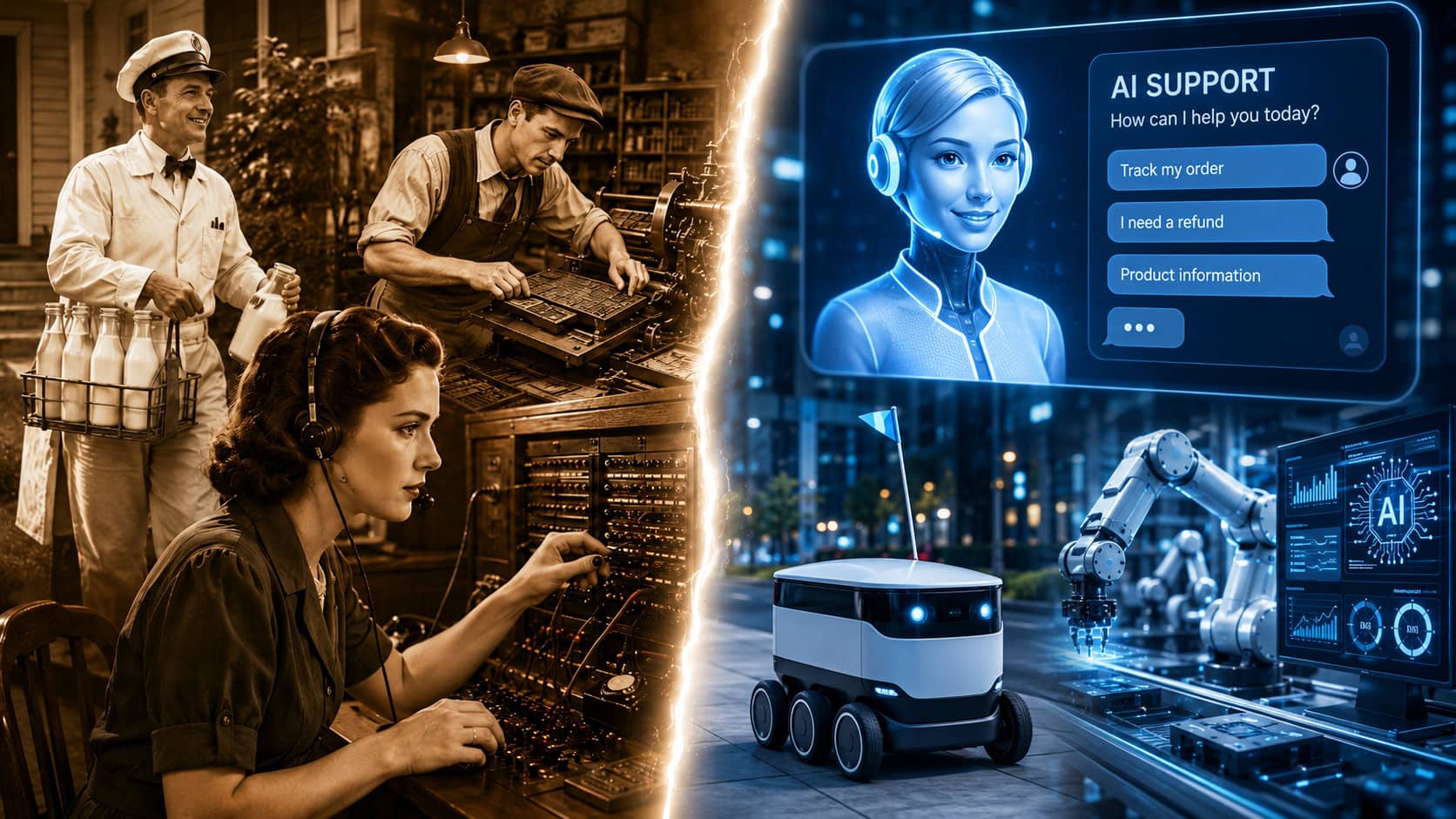
As generations pass and technology moves forward, certain occupations stop making sense. Sometimes it happens suddenly, but more often than not, it’s a slow process, with fewer openings and fewer people trained, until there comes a time when the position simply disappears from the job market entirely.
A machine gets cheaper, software gets smarter, or a consumer preference changes, making the human intermediary obsolete. There are many reasons why, but the result is always the same. These 10 jobs were once promising careers, often unionized and well-paying, with training programs and career ladders. Then they weren’t.
Video Store Clerk
The video store clerk was part of American life for roughly two decades. Knowledgeable about stock, able to debate directorial talent, and capable of knowing precisely where the third copy of Die Hard was stashed away. Blockbuster employed more than 84,000 people worldwide at its peak in 2004. It wasn’t a glamorous job, but it required a certain level of knowledge and involved curating recommendations, managing inventory, and dealing with the occasional late fee and unrewound tape while keeping a straight face.
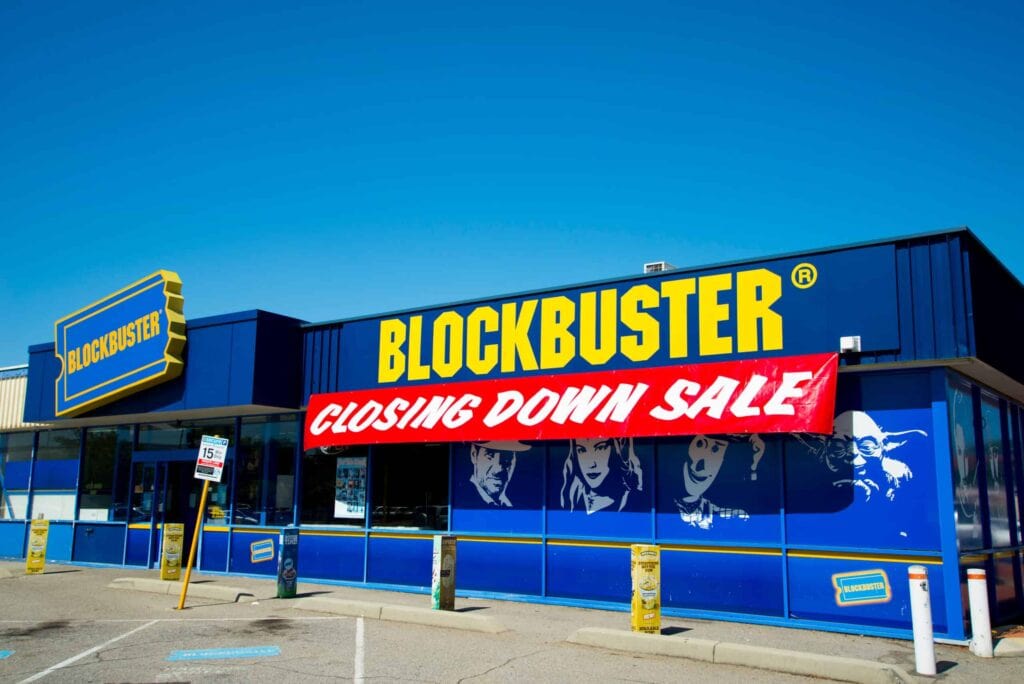
The last Blockbuster video store in Australia closing down in the suburb of Morley.
Netflix kicked off its DVD-by-mail service in 1998, then added streaming in 2007. By the time Blockbuster filed for bankruptcy in 2010, it was clear that the position had little to no future. Today, there is only one Blockbuster, located in Bend, Oregon, and it serves mostly as a tourist attraction. Those who worked at countless Blockbusters scattered into retail, customer service, and whatever else was hiring.
Travel Agent
In their heyday, travel agents were absolutely necessary. They had contacts in the airline industry, knew the fine print on hotel cancellations, and could arrange the most complicated itinerary across multiple cities in ways travelers could never manage on their own. According to the Bureau of Labor Statistics, there were more than 124,000 travel agents in the United States in 2000. It was a stable and respected middle-class job.
Websites like Expedia, Kayak, Booking.com, and Google Flights started popping up, and suddenly anyone could do it themselves. The travel agent was slowly replaced, and in 2023, the Bureau of Labor Statistics reported only 66,000 travel agents left, many of whom specialize in certain niches, like corporate travel and honeymoon packages, where the human touch still commands a fee. The mass market travel agent that used to arrange family vacations and spring break flights is almost extinct.
Elevator Operator
It sounds strange now, but in the first half of the twentieth century, no elevator would be complete without the presence of an operator. He regulated its speed, leveled the car with the floor, opened the doors, and told people riding which floor they were in. In department stores and office blocks, elevator operators became as much a feature of the place as merchandise itself. In New York and Chicago, veteran operators were a reliable part of the neighborhood, greeting regulars by name and knowing their floors without being prompted.

The automatic elevator emerged in the 1950s, and it was quickly adopted. It no longer made sense to pay for labor that had been completely automated. Operators were out within a generation. A few historic and luxury buildings still hire them today as a service detail rather than a necessity. Having someone press the button for clients gives a certain sense of luxury, but that’s about it.
Human Computer
There was a time when the word “computer” was not descriptive of a machine, but rather of a person. The computer was a worker hired to do complicated mathematical calculations. The work was done manually and usually in a team of many others whose function was to double-check each other’s calculations. NASA employed hundreds of such workers through the 1950s and into the 1960s, most of whom were Black women with degrees in mathematics and worked out the trajectories and orbital paths for the flights.
The electronic computer made the profession redundant almost immediately. Early models from IBM did what would take humans several weeks to do in a few hours. When the Apollo 11 went up into space in 1969, electronic computers took care of almost all of the calculations.
Bowling Alley Pinsetter
Before the 1950s, bowling alleys relied on teenage boys, known as “pin boys” or “pin chasers,” who stood at the end of lanes manually resetting the pins. It was noisy, exhausting, and not particularly safe, as the boys were standing in the way of ten-pound balls rolling their way at high speeds. It was a poorly paid job with strenuous hours. Pin boys constantly came and went.
AMF showcased its first automatic pinsetter at a public demonstration in 1946, and it started being used commercially in 1951. Adoption happened very quickly throughout the next decade. The pin boy became extinct in the 1960s. The mechanical pinsetter allowed alley owners to keep their lanes open for longer periods of time, add more lanes, serve more customers, all while saving money on labor. The boys who’d worked the pits moved on and that’s probably a good thing. It wasn’t a great job to begin with.
Film Projectionist
For most of the 20th century, every movie shown at a theater passed through a projectionist’s hands. They were in charge of loading film reels, handling reel changes during the screening (usually in complete darkness), focusing the projector, and operating the machinery. It required real technical skill, and in many cities it was a union job with decent pay and seniority protections.

Digital cinema changed everything in the 2000s and 2010s. Studios switched from film reels to hard drives for movie distribution, and digital projectors needed significantly less human supervision. As of 2013, the vast majority of movie theaters in America had switched to digital. While there still is usually somebody technically responsible for a projector booth, this responsibility has become integrated with management functions, and there is no longer a need for a specialist who spent their entire career mastering the handling of a 35mm film reel.
Toll Booth Collector
Being a highway toll collector used to be a reliable job. Workers collected cash, made change, and ensured that traffic flowed as smoothly as possible. New Jersey, for example, had thousands of toll collectors all over the Garden State Parkway and New Jersey Turnpike back in 1990.
Electronic tolls have slowly been eliminating the need for toll collectors. Most toll roads are now fully automated, and drivers are charged electronically via license plate recognition and toll transponders. New York’s MTA eliminated its last human toll collectors on the Triborough Bridge and Tunnel Authority in 2017. The job hasn’t disappeared everywhere, but it’s been cut to a fraction of what it was.
Linotype Operator
The Linotype machine, invented in 1886, was the essential element in newspaper and magazine production for almost a century. Linotype operators sat at the keyboard typing letter by letter, assembling a line of brass molds that the machine then cast into a solid metal slug, ready for the printing press. This was a highly paid, skilled trade, traditionally performed through apprenticeship programs and unionized almost everywhere. Large city newspapers had Linotype rooms and kept them full of people working around the clock.
Phototypesetting appeared in the 1960s, and desktop publishing appeared in the 1980s. With the transition from hot metal typesetting to digital, the Linotype room disappeared altogether. The International Typographical Union, which represented Linotype operators for decades, was merged with the Communications Workers of America in 1987. A very skilled, well-paid craft became just another software function anyone with a computer could perform.
VCR Repairman
In the 1980s and early 1990s, VCR repairmen were a legitimate, small business segment. A videocassette recorder cost too much to replace outright, and failed often enough to keep repair shops busy. Heads required cleaning. Belts would break. Mechanisms would jam. A skilled repairman could build up a solid clientele in any sizeable city.

The economics of this industry quickly deteriorated. DVD players debuted in the late 1990s and were less expensive than repairing a VCR. In 2016, Sony stopped producing VHS recorders, but repairmen who made careers out of servicing this particular format had long since moved on or retired from the industry. Automation didn’t kill this one. The position got undercut by cheaper technology until there was nothing left to fix.
Ice Cutter
Before the invention of the electric refrigerator, people relied on ice harvested during winter periods. Ice cutters worked frozen lakes with handsaws and later power tools, cutting large blocks that were then stored in insulated ice houses for sale during the warmer months to households and businesses. Ice cutting was a seasonal job in the states of New England and the upper Midwest, and some companies were shipping ice as far away as the Caribbean region.
The domestic electric refrigerator made its first appearance during the 1910s and gained wide popularity during the 1920s and 1930s. By the 1940s, the natural harvesting of ice had become practically extinct in the U.S. This change was so sudden that many regional economies relying on winter ice harvesting just vanished after one decade. Even though mechanical ice factories still exist, the job of cutting ice from a frozen lake stopped being a viable profession almost completely within a single generation.