eurobanks/iStock.com

tab1962 / Getty Images

Ruslan Lytvyn / iStock via Getty Images

Photos.com / Getty Images

jtyler / Getty Images

DNY59 / Getty Images
Keith Lance / Getty Images

traveler1116 / Getty Images

www.americaslibrary.gov / Wikimedia Commons

tzahiV / Getty Images

LUNAMARINA / Getty Images

powerofforever / Getty Images

giftlegacy / Getty Images
CHBD / Getty Images

izanbar / Getty Images

zimmytws / Getty Images

powerofforever / Getty Images

SeanPavonePhoto / Getty Images

heliopix / Getty Images

gollykim / Getty Images

narvikk / Getty Images



20 U.S. Citizenship Questions to Try at Your Own Risk
Before we begin, a quick reassurance for everyone born in the United States: getting these questions wrong will not actually result in your citizenship being revoked. Still, depending on your score, you may want to keep the results between yourself and your browser history.
The U.S. naturalization test includes an English portion and a civics test covering American government and history. USCIS introduced a new civics test for people who filed Form N-400 on or after Oct. 20, 2025. The current version contains 128 possible civics questions. An officer can ask up to 20 of them, and an applicant must answer at least 12 correctly to pass. People who filed before that date generally take the older 2008 version instead.
That sounds manageable until someone asks you to name five original states, explain the rule of law, identify your congressional representative, and remember who wrote the Federalist Papers while another human being waits for your answer. So, how would someone who is already an American do? Here are 20 questions from the current USCIS civics test. Proceed with confidence, or at least plausible deniability.
There Were 13 Original States. Name Five.
The 2025 test makes this a little tougher than the older version, which asked applicants to name only three. Any five will work: New Hampshire, Massachusetts, Rhode Island, Connecticut, New York, New Jersey, Pennsylvania, Delaware, Maryland, Virginia, North Carolina, South Carolina, or Georgia. If you need a head start, New York, New Jersey, and New Hampshire knock out three with the word "New" doing most of the heavy lifting.
Benjamin Franklin Is Famous for Many Things. Name One.
This question has become a little more forgiving. USCIS accepts several answers, including that Franklin was an inventor, a U.S. diplomat, the first Postmaster General, helped write the Declaration of Independence, or founded the first free public libraries. So yes, "inventor" now counts. Just don't confidently announce that he invented the light bulb. That was Thomas Edison, and Franklin has enough accomplishments without stealing somebody else's.
Name One Reason Americans Declared Independence From Britain.
You have several ways to survive this one. USCIS accepts answers including high taxes, taxation without representation, British soldiers being quartered in Americans' homes, lack of self-government, the Boston Massacre, Boston Tea Party, Stamp Act, Sugar Act, Townshend Acts, and Intolerable Acts. In other words, you do not need to recite a Revolutionary War documentary. One valid grievance gets you there.
Dwight Eisenhower Is Famous for Many Things. Name One.
The easiest answer is probably that Dwight D. Eisenhower was a general during World War II. USCIS also accepts that he was the 34th president, was president at the end of the Korean War, or signed the Federal-Aid Highway Act of 1956 that created the Interstate Highway System. If you remember D-Day, you've already got this one covered.
What Does the Judicial Branch Do?
USCIS gives you four acceptable answers: it reviews laws, explains laws, resolves disputes about the law, or decides whether a law violates the Constitution. The federal judicial branch includes the Supreme Court and lower federal courts. State and local courts have their own judicial systems, so tossing every courthouse in America into one giant branch of the federal government would be a little too enthusiastic.
Name Two Important Ideas From the Declaration of Independence and Constitution.
The current test accepts equality, liberty, social contract, natural rights, limited government, and self-government. You only need two. This replaces an older citizenship-test question that specifically asked for rights listed in the Declaration of Independence. That old answer was life, liberty, and the pursuit of happiness. Useful knowledge, certainly, but make sure you're answering the question USCIS actually asks now.
Why Did the United States Enter World War I?
USCIS accepts several answers: Germany attacked U.S. civilian ships, the United States entered to support the Allied Powers, or it entered to oppose the Central Powers. The U.S. joined the war in 1917 while Woodrow Wilson was president. The older civics test simply asked who the president was during World War I. Apparently the new version expects you to know a little more than the guy's name.
Name One Writer of the Federalist Papers.
James Madison, Alexander Hamilton, and John Jay wrote the essays supporting ratification of the Constitution under the shared pseudonym "Publius." USCIS therefore accepts any of those three names or Publius. Hamilton is probably the easiest one to remember these days, particularly if Broadway managed to sneak some constitutional history into your brain without you noticing.
Who Is the Speaker of the House Right Now?
As of October 2026, the answer is Mike Johnson of Louisiana. This is one of the questions that can change, so an actual naturalization applicant needs to know who holds the office at the time of the interview. USCIS specifically directs applicants to use the current officeholder rather than whichever name happened to be in the study guide when they started preparing.
Who Was President During the Great Depression and World War II?
Franklin D. Roosevelt. He entered office in 1933 during the Great Depression and remained president through most of World War II, dying in office in April 1945. He was elected four times, making him the only U.S. president to serve more than two terms. If the Depression portion of the question did not get you there, the four-term president clue probably should.
Name Your U.S. Representative.
There is no universal answer here. Your representative depends on the congressional district where you live. The House has 435 voting members, and district boundaries can change after reapportionment and redistricting. For the actual citizenship test, USCIS expects the representative serving your district at the time of your interview. This is one question where memorizing somebody else's study sheet could backfire spectacularly.
What Founding Document Was Written in 1787?
The Constitution. This is exactly the sort of question where 1776 tries to jump into your brain simply because it is America's favorite historical year. The Declaration of Independence was adopted in 1776. Delegates drafted and signed the Constitution in 1787. Keep those two dates in separate mental drawers and you'll be fine.
Who Is the Chief Justice of the United States Right Now?
As of October 2026, it is John G. Roberts Jr. Roberts became chief justice in 2005 and remains the 17th person to hold the office. Like the Speaker question, this answer can eventually change, so USCIS tells applicants to know the official serving at the time of their interview. If your civics knowledge is frozen somewhere around 2004, this is where things begin to go poorly.
Name One of Your State's U.S. Senators.
Every state has two U.S. senators, so the correct answer depends on where you live. Residents of Washington, D.C., and U.S. territories do not have U.S. senators, which USCIS accounts for in its answer guidance. For everybody else, you need only one of your state's two current senators. Considering they serve six-year terms, you at least have a decent chance of your studying remaining useful for a while.
How Many Amendments Does the Constitution Have?
Twenty-seven. The first 10 make up the Bill of Rights, which was ratified in 1791. The most recent amendment, the 27th, deals with congressional pay and was ratified in 1992, more than two centuries after it was originally proposed. Sometimes government moves slowly. Apparently "203 years later" still counts as getting around to it eventually.
How Many Voting Members Are in the House of Representatives?
The answer is 435. The number of voting House seats has been fixed at 435 for more than a century, except for temporary adjustments after Alaska and Hawaii became states. Each state's share of those seats is based largely on population, while every state receives at least one representative. Do not confuse it with the Senate's much cleaner number of 100.
How Many Seats Are on the Supreme Court?
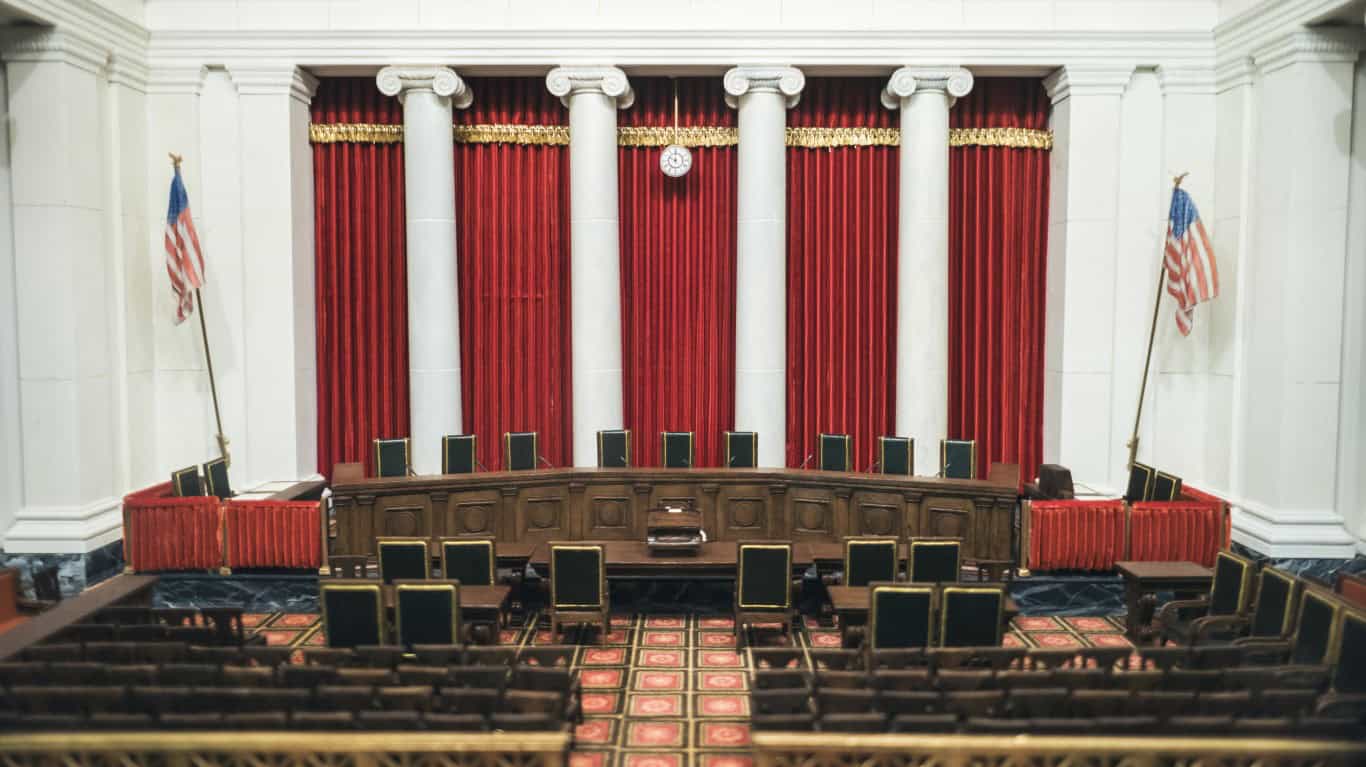
Nine. The Constitution created the Supreme Court but did not specify the number of justices. Congress has changed the Court's size several times during U.S. history, but it has remained at nine seats since 1869. As of 2026, that means one chief justice and eight associate justices. Thankfully, the test asks for the number, not for you to recite the entire seating chart.
What Is the Rule of Law?
USCIS accepts four versions of essentially the same idea: everyone must follow the law, leaders must obey the law, government must obey the law, or no one is above the law. You do not need a law degree or a 40-minute constitutional argument. In fact, attempting either one would probably make this question considerably harder than necessary.
How Long Is a Term for a U.S. Senator?
Six years. This becomes confusing only because Washington has decided almost every major elected office should get its own number. Members of the House serve two-year terms, presidents are elected to four-year terms, and senators serve six. Remember 2, 4, 6 in that order and you've just turned civics into a very basic math problem.
Name One Power That Belongs Only to the Federal Government.
You have several acceptable answers: print paper money, mint coins, declare war, create an army, make treaties, or set foreign policy. Notice that the current 2025 test gives you more options than the older version did. Pick one and stop. This is not the moment to impress the USCIS officer with your complete understanding of federalism.