Sports can turn frightening in a matter of seconds. A routine tackle, a line drive, a tire failure, or a player suddenly collapsing can turn a game into an emergency before anyone has time to understand what happened. The athletes below lived through some truly terrifying moments. Some eventually returned to competition. Others never played professionally again.
For this updated look, 24/7 Tempo reviewed league, team, medical, Hall of Fame, and established news sources to verify what happened and when. These stories include racing crashes, head and spinal injuries, cardiac arrests, and freak accidents across football, baseball, soccer, and motorsports.
Ernie Irvan

Image source: Darryl W. Moran Photography / BY-ND 2.0
Imagine being told you have only about a 10% chance of living, then finding your way back to the sport that nearly killed you. That is part of Ernie Irvan’s story.
During practice at Michigan International Speedway in August 1994, a tire failed and Irvan’s car slammed into the wall. NASCAR reported that he was bleeding so badly that a doctor performed an emergency tracheotomy while Irvan was still inside the car so he could breathe. He was airlifted to a hospital with a traumatic brain injury, skull fracture, and chest injuries. Doctors gave him a 10% chance of survival.
Irvan recovered and eventually returned to NASCAR, winning three more Cup races. Another serious crash at Michigan years later ultimately helped bring his racing career to an end.
Steve Park

Image source: Darryl W. Moran Photography / BY-ND 2.0
Racing doesn’t even have to be at full speed for something to go terribly wrong. On Sept. 1, 2001, Steve Park was running under caution during a Busch Series race at Darlington Raceway when his car suddenly veered left into the path of Larry Foyt.
Park later explained that when he pulled on the steering wheel, it came off. Foyt’s car struck Park’s on the driver’s side, leaving Park with a serious brain injury. ESPN reported that his recovery lasted nearly seven months, not several years as some later retellings have suggested.
Remarkably, Park chose Darlington for his return. He climbed back into a Cup car there in March 2002, at the same track where the frightening accident had happened.
Travis Pastrana

Image source: Rob Street / BY-SA 4.0
Injuries are nothing new to Travis Pastrana. His career has included motocross, rally racing, NASCAR, and stunts that most people wouldn’t dream of attempting. One of his most frightening accidents happened when he was only 14.
During a motorcycle jump, Pastrana crashed so violently that his spine separated from his pelvis. He later said doctors told him he was the third known person at the time to survive that type of injury without bleeding to death, so that remarkable statistic comes from Pastrana’s own account rather than a broader medical study.
He survived, recovered, and somehow went right back to the kind of high-risk competition that made him famous.
Daniel Ponce de León

Image source: D. Benjamin Miller / CC0 1.0
Baseball doesn’t feature constant collisions, but a line drive can become terrifying in less than a second. Daniel Ponce de León learned that on May 9, 2017, while pitching for Triple-A Memphis against the Iowa Cubs.
Víctor Caratini hit a line drive that struck Ponce de León in the right temple. He was rushed to a hospital, where doctors performed emergency brain surgery after he suffered a fractured skull and bleeding around his brain. At the time, simply surviving and recovering normally was the concern.
Fourteen months later, on July 23, 2018, Ponce de León made his Major League debut for the St. Louis Cardinals. He threw seven hitless innings. It was an incredible ending to a comeback that had started with doctors wondering whether he would survive the original injury.
Ryan Newman

Image source: Nascarking / BY-SA 4.0
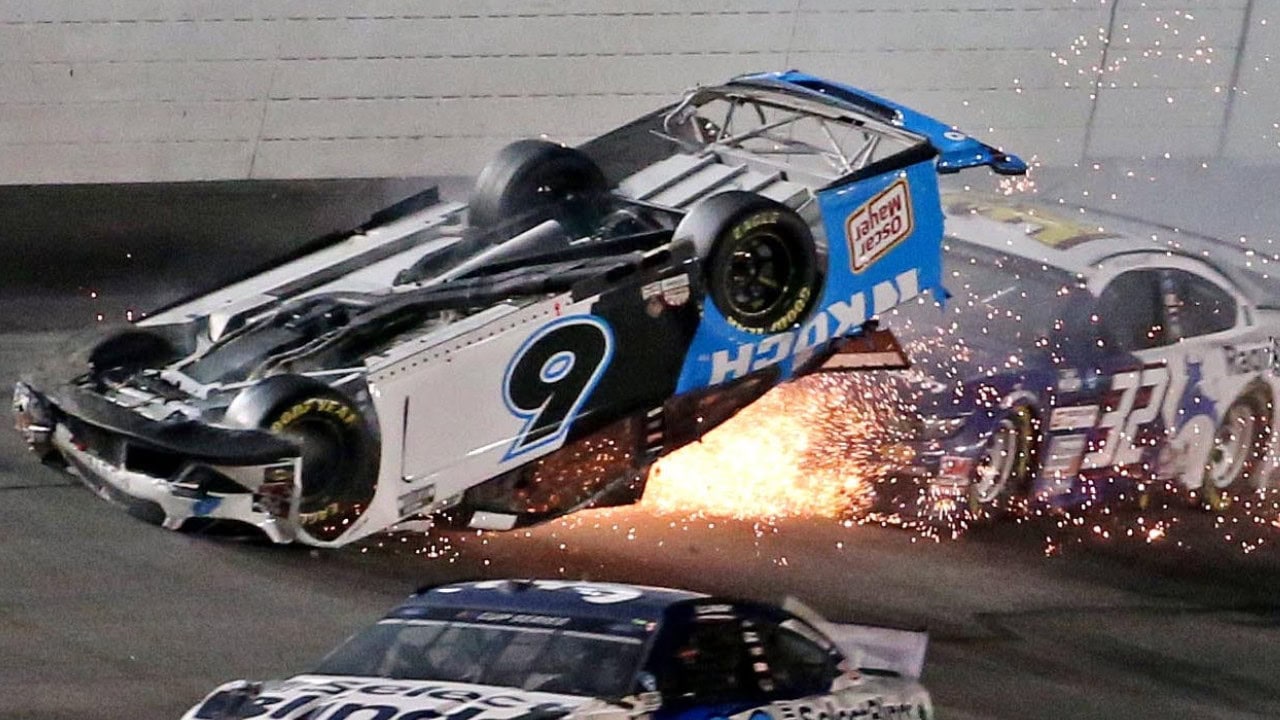
Ryan Newman’s crash on the final lap of the 2020 Daytona 500 looked catastrophic. Contact from Ryan Blaney sent Newman’s car into the wall before it went airborne, flipped, and was struck by Corey LaJoie’s car.
Newman was hospitalized in serious condition, but there is an important distinction here. His doctors and racing team said his injuries were not life-threatening. Newman later said he suffered a head injury but remarkably had no broken bones or internal organ damage.
He was released from the hospital two days after the crash and eventually returned to racing. Newman has said he remembers little, if anything, about the accident itself, which makes the footage even more unsettling to watch.
Damar Hamlin

Image source: Joe Biden / BY-SA 4.0
Millions of football fans watched one of the most frightening moments in modern NFL history unfold on live television on Jan. 2, 2023. Buffalo Bills safety Damar Hamlin tackled Cincinnati Bengals receiver Tee Higgins, stood back up, and then suddenly collapsed on the field.
Hamlin had suffered cardiac arrest. Medical personnel immediately performed CPR and used a defibrillator, restoring his heartbeat before he was taken by ambulance to the University of Cincinnati Medical Center in critical condition.
Hamlin later revealed that doctors determined he had experienced commotio cordis, a rare condition in which a sudden blow to the chest at exactly the wrong moment in the heart’s electrical cycle can trigger cardiac arrest. Remarkably, Hamlin eventually returned to the NFL.
His story is still unfolding. The Bills re-signed Hamlin to a one-year deal in March 2026, putting him in position for his sixth NFL season. He has also turned his experience into an effort to promote CPR and AED training. During the 2026 NFL Draft in Pittsburgh, Hamlin helped lead an event in which 1,293 people completed CPR training in one hour, setting a Guinness World Record.
Christian Eriksen

Image source: Дмитрий Неймырок/Dmitriy Neymyrok/Dmitrij Nejmyrok / BY-SA 3.0
Two years before Hamlin’s collapse shocked NFL fans, soccer fans watched something similarly frightening happen to Christian Eriksen.
On June 12, 2021, Eriksen suddenly collapsed during Denmark’s Euro 2020 match against Finland. There had been no collision. He was suffering a cardiac arrest. Medical personnel performed CPR and used a defibrillator to revive him before he was taken to the hospital.
Eriksen later had an implantable cardioverter-defibrillator, or ICD, placed in his chest. For many athletes, that might have been the end of the story. Instead, he returned to competitive soccer with Brentford on Feb. 26, 2022, a little more than eight months after his heart stopped on the field.
Tyler Zombro

Image source: Dnipro Assets / Shutterstock.com
Baseball has produced several of the most frightening moments on this list. On June 3, 2021, Durham Bulls pitcher Tyler Zombro was struck on the right side of his head, just above his ear, by a line drive traveling 104 mph off the bat of Brett Cumberland.
Zombro underwent emergency brain surgery at Duke University Hospital. The procedure lasted about two and a half hours and left him with 16 plates and 36 screws stabilizing his skull.
His comeback took longer than originally described in this post. Zombro returned to a regular-season game on April 24, 2022, nearly 11 months after the accident. He continued trying to play professionally but announced his retirement in August 2024, saying he had continued dealing with nerve problems related to the injury.
Mickey Cochrane

Image source: Becker Brothers, Public domain, via Wikimedia Commons
Long before batting helmets became standard equipment, baseball players faced a much different level of risk at the plate. Hall of Fame catcher Mickey Cochrane’s career ended because of it.
On May 25, 1937, New York Yankees pitcher Bump Hadley hit Cochrane in the head with a fastball. Cochrane suffered a fractured skull and never played in another Major League game. The National Baseball Hall of Fame says one doctor later compared the appearance of his X-rays to a road map.
The injury ended the playing career of one of baseball’s great catchers at just 34 years old. Cochrane survived and was elected to the Baseball Hall of Fame in 1947.
D.J. Hayden

Image source: Jeffrey Beall / BY 3.0
D.J. Hayden almost never made it to the NFL. On Nov. 6, 2012, during a full-pads practice at the University of Houston, Hayden collided with a teammate and took an accidental knee to the chest.
The impact nearly tore Hayden’s inferior vena cava, the major vein carrying blood from the lower body back to the heart, away from the back of his heart. Doctors opened his chest during emergency surgery, and one of the surgeons later said Hayden had been about five minutes from dying.
He recovered, became the No. 12 overall pick in the 2013 NFL Draft, and played nine seasons in the league. Sadly, Hayden died at age 33 in a Houston car crash in November 2023, more than a decade after surviving the football injury.
Darryl Stingley

Image source: City of Boston Archives from West Roxbury, United States / BY 2.0
One play can completely change a person’s life. For New England Patriots receiver Darryl Stingley, that play came on Aug. 12, 1978, during a preseason game against the Oakland Raiders.
Stingley went up for a pass and was hit from behind by Raiders safety Jack Tatum. The collision broke his neck and left Stingley a quadriplegic. He never walked again and never played another NFL game.
Stingley’s story became one of the most sobering reminders of how violent professional football could be. He continued living an active life despite his paralysis and died in 2007 at age 55, nearly three decades after the injury that ended his career.
Fabrice Muamba

Image source: Mattchad / BY-SA 3.0
Few sports stories are as difficult to believe as Fabrice Muamba’s. On March 17, 2012, the Bolton Wanderers midfielder collapsed during an FA Cup match against Tottenham Hotspur after suffering cardiac arrest.
Medical personnel immediately began trying to save him. According to England’s Football Association, Muamba’s heart was stopped for 78 minutes before the combined efforts of medical personnel finally got it beating again.
Muamba survived, but his playing career was over. He retired from professional soccer later in 2012 on medical advice. His experience has since made him an advocate for cardiac screening and access to defibrillators, equipment that can make an enormous difference when cardiac arrest occurs.
Kevin Everett

Image source: UsernameUnavailable / BY-SA 4.0
Another Buffalo Bills player experienced a frightening injury years before Damar Hamlin’s collapse. On Sept. 9, 2007, tight end Kevin Everett suffered a severe cervical spinal cord injury while making a tackle during a kickoff return against the Denver Broncos.
Everett was initially paralyzed from the neck down and underwent surgery that night. Doctors feared he might never walk again. Over the weeks that followed, however, he gradually regained movement.
By December 2007, Everett was walking on his own, although his stride and mobility were still limited. His football career was over, but his recovery earned him the Professional Football Writers of America’s George Halas Award in 2008 for overcoming tremendous adversity.
Reggie Brown

Image source: Keith Allison / BY-SA 2.0
Lastly, there is Reggie Brown, whose NFL career ended on what looked like a routine football play.
During the Detroit Lions’ final regular-season game of 1997, Brown helped tackle New York Jets running back Adrian Murrell. Brown didn’t get back up. He couldn’t move, was struggling to breathe, and then lost consciousness. Medical personnel performed CPR on the field, an intervention the NFL says saved his life.
Brown had suffered a serious spinal cord injury and underwent surgery the following day to stabilize his neck. The paralysis proved temporary, but his football career was finished after just two NFL seasons. He survived an injury that remains vivid for many of the players and coaches who were on the field that day.