
History of Medicine

Public Domain / Wikimedia Commons

ElenaR/ Shutterstock

Dignity100 / Shutterstock.com

Public Domain / Wikimedia Commons

Hulton Archive / Hulton Royals Collection via Getty Images
Public Domain / Wikimedia Commons

Public Domain / Wikimedia Commons

Public Domain / Wikimedia Commons

Public Domain / Wikimedia Commons

Everett Collection / Shutterstock.com

Public Domain / Wikimedia Commons

Public Domain / Wikimedia Commons

Public Domain / Wikimedia Commons



11 Mysterious People From History Who Still Raise Questions
What makes someone mysterious? Sometimes it is an unidentified criminal who seemingly vanished into thin air. Sometimes it is a person whose real name was never discovered. And sometimes the mystery grows because fact, rumor, and legend have become so tangled together that separating them is half the story.
Not every mystery on this list is still completely unsolved. Modern DNA testing settled the question of whether Grand Duchess Anastasia survived the execution of the Romanov family, while historical research has raised serious doubts about parts of the famous story behind the so-called Drowned Woman of the Seine. Others, including D.B. Cooper and the Isdal Woman, remain genuine unanswered cases decades later.
To update this post, 24/7 Tempo reviewed government records, peer-reviewed research, museum and historical sources, archival material, and established reference works. Here are 11 people from history whose identities, disappearances, deaths, or legends still leave something to puzzle over.
This post was updated September 16, 2026, to reflect additional information.
D.B. Cooper
D.B. Cooper stole $200,000 and jumped from a plane in 1971.
On November 24, 1971, a man calling himself Dan Cooper bought a one-way ticket on Northwest Orient Airlines Flight 305 from Portland, Oregon, to Seattle. The name "D.B. Cooper" came from an early media mix-up, but it stuck. Shortly after takeoff, Cooper handed a flight attendant a note saying he had a bomb and demanded $200,000 in $20 bills and four parachutes.
When the Boeing 727 landed in Seattle, Cooper exchanged the 36 passengers for the money and parachutes, then ordered the remaining crew to head toward Mexico City. A little after 8 p.m., somewhere between Seattle and Reno, Nevada, he lowered the aircraft's rear stairs and jumped into the night with the ransom money. No confirmed sighting of him was ever made again.
The FBI spent decades investigating the hijacking, which it called NORJAK. In 1980, a boy found $5,800 in deteriorating $20 bills along the Columbia River, and the serial numbers matched the ransom. Cooper also left behind a black clip-on tie that later yielded a DNA sample. Neither clue has revealed who he was.
What Happened to D.B. Cooper?
D.B. Cooper's remains were never found.
One of the biggest questions is whether Cooper even survived the jump. The FBI has pointed out that the parachute he chose could not be steered, his clothing and footwear were poorly suited for a wilderness landing, and he jumped at night into bad weather. Investigators ultimately concluded that the evidence did not make him look like a highly experienced skydiver.
Then again, no body, parachute, or definitive landing site has ever been found. Apart from the $5,800 discovered in 1980, the ransom money has never been recovered. The FBI stopped actively dedicating resources to the case in 2016, although it said it would still consider significant new physical evidence. Whether Cooper died that night or managed one of the strangest escapes in American criminal history remains unknown.
The Isdal Woman
The Isdal Woman's body was found at Isdalen in Bergen, Norway.
On November 29, 1970, a man hiking with his two daughters in Isdalen, near Bergen, Norway, discovered the badly burned body of an unidentified woman. More than half a century later, her real name has still not been established.
The autopsy found barbiturates in her system and carbon monoxide in her blood. Soot in her airways showed that she was still breathing while the fire burned. Investigators concluded that she had consumed a large quantity of the sleeping drug phenobarbital. Norwegian police eventually leaned toward suicide, but the physical evidence does not establish with certainty whether she took her own life or whether someone else was involved.
The scene only deepened the mystery. Labels and identifying marks had been removed from belongings associated with her, making an already difficult identification case even harder.
The Isdal Woman's Trail of False Identities
The Isdal Woman was eventually buried at Møllendal Cemetery in Norway.
Police later linked two suitcases at Bergen railway station to the dead woman through fingerprints. Inside were clothes, wigs, cosmetics, foreign currency, maps, timetables, and a notebook containing coded records of her travels. Investigators traced her stays at hotels around Norway and found that she had registered under at least eight different names. Contrary to a story that has been repeated for years, there is no solid evidence that police actually recovered several false passports belonging to her.
Her unusual travel pattern and use of aliases helped fuel theories that she was involved in Cold War espionage, but that has never been proved. Modern analysis of her teeth has narrowed the likely region where she spent parts of her early life to Central and Western Europe, but it has not produced a name.
She was given a Catholic burial at Møllendal Cemetery in Bergen on February 5, 1971. Her identity and the full circumstances surrounding her death remain unresolved.
Grand Duchess Anastasia Romanov
For years, many people believed that Princess Anastasia escaped the fate of her family.
For much of the 20th century, one of the most famous royal mysteries centered on Grand Duchess Anastasia Nikolaevna, the youngest daughter of Russia's last emperor, Nicholas II. After Nicholas abdicated in 1917, the former imperial family was held in captivity. Nicholas, Alexandra, their five children, and four members of their household were executed in Yekaterinburg in the early hours of July 17, 1918.
The Soviet government's secrecy surrounding the killings helped rumors flourish. A grave containing nine people was located by researchers in the late 1970s and officially excavated in 1991. DNA testing identified Nicholas, Alexandra, three daughters, and four members of their household, leaving two Romanov children apparently unaccounted for. That absence kept the Anastasia survival story alive.
The mystery was finally settled after a second grave was discovered nearby in 2007. DNA testing showed that the remains belonged to a son and daughter of Nicholas and Alexandra. When the two graves are considered together, all five Romanov children are accounted for. Researchers have disagreed over whether the female remains in the second grave were Anastasia or her sister Maria, but the genetics establish the important point: neither sister survived the 1918 execution.
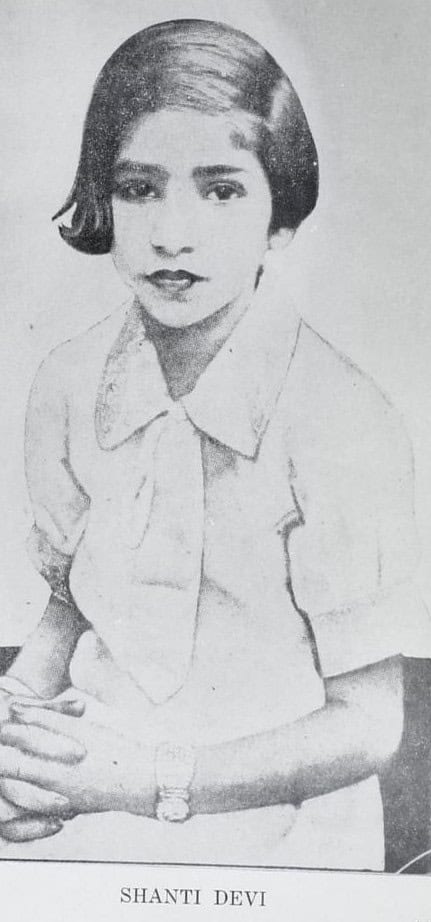
Shanti Devi
Shanti Devi claimed to remember details from her past life.
Shanti Devi was born in Delhi in 1926 and became famous as a child after saying she remembered another life in Mathura, roughly 90 miles away. She claimed that she had previously been a woman named Lugdi Devi, who had a husband and son and died shortly after giving birth in 1925.
The story became famous enough to attract the attention of Mahatma Gandhi. A 15-member committee investigated the claims and accompanied Shanti to Mathura in 1935. Supporters reported that she recognized people and places connected with Lugdi's life and knew details they considered difficult to explain. Later researcher Ian Stevenson wrote that accounts of the case contained at least 24 statements that matched facts about Lugdi's life.
That does not make reincarnation an established scientific explanation. Indian skeptic Bal Chand Nahata investigated the case and concluded that the available material did not prove past-life memories or reincarnation. The case has remained a subject of debate ever since, with questions about how information was gathered, what Shanti might have learned beforehand, and how much later retellings embellished the original events. Shanti never married and remained associated with the reincarnation story for the rest of her life.
The Zodiac Killer
The true identity of the Zodiac Killer remains unknown.
The Zodiac Killer murdered five confirmed victims and wounded two others in Northern California in 1968 and 1969. The killer then became notorious for sending letters, threats, and cryptograms to newspapers, eventually referring to himself as "the Zodiac." He claimed responsibility for far more killings, but those additional claims have never been conclusively established.
Some of his codes have been broken. Donald and Bettye Harden solved the large 408-symbol cipher in 1969. Another message, the 340-character cipher, resisted efforts for 51 years before David Oranchak, Sam Blake, and Jarl Van Eycke solved it in 2020. The FBI independently verified their solution.
Neither deciphered message revealed the killer's identity. Other short ciphers remain unresolved, and despite decades of suspects, books, documentaries, and claims that someone has finally cracked the case, law enforcement has never publicly confirmed the Zodiac Killer's identity.
B. Traven
Most scholars link B. Traven with Ret Marut, although questions about his birth identity remain.
B. Traven managed something difficult for a successful author: he became famous while keeping his biography deliberately slippery. His best-known novel, The Treasure of the Sierra Madre, was first published in German in 1927 and became the basis for John Huston's acclaimed 1948 film starring Humphrey Bogart and Walter Huston.
The strongest body of evidence connects Traven with Ret Marut, a German stage actor and anarchist who published the radical journal Der Ziegelbrenner and disappeared after the collapse of the Bavarian Soviet Republic in 1919. Years later, a man known as Traven Torsvan and later Hal Croves appeared in Mexico and was closely connected with B. Traven's books. Traven's surviving archive associates those names with the same writer.
Even that does not answer every question. Traven gave conflicting accounts of his nationality, birthplace, and original name, and researchers have proposed additional identities, including Otto Feige. He died in Mexico City in March 1969. After his death, his wife Rosa Elena Luján confirmed that he had also used the identity Ret Marut, settling part of the mystery while leaving his earliest biography open to debate.
The Unknown Woman of the Seine
The face of Resusci Anne was based on the famous mask known as L'Inconnue de la Seine.
Her face is famous. Her supposed life story is much harder to pin down. For generations, the mask known as L'Inconnue de la Seine, or the Unknown Woman of the Seine, was said to have been made from an unidentified young woman pulled from the river in Paris during the late 19th century. According to the familiar version of the story, a worker at the Paris morgue was struck by her peaceful expression and made a cast of her face.
There is a problem: historians have not found documentary evidence tying the mask to an actual unidentified drowning victim. Researchers have found images of the face dating to at least the 1860s, earlier than many versions of the drowning story. Other theories suggest the original model may not have drowned at all. The mask is real. The biography attached to it may be legend.
What is well documented is what happened later. Norwegian manufacturer Åsmund Lærdal used the face as inspiration while developing Resusci Anne with physicians Peter Safar and Bjørn Lind around 1960. The CPR training manikin became one of the most recognizable medical training tools in the world, giving the anonymous face a second life even if we still do not know whose face it actually was.
Grigori Rasputin
Rasputin eventually became a close advisor to the Russian royal family.
Grigori Yefimovich Rasputin was born in 1869 in Pokrovskoye, a village in western Siberia. He married and had children, then underwent a religious transformation and spent time traveling as a pilgrim. Although he is often called a monk, Rasputin was never ordained as one.
Rasputin reached St. Petersburg in the early 1900s and met Emperor Nicholas II and Empress Alexandra in 1905. His place in the imperial family's inner circle grew largely because Alexandra believed he could help her son Alexei, who had hemophilia B. Contemporary accounts indicate that Alexei sometimes improved after Rasputin intervened, but there is no evidence that Rasputin possessed supernatural healing powers, and historians still debate exactly why his presence appeared to help during some of the boy's medical crises.
Rasputin's influence, behavior, and reputation made him one of the most controversial figures in late imperial Russia. He was murdered by a group of aristocrats in December 1916. His death quickly acquired its own mythology, including increasingly dramatic stories about poisoning, repeated shootings, and drowning. As with much of Rasputin's life, separating what actually happened from what people later said happened is part of what makes him so enduringly mysterious.
Jerome of Sandy Cove
In 1863, an unidentified man with both legs amputated was found on the shore of Sandy Cove.
On September 8, 1863, an unidentified man was found on the beach at Sandy Cove in Nova Scotia. Both of his legs had been amputated above the knees, and accounts describe the wounds as still bandaged. He carried no identification that could tell the people who found him who he was or where he had come from.
The man spoke very little. The name "Jerome" apparently came from something he mumbled when people tried to ask his name, although even that detail comes through historical accounts written after the fact. Attempts to determine his language or nationality went nowhere. He was eventually cared for by families in the area's Acadian community and remained in Nova Scotia until his death in 1912.
Stories eventually grew around Jerome's past. He was said to be a sailor, a victim of punishment at sea, a man abandoned after a medical emergency, or someone caught in a personal dispute. None of those stories has been proved. What can be said with confidence is that a badly injured unidentified man arrived on a Nova Scotia beach in 1863 and lived for decades without revealing a verifiable identity.
The Leatherman
The mysterious Leatherman was never identified.
The man remembered as the Leatherman became a familiar sight in parts of Connecticut and New York during the second half of the 19th century. His first documented appearance in Connecticut dates to 1858. He wore a heavy homemade suit pieced together from leather and spent years walking a remarkably regular circuit through southwestern Connecticut and neighboring New York.
According to historical accounts, his route stretched roughly 365 miles and took about 34 days to complete. Residents became so familiar with his schedule that some knew when to expect him. They offered him food, while he generally preferred sleeping in caves and other outdoor shelters rather than staying in homes.
He rarely spoke, and his identity remains unknown. A once-popular story claimed he was a Frenchman named Jules Bourglay who wandered America after a failed romance and financial scandal, but historians have since rejected that identification. The Leatherman died in 1889. When his burial site was relocated in 2011, researchers hoped his remains might provide clues, but virtually nothing remained to test. His new gravestone simply reads "The Leatherman."
Count Saint-Germain
Legends portrayed Count Saint-Germain as far older than he appeared.
Count Saint-Germain was a real 18th-century adventurer whose unclear origins helped turn him into something much larger than life. By the 1740s, he was moving through elite European circles as a musician, courtier, chemist, and occasional diplomatic figure. He spoke several languages, composed music, experimented with dyes and metals, and seemed remarkably good at getting himself invited into important rooms.
What he would not provide was a straightforward biography. His birthplace, parents, original name, and even age remain uncertain. Contemporary stories described him as looking unusually young for the age he implied he had reached, and later writers expanded those stories into claims that he had discovered an elixir of youth or was effectively immortal.
The historical record is less supernatural. Saint-Germain died in Eckernförde, in what is now Germany, on February 27, 1784, and his death was recorded in the register of St. Nicolai Church. Stories of sightings after his death belong to legend rather than documented biography. His immortality may be easy to dismiss, but the identity of the charismatic man behind the Count Saint-Germain name remains much harder to settle.