There was only one Babe Ruth. The man changed the way baseball was played, hit 714 career home runs, and turned a professional athlete into something approaching a national celebrity. But the familiar image of Ruth crushing a baseball over an outfield fence tells only part of the story. He was just as likely to attract a camera when he was nowhere near home plate.
Born George Herman Ruth in Baltimore in 1895, the future Sultan of Swat entered professional baseball in 1914 and eventually played 22 major-league seasons. He won three World Series championships with the Boston Red Sox and four more with the New York Yankees. By the time he retired in 1935, he had become one of the best-known faces in America, famous for his towering home runs and larger-than-life personality.
These vintage photographs offer a more unusual look at Ruth: exercising to save his career, raising chickens, playing the piano, spending time with his daughters, and even climbing onto a bull. Some of the stories are funny, some are genuinely moving, and a few need a little separating of fact from folklore.
The Comeback That Started in a Gym

Babe Ruth looked a long way from the feared home-run hitter of earlier seasons when he reported to trainer Artie McGovern in late 1925. Ruth had battled a serious illness, played in only 98 games, and managed 25 home runs that year. His conditioning was another problem. McGovern, a former boxer who trained prominent New Yorkers, put him through a structured program of exercise, diet, and rest. In this photograph, Ruth is on a stationary exercise bicycle while McGovern looks on. It is quite a different kind of workout from swinging a bat.
The results were hard to argue with. Accounts of the program say Ruth dropped about 44 pounds before spring training in 1926. He returned to hit 47 home runs that season, then set his famous single-season record of 60 in 1927. McGovern did not create Ruth’s talent, of course, but the turnaround helped keep one of baseball’s biggest careers moving when plenty of people thought his best days might already be behind him.
The Babe at the Piano

Here is a side of Babe Ruth that did not require a baseball bat. In this archival photo, he sits at a piano with a pipe in his mouth while his first wife, Helen, stands nearby. The image dates to the 1910s, long before Ruth’s most famous years as a Yankee. It is a reminder that the man whose swing could fill a ballpark also enjoyed more ordinary pleasures at home, even if he was rarely able to escape the attention of photographers for very long.
His musical connection eventually turned up on film. In 1937, Ruth appeared in the short musical comedy ‘Home Run on the Keys’ alongside pianist and composer Zez Confrey and songwriter Byron Gay. The Library of Congress catalogs a 1936 piano score for the production that credits Ruth along with Confrey and Gay. That makes the music story more than a random publicity photo, although it would be a stretch to suggest Ruth was a professional composer in the same league as his musical collaborators.
A Rooster Showdown With Walter Johnson

Two baseball legends, two roosters, and not a fastball in sight. This 1927 photo shows Yankees slugger Babe Ruth posing beside Washington Senators pitching great Walter Johnson, with each man holding a prize-winning bird. Both players had interests in breeding and raising animals, making this one of those strange old sports photographs that makes perfect sense once you know the backstory. Ruth was already a household name, but poultry apparently had its own competitive streak in the 1920s.
The original story also mixed this picture up with a different, wonderfully odd baseball connection. In Nebraska, a white Leghorn hen called Lady Amco of Norfolk was nicknamed ‘Babe Ruth’ because of her remarkable laying streak. According to the National Baseball Hall of Fame, the hen laid an egg on 173 consecutive days in 1927. She did not lay an egg every time the human Babe hit a home run, and she was not one of the roosters pictured here. As baseball stories go, the truth is plenty strange enough.
Life at Home Plate Farm

When Ruth wanted a break from the noise of New York, he had a place to go: Sudbury, Massachusetts. He bought a property there in 1922 and named it Home Plate Farm. Chickens were part of the operation, along with other farm animals, and Ruth was photographed feeding his flock. The property gave him room to hunt, fish, spend time with friends, and try his hand at country living. Whether he was especially good at running a farm is another question. Contemporary accounts suggest the poultry venture was not exactly a runaway financial success.
There is also the famous story about a piano ending up in nearby Willis Pond. Depending on who tells it, Ruth threw the instrument into the water during a party or left it on the ice, where it sank after the thaw. The town’s historical accounts record the story, but later searches did not conclusively recover the piano. It belongs in the category of enduring local legend, not established fact. Ruth sold Home Plate Farm in 1926, but the place remains a wonderfully unlikely chapter of his life.
The Ruth Family Behind the Headlines

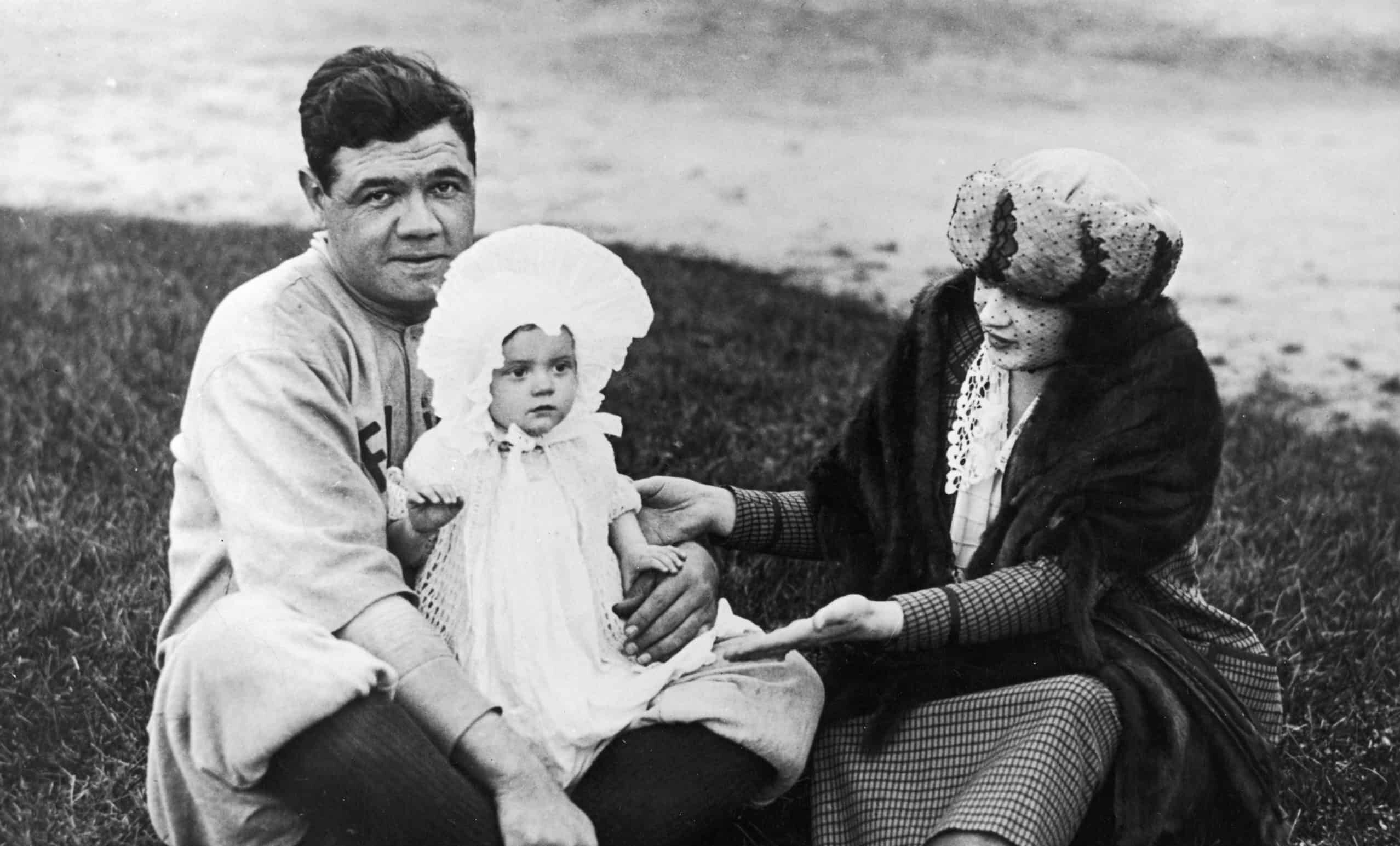
Long before the later stories about his marriages and personal life, Ruth posed with his first wife, Helen Woodford, and their daughter Dorothy. The family photograph captures a quieter version of a man who was already well on his way to becoming a national celebrity. Ruth married Helen in 1914, and the couple raised Dorothy, who was presented publicly as their adopted daughter. Their home life was considerably more complicated than the warm picture might suggest, and Ruth’s demanding schedule and turbulent personal life took a toll on the marriage.
Ruth and Helen separated during the 1920s. She died in a house fire in January 1929, and he married Claire Hodgson later that year. Ruth subsequently adopted Claire’s daughter Julia, while Claire adopted Dorothy. Decades later, Dorothy said that Ruth was actually her biological father and that her birth mother was Juanita Jennings. Those details matter because they explain why the old description of the family as a simple adoption story is incomplete. The photograph remains a portrait of Helen, Dorothy, and Babe – not Ruth’s second family.
The Day Babe Ruth Rode a Bull

If someone dared Babe Ruth to do something ridiculous in front of a crowd, there was a pretty good chance he would at least consider it. On November 9, 1922, he visited an estate in Harrington Park, New Jersey, where lawyer John M. Kelley had challenged circus performer May Wirth to ride an ill-tempered Holstein bull named King Jess. Wirth managed the ride, and several other guests were coaxed into giving it a try. Ruth was among them, which is how this gloriously improbable photograph came to exist.
He is pictured sitting astride the animal, lifting his hat as if he had just finished a parade rather than mounted a notoriously difficult bull. That sight is entertaining enough without embellishment. The original article claimed Ruth personally placed a winning wager on Wirth, but the surviving photo caption does not establish that detail. What it does establish is that the Babe really did climb aboard King Jess. It’s one more reminder that the world’s biggest baseball star was rarely content to be just a spectator.
The Blood Transfusion That Helped His Daughter

One of the most remarkable Babe Ruth photographs has nothing to do with sports. In August 1938, his adopted daughter Julia was seriously ill in a New York hospital. Ruth, then working as a coach for the Brooklyn Dodgers, left Ebbets Field to donate blood after doctors determined he was a compatible donor. A contemporary New York Times report, later cited by the Society for American Baseball Research, said he gave Julia 500 cubic centimeters of blood at the Manhattan Eye, Ear and Throat Hospital.
Years later, Julia remembered lying on a gurney beside her father during the transfusion. She had suffered a serious throat infection, and the treatment became one of her most enduring memories of him. Ruth could be a complicated public figure, but Julia spoke warmly and repeatedly about how he treated her as his daughter in every sense. The hospital image captures a rare private moment that mattered far more to the family than anything that happened on a baseball diamond.
Babe Ruth, Movie Star

Babe Ruth did not stop drawing crowds when he stepped away from the batter’s box. He also made screen appearances, usually playing a recognizable version of himself. This photograph comes from the 1942 film ‘The Pride of the Yankees,’ the Hollywood story of his former teammate Lou Gehrig. Gary Cooper played Gehrig, while Ruth appeared as Ruth. Having the real Babe on screen helped connect the dramatized story to the baseball world audiences remembered.
The film was a major production rather than a throwaway sports novelty. It received 11 Academy Award nominations and won one Oscar, for Film Editing. Ruth’s presence also carried emotional weight: Gehrig had died in 1941, and audiences were still mourning the first baseman who had played alongside the Yankees’ most famous slugger. Ruth had appeared in other movies and shorts, including the silent comedy ‘Speedy’ and ‘Home Run on the Keys,’ but this role is especially memorable because the relationship at its center was real.
The Celebrity Beyond the Pinstripes

Babe Ruth could put on a suit, step away from Yankee Stadium, and still have photographers chasing him. That was the reality of being one of America’s earliest sports superstars. By the 1920s, his face was familiar to people who might never have attended a baseball game. Advertisements, public appearances, newspaper stories, and carefully staged pictures helped build the legend. He did not need a uniform to look like the most famous man in the room.
There was a less glamorous side to that celebrity, too. Ruth had a reputation for extravagant nights, heavy eating, and drinking, and the demands of his lifestyle contributed to concerns about his conditioning in 1925. But reducing his entire life outside baseball to alcohol misses the point of these pictures. He was also a family man, a hobby farmer, an eager participant in publicity stunts, and someone who seemed to enjoy meeting people almost as much as they enjoyed meeting him. The public Babe was larger than life; the private one was considerably harder to summarize.
A Final Farewell to the Bambino

The last photograph captures a far more solemn moment: Babe Ruth’s funeral in New York City on August 19, 1948. His casket is being carried from St. Patrick’s Cathedral as dignitaries, including New York Mayor William O’Dwyer and Governor Thomas E. Dewey, pay their respects. Ruth had died three days earlier, on August 16, at age 53 after a battle with cancer of the nasopharynx, a region behind the nose and above the throat. Calling it simply ‘throat cancer’ is understandable shorthand, but it misses that medical distinction.
Before the funeral, huge crowds lined up to honor him at Yankee Stadium, where his body lay in state. Ruth was later buried at Gate of Heaven Cemetery in Hawthorne, New York. He left behind 714 regular-season home runs, seven World Series championships, and an impact on the sport that is difficult to overstate. But the images collected here suggest why his celebrity survived so long: America followed Babe Ruth through far more than home runs. Even the ordinary moments somehow became part of the legend.