
New York Yankees - Heritage Auctions / Public Domain / Wikimedia Commons

Jay Publishing via tradingcarddb.com, Public domain, via Wikimedia Commons

Hulton Archive / Getty Images

Michael Ochs Archives / Michael Ochs Archives via Getty Images
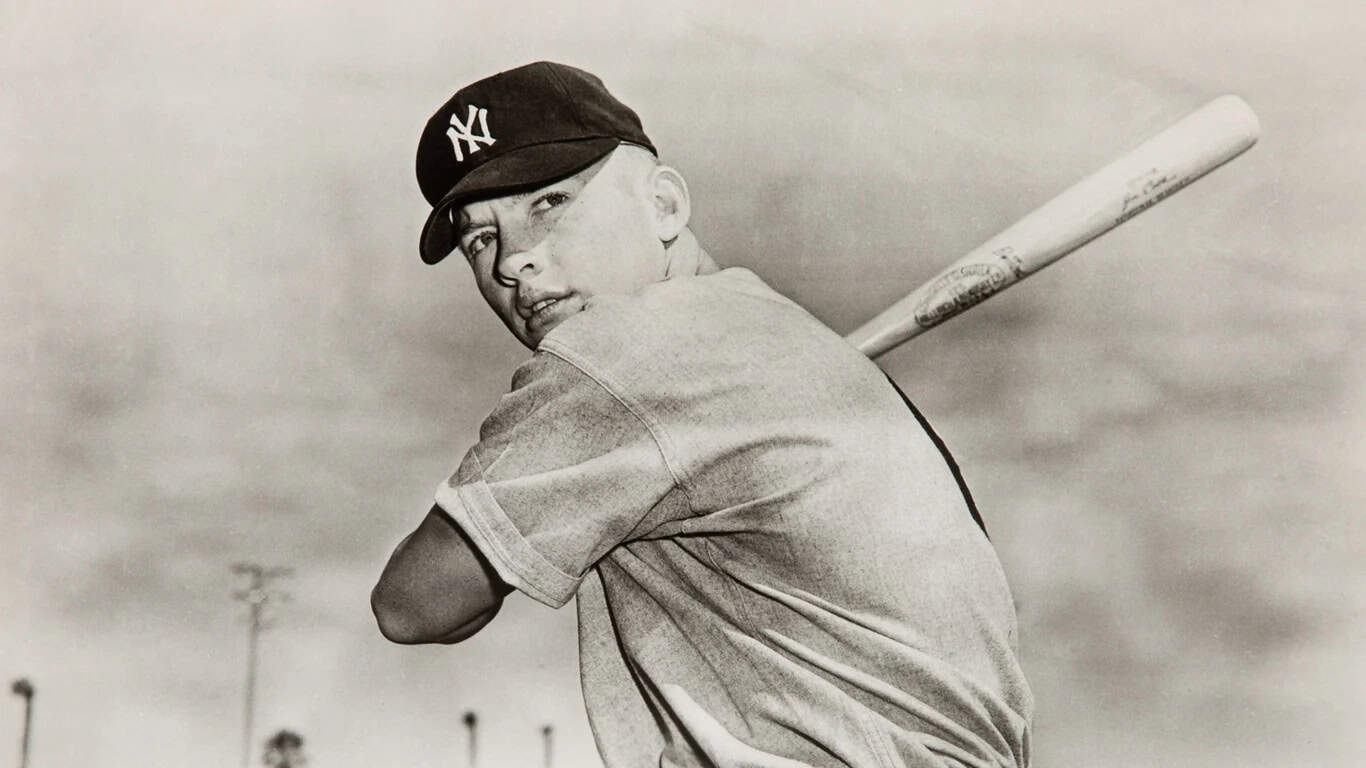
New York Yankees - Heritage Auctions / Public Domain / Wikimedia Commons

Michael Ochs Archives / Michael Ochs Archives via Getty Images

Hulton Archive / Archive Photos via Getty Images

Hulton Archive / Archive Photos via Getty Images

Hulton Archive / Archive Photos via Getty Images

Getty Images / Archive Photos via Getty Images

Public Domain / Wikimedia Commons

Hulton Archive / Archive Photos via Getty Images

Getty Images / Getty Images Sport via Getty Images

Getty Images / Hulton Archive via Getty Images

Pictorial Parade / Moviepix via Getty Images

Getty Images / Archive Photos via Getty Images

Getty Images / Archive Photos via Getty Images


16 Mickey Mantle Quotes That Still Hit Home
Few baseball names carry quite as much weight as Mickey Mantle. The New York Yankees legend spent his entire 18-year major league career in pinstripes from 1951 through 1968, playing through an era when the Yankees seemed to treat the World Series like an annual appointment.
Mantle finished with 2,415 hits, 536 home runs, 1,509 RBIs and a .298 career batting average. The switch-hitting center fielder won three American League MVP awards, captured the Triple Crown in 1956, earned 20 All-Star selections and helped the Yankees win seven World Series championships. His 18 World Series home runs remain the most by any player in Fall Classic history.
Those numbers explain why Mantle became a legend. His words help explain the person behind them. He could be funny, remarkably self-deprecating and surprisingly candid about the game that consumed most of his life. These 16 Mickey Mantle quotes capture a little of all three.
"All I had was natural ability."
Calling Mantle naturally talented is putting it mildly. He combined power, speed and the rare ability to hit from both sides of the plate, eventually becoming one of baseball's greatest switch-hitters. The funny part is how often Mantle talked about those gifts as though he had simply lucked into them. Coming from a three-time MVP and Hall of Famer, "all I had was natural ability" is some world-class understatement.
"It was all I lived for, to play baseball."
Baseball was part of Mantle's life from childhood. His father and grandfather helped teach him to switch-hit, giving the future Yankee practice from opposite sides of the plate. By 19, Mantle was in the major leagues. He would never play for another MLB team. Considering that baseball eventually carried him from small-town Oklahoma to Yankee Stadium and Cooperstown, this quote does not sound like much of an exaggeration.
"Somebody once asked me if I ever went up to the plate trying to hit a home run. I said, 'Sure, every time.'"
At least he was honest about it. Mantle finished with 536 career home runs and led the American League in homers four times. His biggest season came in 1961, when he hit 54 while teammate Roger Maris chased and eventually broke Babe Ruth's single-season record with 61. Plenty of hitters preach about simply making good contact. Mantle apparently walked to the plate with a slightly more ambitious plan.
"Hitting the ball was easy. Running around the bases was the tough part."
For Mantle, this was more than a punchline. Injuries followed him throughout his career, particularly problems involving his legs, yet he still played 18 seasons and appeared in more than 2,400 games. His ability to keep producing despite those physical problems became a major part of his legend. Hitting a baseball may not have actually been easy, but with 536 home runs and a career .977 OPS, Mantle occasionally made it look that way.
"If I knew I'd live this long, I would have taken better care of myself."
This line became closely associated with Mantle later in his life, although versions of the joke existed before he used it. A 1978 news account quoted Mantle making a similar remark while reflecting on getting older. It fit the self-deprecating style that made so many of his quotes memorable. Mantle rarely presented himself as the flawless sports hero that fans might have imagined from watching him patrol center field at Yankee Stadium.
"After I hit a home run I had a habit of running the bases with my head down. I figured the pitcher already felt bad enough without me showing him up rounding the bases."
Baseball's unwritten rules have changed quite a bit since Mantle's era, but this quote captures the style expected from many stars of his generation. Mantle did not need much extra celebration to make a home run noticeable. The ball leaving Yankee Stadium in a hurry usually handled that part. His explanation also shows the empathy and modesty that teammates and opponents frequently associated with him.
"All the ballparks and the big crowds have a certain mystique."
Mantle went on to describe feeling permanently connected to the sounds of the stadium and fans chanting his name, even on lightly attended afternoons. Few players had a better opportunity to experience that connection. He spent his entire career with the Yankees and played home games at the original Yankee Stadium, one of the sport's most famous stages. By the time he retired, generations of fans simply knew him as "The Mick."
"In 1960 when Pittsburgh beat us in the World Series, we outscored them 55-27."
That number sounds almost impossible, but Mantle remembered it correctly. The Yankees outscored the Pittsburgh Pirates 55-27 in the 1960 World Series and still lost the series four games to three. New York's three victories were blowouts, while Pittsburgh won the closer contests. Bill Mazeroski finally ended Game 7 with a walk-off home run in the bottom of the ninth. Mantle later said he believed the better team had lost and remembered being devastated by the result.
"When you reach the major leagues, it's unbelievable how much you don't know about the game you've been playing all your life."
Mantle included this observation in his 1964 book, The Quality of Courage. It is a pretty good reminder that reaching the highest level of a sport does not mean there is nothing left to learn. Mantle had been playing baseball since childhood and reached the Yankees at 19, yet more than a decade into his career he was still talking about how much deeper the game became at the major league level.
"Sometimes I think if I had the same body and the same natural ability and someone else's brain, who knows how good a player I might have been."
There is Mickey Mantle's self-deprecation again. The player wondering how good he might have been already owned three MVP awards, a Triple Crown, seven championship rings and more than 500 home runs. It also hints at one of the great baseball "what ifs." Mantle accomplished all of that despite a career repeatedly interrupted by injuries. Apparently being Mickey Mantle was still not enough to stop Mickey Mantle from wondering whether he could have been better.
"I don't care who you are, you hear those boos."
Playing for the Yankees came with enormous advantages, but New York fans were not exactly famous for quietly accepting a slump. Even Mantle heard boos during his career. Baseball Almanac traces this quote to a 1969 issue of Look magazine, after Mantle's playing days had ended. For someone remembered as one of the most beloved Yankees ever, it is an interesting reminder that legendary status usually looks considerably smoother in hindsight.
"The only thing I can do is play baseball. I have to play ball. It's the only thing I know."
For athletes who reach the majors as teenagers, baseball can stop feeling like a job and start feeling like their entire identity. Mantle debuted for the Yankees at 19 and remained with the organization throughout his major league career. That made retirement particularly difficult. When he finally announced it before the 1969 season, Mantle was leaving the game that had structured virtually his entire adult life.
"To play eighteen years in Yankee Stadium is the best thing that could ever happen to a ballplayer."
Mantle said this during Mickey Mantle Day at Yankee Stadium on June 8, 1969. The Yankees retired his No. 7 during the ceremony, placing him alongside Babe Ruth, Lou Gehrig and Joe DiMaggio among the franchise icons whose numbers had already been retired. Mantle had arrived in New York as a teenager in 1951. Eighteen seasons, seven championships and one Hall of Fame career later, his affection for the place was not especially difficult to understand.
"Baseball was my whole life. Nothing's ever been as fun as baseball."
Mantle made this observation years after retirement, in a quote published by The New York Times in 1988. By then, his playing career had been over for nearly two decades, but baseball was still the thing against which everything else was measured. That seems fitting for someone who reached the Yankees at 19 and spent 18 seasons playing center field for the most successful franchise of his era.
"Now I think I know how Lou Gehrig felt."
Mantle invoked another Yankees legend during Mickey Mantle Day in 1969. He reflected on Lou Gehrig's famous 1939 farewell, when Gehrig called himself "the luckiest man on the face of the earth" despite facing a devastating illness. Standing before his own enormous Yankee Stadium ovation three decades later, Mantle said he finally understood how Gehrig could feel fortunate in such an emotional moment. It was one Yankees icon paying tribute to another.
"When I hit a home run I usually didn't care where it went. So long as it was a home run was all that mattered."
Mantle had plenty of opportunities to test that philosophy. He hit 536 major league home runs, including 372 from the left side of the plate and 164 from the right. Eighteen of those homers came in the World Series, still the most in Fall Classic history. Fans could debate distance, direction and which side of the plate produced the prettier swing. Mantle's standard was considerably simpler: if the ball cleared the fence, mission accomplished.