
Bojtos Gabriella / Shutterstock.com

Marco Frino Fotografo / Shutterstock.com
Parilov / Shutterstock.com

costas anton dumitrescu/Shutterstock

English: NPS, Public domain, via Wikimedia Commons

Nick Brundle Photography / Shutterstock.com

No machine-readable author provided. Marsyas assumed (based on copyright claims)., CC BY-SA 3.0 , via Wikimedia Commons

ibrahimhalil / Shutterstock.com

Lakeview Images / Shutterstock.com

Munimara / Shutterstock.com

Claudio Caridi / Shutterstock.com

zaferkizilkaya / Shutterstock.com

Andreas Wolochow / Shutterstock.com
Bojtos Gabriella / Shutterstock.com

Alzay / Shutterstock.com




14 Archaeological Discoveries That Changed What We Know About the Past
Every once in a while, archaeology turns up something that completely changes how we picture the past. A buried city can preserve the final moments of everyday life. A shipwreck can reveal an ancient international trade network. A few footprints in dried mud can push the known human history of an entire continent back thousands of years.
Some of these discoveries happened almost by accident. Others took decades of excavation and research before archaeologists understood what they were looking at. And in a few cases, the sites were never truly "lost" at all, even if the wider world only learned their significance much later.
From an underground city beneath modern Türkiye to an ancient Greek machine that looks centuries ahead of its time, these 14 discoveries gave us extraordinary new windows into the people who came before us.
Pompeii: A Roman City Buried by Vesuvius
When Mount Vesuvius erupted in 79 CE, Pompeii disappeared beneath layers of pumice, ash, and other volcanic debris. That disaster ultimately preserved an extraordinary snapshot of Roman life, including houses, shops, baths, wall paintings, graffiti, streets, and everyday objects. The famous human figures associated with Pompeii are not intact preserved bodies. As victims decomposed, cavities remained in hardened volcanic material, and archaeologists later filled some of those spaces with plaster to create casts of their final positions. Excavation has been underway in one form or another since the 18th century, and Pompeii is still producing new discoveries today.
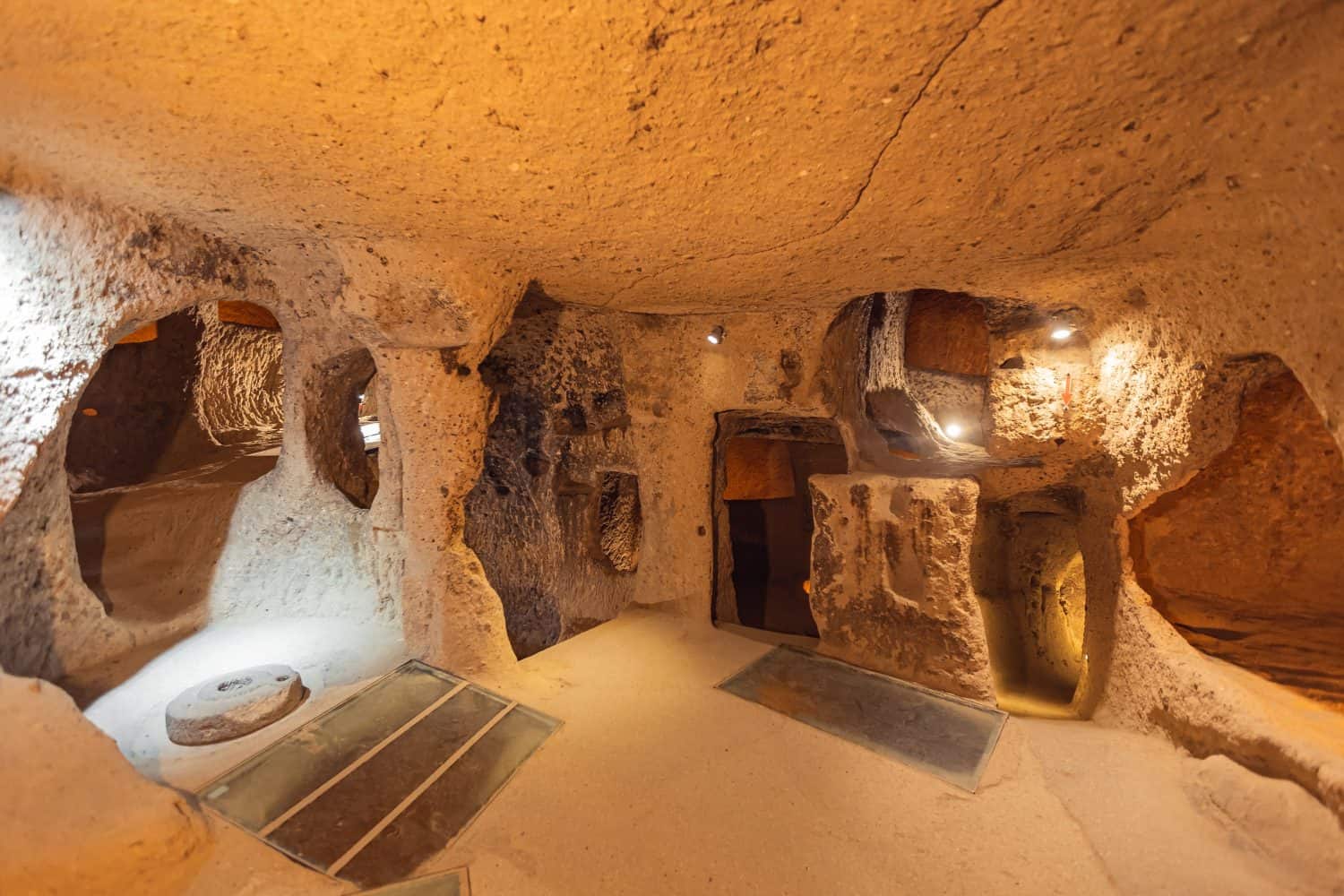
Derinkuyu: An Entire City Hidden Underground
Derinkuyu makes the phrase "underground city" surprisingly literal. Carved into the volcanic rock of Cappadocia in modern Türkiye, the sprawling complex descends roughly 280 feet and contains tunnels, rooms, storage areas, stables, wells, churches, and massive stone doors that could seal passages from the inside. A widely repeated account says the site returned to modern attention in 1963 when a local resident uncovered a passage while renovating his home. Exactly when the complex was first created remains debated, but it was expanded and used over many centuries, including as a refuge during periods of conflict.
The Terracotta Army: Thousands of Soldiers Guarding an Emperor
In 1974, people digging near Xi'an, China, uncovered fragments that led archaeologists to one of the most spectacular burial complexes ever found. Thousands of life-size terracotta warriors, along with horses and chariots, had been placed near the mausoleum of Qin Shi Huang, the ruler who unified China and became its first emperor in 221 BCE. Estimates put the army at roughly 8,000 soldiers, and no two faces appear exactly alike. Even more remarkable, the emperor's central burial mound has not been fully excavated, which means one of archaeology's most famous sites may still be hiding some of its biggest secrets.
White Sands Footprints: Humans in America 23,000 Years Ago
Fossilized footprints at White Sands National Park in New Mexico have become some of the most important evidence in the debate over when humans reached the Americas. Research published in 2021 dated some tracks to roughly 21,000 to 23,000 years ago, and later studies using additional dating methods supported that surprisingly early age. Other trackways at White Sands preserve almost personal moments from the Ice Age. One nearly mile-long set appears to show an adult or adolescent carrying a toddler, occasionally putting the child down before continuing through the muddy landscape.
King Tut's Tomb: More Than 5,000 Objects Behind a Sealed Door
Howard Carter had spent years searching Egypt's Valley of the Kings when workers uncovered the top of a buried staircase on Nov. 4, 1922. What lay beyond it became the archaeological discovery of a lifetime: the largely intact tomb of Tutankhamun. The young pharaoh had not been one of Egypt's most powerful rulers, but his tomb survived with an extraordinary collection of furniture, jewelry, statues, chariots, weapons, clothing, and other burial goods. More than 5,000 objects were documented, giving historians an unparalleled look at royal life and burial practices in ancient Egypt.
The Antikythera Mechanism: An Ancient Machine Ahead of Its Time
Greek sponge divers located an ancient shipwreck near the island of Antikythera in 1900, and recovery work soon brought up statues, jewelry, pottery, and a corroded lump that initially did not look nearly as impressive. In 1902, researchers noticed gears inside that object. The device we now call the Antikythera Mechanism was an extraordinarily sophisticated astronomical calculator built more than 2,000 years ago. Its interlocking bronze gears modeled celestial cycles and could help predict events such as eclipses. Nothing else quite like it survives from the ancient world.
Göbekli Tepe: Monumental Stonework Before Cities
Göbekli Tepe changed the conversation about what hunter-gatherer societies were capable of building. Located in southeastern Türkiye, the site contains enormous carved T-shaped pillars arranged in monumental structures dating to roughly 9600 to 8200 BCE. Archaeologists surveyed the hill in the 1960s but did not recognize its true importance. Klaus Schmidt and colleagues rediscovered it in 1994, with excavations beginning the following year. The site is older than Stonehenge by thousands of years and was constructed before pottery and large settled cities became common in the region.
The Dead Sea Scrolls: Ancient Texts Hidden in Desert Caves
The first Dead Sea Scrolls came to light in 1947, when ancient manuscripts were found in a cave near Qumran by the Dead Sea. Searches over the following years uncovered manuscripts and fragments in ten additional Qumran caves. The collection represents more than 900 texts dating from roughly the third century BCE through the first century CE. Most were written in Hebrew, with many in Aramaic and others in Greek, plus a small number of fragments in additional languages. Among them are some of the oldest surviving copies of books that later became part of the Hebrew Bible.
Altamira: Cave Paintings Experts Once Refused to Believe
The cave of Altamira in northern Spain was known locally by 1868, but its most important secret was still overhead. In 1879, María Sanz de Sautuola accompanied her father Marcelino into the cave and became the first person known to recognize the animal figures covering its ceiling. Marcelino argued that the paintings were prehistoric, but many scholars initially rejected the idea that Paleolithic people could have produced art that sophisticated. Later discoveries proved him right. Altamira contains paintings and engravings created across thousands of years, some dating back more than 35,000 years.
The Rosetta Stone: The Find That Helped Unlock Hieroglyphs
French soldiers working on a fort near the Egyptian town of Rosetta uncovered this famous stone in 1799. Created in 196 BCE, it carries the same official decree in three writing systems: Egyptian hieroglyphs, Egyptian Demotic script, and ancient Greek. Because scholars could already read Greek, the stone gave them an extraordinary tool for working out how the Egyptian scripts functioned. Jean-François Champollion's breakthroughs in the early 19th century helped transform hieroglyphs from mysterious symbols into readable records of ancient Egyptian history.
Uluburun: A Bronze Age Shipwreck Packed With Ancient Trade Goods
A Turkish sponge diver spotted strange metal objects off the coast near Kaş in 1982. They turned out to be cargo from a ship that sank around 1320 BCE. Archaeologists spent 11 field seasons excavating the Uluburun wreck between 1984 and 1994, logging more than 22,000 dives. The ship carried about 10 tons of copper along with tin, glass ingots, pottery, resin, jewelry, ivory, and other luxury goods. That remarkable mix gave researchers direct evidence of the long-distance trade networks linking different parts of the Bronze Age Mediterranean and Near East.
Tikal: A Maya City Rising Out of the Jungle
Tikal was one of the great cities of the ancient Maya world, with monumental temples, palaces, plazas, roads, reservoirs, and residential neighborhoods spread through what is now northern Guatemala. A documented Guatemalan expedition led by Modesto Méndez and Ambrosio Tut brought the ruins wider attention in 1848. Much larger archaeological work came later. The University of Pennsylvania launched an ambitious excavation and mapping project in 1956 that continued for years. Today, Tikal is protected as both a cultural and natural UNESCO World Heritage Site.
Petra: A City Carved Into the Desert Rock
Petra was never simply a forgotten ruin waiting for Europeans to stumble across it. Local Bedouin communities knew the site for generations, while Swiss traveler Johann Ludwig Burckhardt brought Petra renewed attention in Europe after visiting in 1812. The Nabataeans developed the city into a major trading center between Arabia, Egypt, Syria, and the Mediterranean world. Its most famous monuments were carved directly into red sandstone cliffs, but Petra was much more than spectacular facades. An ingenious system of channels, dams, cisterns, and reservoirs helped sustain a major city in an extremely dry landscape.
Stonehenge: A Monument Built and Rebuilt Over Centuries
Stonehenge was not built in one burst of ancient engineering. The first major earthwork appeared around 3000 BCE, while the famous large sarsen stones were raised around 2500 BCE. The monument continued to change for centuries afterward. Some of the largest stones weigh roughly 25 tons, while smaller bluestones were transported from Wales, more than 150 miles away. Exactly why generations of people invested so much effort here is still debated, but burial, ceremony, astronomy, and seasonal gatherings all appear to have played roles in the wider Stonehenge landscape.