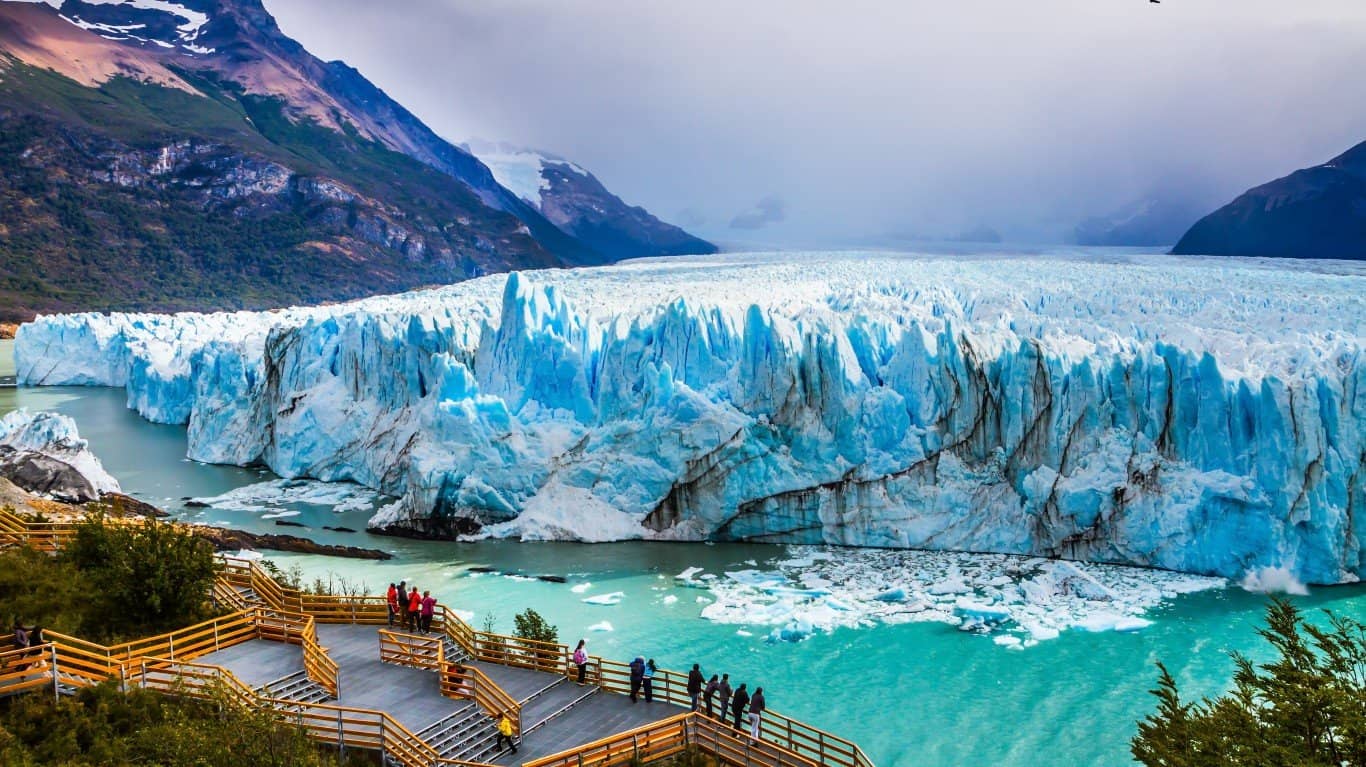
Glaciers are one of Earth’s most awe-inspiring landscapes. These powerful forces of nature have carved valleys, shaped coastlines, and stored vast amounts of the planet’s freshwater. These massive blocks of ice have existed for thousands of years, but in recent decades, they have been changing at a rapid pace. Advances in photography and satellite imagery now allow us to clearly see these transformations.
Before-and-after images of these stunning glaciers reveal more than just melting ice; they tell of altered climates, warming temperatures, and fragile ecosystems. These photographs show dramatic changes in glacial environments and how fast they can evolve within a single generation. This article shows breathtaking photographic comparisons that highlight environmental change.
To compile a list of breathtaking before-and-after images of glacial transformations, 24/7 Tempo reviewed images of glaciers compiled by NOAA and published on their Climate.gov website. To ensure we understood the implications of the images, we researched the loss of glacier mass and looked at statistics and studies around this loss to determine the cause of the problem as scientists currently understand it. We then studied the history of the glaciers mentioned to gain a full understanding of the glaciers themselves.
Pedersen Glacier
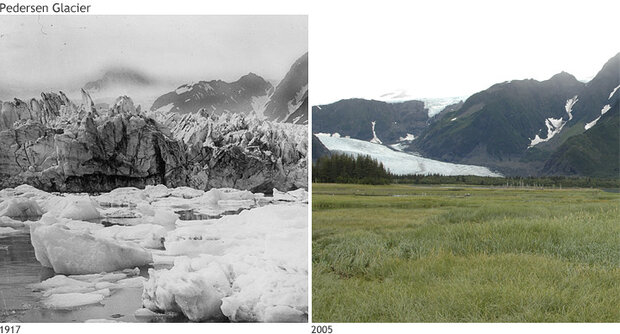
The Pedersen Glacier is in the Kenai Fjords National Park in Alaska. The park encompasses the glacier, Pedersen Lagoon, and Pedersen Spit. It is a 1,700-acre nature sanctuary where visitors can enjoy and see the beautiful sights. In the 20th century, the Pedersen Glacier was quite large.
The ice formations of the glacier reached the edge of the lake and obscured Pedersen Spit from the naked eye entirely. However, in modern days, the glacier has retreated greatly. The area around the lake is no longer a frozen wonderland. Instead, the glacier has melted into the lake, and the ice no longer reaches the edge. The area around the glacier was once frosted over.
It is now habitable to plant life that would have previously died if it tried to grow there. The retreat glacier revealed the sedimentary rock underneath the frost, and the park is now home to a small grassland. The national park is still taking visitors. Potential visitors have many options for how they can get to the park. It is open to foot traffic, but visitors can also see the park by cruise.
Muir Glacier

The Muir Glacier is in southeastern Alaska in the Glacier Bay National Park and Preserve. It is named after the Scottish explorer John Muir, who traveled around the area and wrote about the glacier, generating early interest in the location. His first two visits to the glacier were in 1879, and he wrote about the experience in the San Francisco Bulletin.
He would later collect these writings and create a compendium out of them known as Travels in Alaska. The book was published in 1915, one year after he died. Muir Glacier’s retreat has been rapid and well-documented throughout the years. It reached its maximum mass during the Little Ice Age in the late 1700s. In 1794, explorer Captain George Vancouver documented the size of the glacier.
At the time, a sheet of ice covered most of Glacier Bay. He documented the size of the ice sheet as being over 3,900 feet in size. Since then, the glacier has retreated significantly. From 1892 to 1980, the glacier retreated over 20 miles, losing a large amount of its mass. Between 1941 and 2004, the glacier retreated 7.5 miles and became 800 feet thinner.
The retreat of the glacier caused ocean water to flood the valley it is located in. The ocean water has replaced much of the ice that was once there and created the Muir Inlet.
Careser Glacier

The Giacchio del Careser in Italy is another well-documented glacier. It is an alpine glacier in the Ortles-Cevedale Group, a mountain in the Southern Rhaetian Alps in Northern Italy. The glacier’s water forms an artificial lake known as the Lake of Careser. The lake is used to provide energy using the Malga Mare plant located in the area. The glacier has experienced rapid decay and is retreating very quickly.
Careser Glacier is unique in that it is exceptionally well documented. It is one of the most well-documented glaciers in Italy. Scientists have observed a mass loss of 1.5 meters of water per year until the most recent years, when that rate increased to 2 meters per year. It doesn’t sound like a lot of water until you realize how big a glacier is.
Losing that much water from such a large ice structure causes significant changes to the geometry of the structure. At the moment, the Careser Glacier is “off-balance.” Scientists estimate that if the glacier continues to retreat at the rate it is at the moment, it will disappear entirely within a few decades.