Hulton Archive / Getty Images

Thomas Dutour/ Shutterstock

Miguel AF/ Shutterstock

Vadym Lavra/ Shutterstock

Christopher Wood/ Shutterstock

Rawpixel.com / Shutterstock

Maxx-Studio / Shutterstock

Svet foto / Shutterstock.com

fizkes / Shutterstock.com

Creatas Images / Getty Images

Wally Stemberger/ Shutterstock

jacoblund / Getty Images
Billion Photos/ Shutterstock

phloxii/ Shutterstock

BublikHaus/ Shutterstock

George Sheldon/ Shutterstock

Adam Parent/ Shutterstock

In Green/ Shutterstock

Azlan Stock/ Shutterstock




9 American Flag Trivia Questions, Answered
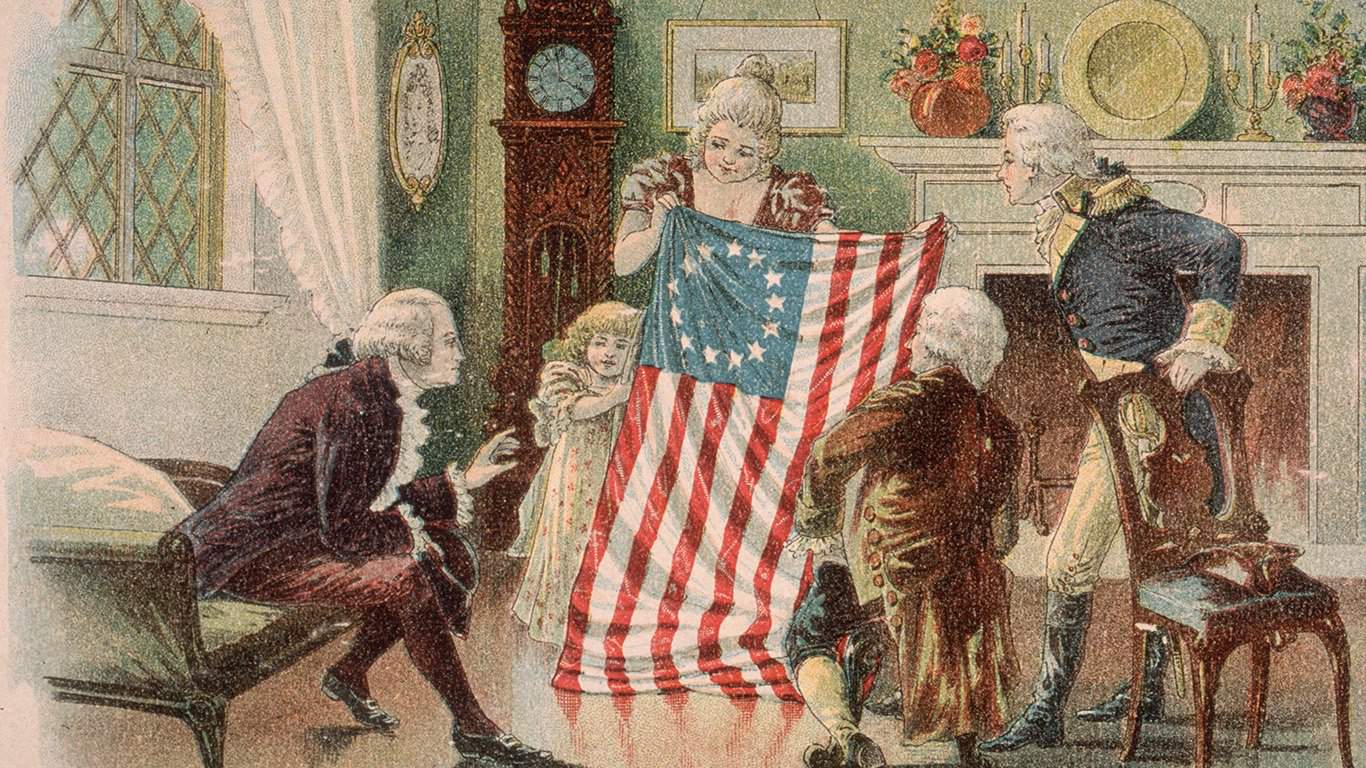
Most Americans can recognize the Stars and Stripes without giving it a second thought. It's on everything from government buildings and military uniforms to baseball stadiums and neighborhood front porches. But how much do you actually know about the American flag? There's considerably more to its history than the familiar story of Betsy Ross sitting at a sewing machine.
Over the last 250 years, the American flag has changed as the country has grown, inspired a few unusual traditions, and accumulated its fair share of misconceptions. Some of the things we're taught about flag etiquette aren't quite accurate, and a few details about its history might surprise even people who proudly display one every day.
We've put together nine American flag trivia questions covering its history, design, and proper display. Each question has its own slide, followed by an explanation of the answer. See how many you can get right before moving on to the next slide.
Who Designed the First American Flag?
Ask almost anyone who designed the first American flag, and there's a pretty good chance you'll hear the same name. It's a story that has appeared in history books, school lessons, and patriotic celebrations for generations.
But the flag's origins are a little more complicated than the familiar legend suggests. Before the Stars and Stripes became the country's official flag in 1777, American forces had already used several different banners during the Revolutionary War. So, do historians actually know who designed the first official American flag?
Answer: Nobody Knows for Certain
If you answered Betsy Ross, you're certainly not alone. Unfortunately, historians haven't found convincing contemporary evidence that she designed or sewed the first official Stars and Stripes. The famous story didn't become widely known until 1870, when her grandson publicly shared an account passed down through the family.
Another name sometimes associated with early American flags is Margaret Manney, a Philadelphia flag maker whose work has been linked to the Grand Union Flag. That earlier banner featured 13 stripes but retained the British Union flag in its upper corner. However, claims that Manney designed it also remain uncertain.
What we do know is that the Continental Congress adopted the Stars and Stripes on June 14, 1777, specifying 13 alternating red and white stripes and 13 stars on a blue field. The resolution didn't identify a designer or establish the exact arrangement of the stars. As the Colonial Williamsburg Foundation explains, the identity of the original designer remains unknown. Sometimes history simply doesn't give us a definitive answer.
Which Arctic Explorer Left Part of an American Flag in the Ice?
The American flag has traveled to some extraordinary places over the centuries, including mountain summits, battlefields, and eventually the surface of the moon. But one of its more unusual journeys took place during an expedition through the Arctic in the early 20th century.
During an attempt to reach the North Pole, an American explorer carried a flag that had accompanied him on earlier adventures. According to accounts of the expedition, he eventually removed a portion of that flag and left it in the Arctic ice alongside a written record of his journey.
Who was the explorer responsible for this unusual piece of American flag history?
Answer: Robert E. Peary
In April 1909, American explorer Robert E. Peary and his expedition reported reaching the geographic North Pole. Accompanying Peary were explorer Matthew Henson and four Inuit men, Ootah, Egigingwah, Seegloo, and Ooqueah, whose experience in the Arctic was essential to the expedition.
According to accounts of the journey, Peary planted an American flag at the location he believed was the North Pole. He also removed a diagonal strip from the flag and placed it in a container with a written declaration, leaving it in the ice as a record of the expedition.
There's an important distinction here, though. Peary's claim to have reached the exact geographic North Pole remains disputed. Later examinations of his navigational records raised questions about whether the expedition actually reached its destination. The U.S. Capitol Visitor Center notes that Peary was honored for his Arctic achievements even though his precise location couldn't be conclusively established. The story about the flag is documented, but the original claim that he was the only person ever celebrated for cutting one is not something historians can reliably establish.
Which High School Student Designed a 50-Star American Flag?
When Alaska and Hawaii were preparing to become the 49th and 50th states, the United States needed to update its flag. That meant finding a way to arrange 50 stars inside the familiar blue field while keeping the design recognizable.
Thousands of Americans submitted ideas, ranging from professional designs to drawings created by schoolchildren. One particularly famous submission came from a teenager who decided to make a new American flag for a school assignment.
The student didn't exactly receive the grade he was hoping for, but his design would eventually become part of a remarkable story in American flag history. Do you know his name?
Answer: Robert G. Heft
In 1958, Robert G. Heft was a high school student in Lancaster, Ohio, when he created a 50-star American flag as a class project. He arranged the stars in a pattern of alternating rows and submitted his work to his teacher, Stanley Pratt.
Unfortunately for Heft, his teacher wasn't particularly impressed and gave him a B-minus. According to the story preserved by the Library of Congress, Pratt agreed to improve the grade if Heft could get his design accepted by the government. With assistance from Congressman Walter Moeller, Heft submitted the design for consideration.
Heft is widely credited for creating an arrangement matching the eventual 50-star flag. However, the official design was selected through a broader government process involving thousands of submissions and a committee established during President Dwight D. Eisenhower's administration. Eisenhower formally established the new design in August 1959, and it became official on July 4, 1960. As for Heft's grade? His teacher reportedly changed it to an A. That's a pretty satisfying outcome for a school project that initially received less-than-enthusiastic reviews.
What Do You Call Someone Who Studies Flags?
There are people who dedicate their lives to studying just about everything imaginable, from ancient coins and postage stamps to languages most of us have never heard of. And yes, there are even people who specialize in studying flags.
It's actually a fascinating subject when you think about it. A flag might represent an entire country, a state, a military unit, or a political movement. Its colors and symbols can reveal quite a bit about the people and history behind it.
So, what's the proper term for someone who studies flags, their designs, and their historical significance?
Answer: A Vexillologist
Someone who studies flags is called a vexillologist, and the study of flags is known as vexillology. The word comes from the Latin term vexillum, which referred to a type of military standard used in ancient Rome.
Vexillologists study everything from the origins of national flags to the meanings behind their colors, symbols, and designs. Some focus on historical flags, while others examine how flags are created and used in modern society.
There are even organizations dedicated to the subject, including the North American Vexillological Association, which promotes the study and design of flags. Not everyone who studies flags does it professionally, either. For many people, it's simply an interesting hobby that combines history, art, geography, and a little bit of politics. The next time someone asks what you know about vexillology, you'll at least have a pretty good place to start. Whether you'll be able to pronounce it correctly on the first try is another matter entirely.
Has the American Flag Always Had 13 Stripes?
Everyone knows the modern American flag has 50 stars representing the country's 50 states. But the 13 red and white stripes have an entirely different meaning. They represent the original 13 British colonies that declared their independence and became the foundation of the United States.
Unlike the number of stars, which increased as new states joined the Union, the stripes have remained unchanged for most of the country's history.
However, there was a period when the government experimented with a different arrangement. Can you remember whether the flag has always had exactly 13 stripes?
Answer: No. It Once Had 15 Stripes
Between 1795 and 1818, the official American flag featured 15 stars and 15 stripes. The additional stars and stripes represented Vermont and Kentucky, which had joined the Union after the original 13 states.
That design was famously flying above Fort McHenry during the British bombardment of Baltimore in September 1814. The enormous 15-star, 15-stripe flag inspired Francis Scott Key to write the words that eventually became "The Star-Spangled Banner."
But as more states joined the country, adding another stripe for each one became increasingly impractical. In 1818, Congress passed legislation returning the flag to 13 stripes, permanently representing the original colonies, while continuing to add a star for each new state. The change became effective on July 4, 1818. Today, the actual flag that flew over Fort McHenry is preserved at the Smithsonian's National Museum of American History. It's one of the most important surviving artifacts associated with the American flag's history, and one of the few that looks noticeably different from the version we're accustomed to seeing today.
When Does a New Star Officially Appear on the American Flag?
The last time the United States added a new state was in 1959, when Alaska and Hawaii joined the Union. Those additions brought the country's total number of states to 50, giving us the familiar flag that's flown ever since.
But here's something you might not know. A new star doesn't necessarily appear on the flag the same day a state officially joins the country.
Federal law establishes a specific date when additional stars become part of the official design. And despite how rarely the flag changes these days, that rule is still in place. Do you know which day of the year a newly updated American flag officially takes effect?
Answer: July 4
Under Title 4, Section 2 of the United States Code, a new star is added to the American flag when another state joins the Union. However, that addition doesn't officially take effect until the following July 4.
That means a state can join the country months before its star officially appears on the national flag. When Alaska became the 49th state on January 3, 1959, the 49-star flag didn't become official until July 4 of that year. Hawaii then joined the Union on August 21, 1959, bringing the total to 50 states. The current 50-star design officially took effect on July 4, 1960.
The tradition creates a connection between the country's founding and its continuing expansion. It's also a rule that hasn't needed to be used in more than six decades. If another state eventually joins the Union, we'll see the same process play out again, with a new flag becoming official on Independence Day.
What Date Is Flag Day Celebrated in the United States?
Most Americans are familiar with Independence Day, Memorial Day, and Veterans Day. But there's another patriotic observance dedicated specifically to the American flag itself.
Flag Day recognizes an important moment in the country's early history, when the Continental Congress officially established the Stars and Stripes as the national flag. The observance has been celebrated in various forms for generations, although it doesn't receive quite the same attention as some of the better-known national holidays.
It's also not a federal public holiday in the same way as Independence Day. So, can you remember which date Americans observe Flag Day each year?
Answer: June 14
Flag Day is celebrated every year on June 14, commemorating the Continental Congress's adoption of the Stars and Stripes on that date in 1777.
Although Americans had observed the anniversary in different ways throughout the 19th century, Flag Day didn't receive a presidential proclamation establishing a national observance until 1916, when President Woodrow Wilson recognized the occasion. In 1949, President Harry Truman signed legislation formally designating June 14 as Flag Day.
Today, Flag Day remains a national observance rather than a federal holiday requiring most government offices to close. Communities celebrate with flag-raising ceremonies, parades, educational events, and other patriotic activities. The day also falls during National Flag Week, when Americans are encouraged to display the flag at their homes and businesses.
It's a fitting opportunity to appreciate the history behind a symbol that has represented the country through wars, political changes, national celebrations, and countless other moments over nearly 250 years.
Can Private Citizens Fly the American Flag at Half-Staff?
You've probably seen American flags flying at half-staff following a national tragedy or the death of an important public figure. It's a longstanding tradition used to express mourning and respect.
When the president or a governor issues a half-staff proclamation, flags on affected government buildings are generally lowered according to the applicable rules.
But what about the flag flying outside your own house or a privately owned business? Do you need official authorization before lowering it to half-staff, or can you make that decision yourself?
Answer: Yes, Private Citizens Can Choose to Do So
Private individuals and businesses generally do not need a presidential or gubernatorial proclamation to fly their own American flags at half-staff. They may choose to lower the flag to honor someone who has died, mark a local tragedy, or express mourning for another reason.
Government facilities are a different matter. Federal and state rules establish specific circumstances in which official flags are lowered, including the deaths of certain public officials, military personnel, and first responders. The president and state governors have particular responsibilities and authorities under the Flag Code, and public agencies must follow their applicable procedures.
For anyone displaying a flag at half-staff, proper etiquette calls for raising it to the top of the pole briefly before lowering it to the halfway position. When taking it down, the flag should again be raised to the top before being lowered completely.
So, while following an official proclamation is certainly appropriate, Americans generally have the freedom to decide when to lower their own privately displayed flags. The Flag Code provides guidance on the proper way to do it.
Must an American Flag Be Destroyed if It Touches the Ground?
Here's one that's probably responsible for more than a few panicked moments during backyard flag-raising ceremonies.
Most of us were taught that the American flag should never touch the ground. That much is true under the traditional guidelines for properly handling and displaying it.
But somewhere along the way, another idea became popular: that a flag must immediately be destroyed if it accidentally touches the ground, even if it's otherwise in perfectly good condition.
Is that actually what the United States Flag Code requires, or is it another commonly repeated misconception?
Answer: No, You Don't Have to Destroy It
Despite what many of us learned growing up, accidentally dropping an American flag on the ground doesn't mean you have to destroy it.
The United States Flag Code states that a flag should never touch the ground, floor, water, or objects beneath it. However, the code doesn't require a flag to be destroyed simply because it makes accidental contact with one of those surfaces.
If the flag is still in good condition, it can be cleaned if necessary and returned to normal use. Retirement is recommended when a flag becomes too worn, torn, faded, or otherwise damaged to remain a fitting symbol for display. When that happens, the Flag Code recommends disposing of it in a dignified manner, preferably through a respectful burning ceremony.
Organizations such as the American Legion and local veterans' groups often conduct flag retirement ceremonies or help residents properly dispose of worn flags. And while the Flag Code establishes guidelines for respectful treatment, most of its civilian etiquette provisions do not carry criminal penalties. So, if your flag accidentally touches the ground while you're putting it up, there's no need to panic. Just pick it up, make sure it's clean and undamaged, and carry on.