
Stephanie Keith / Getty Images

Mario Tama / Getty Images News via Getty Images

ooocha / Flickr

Nancy Wong / Wikimedia Commons

GBlakeley / Getty Images

FBI / Getty Images
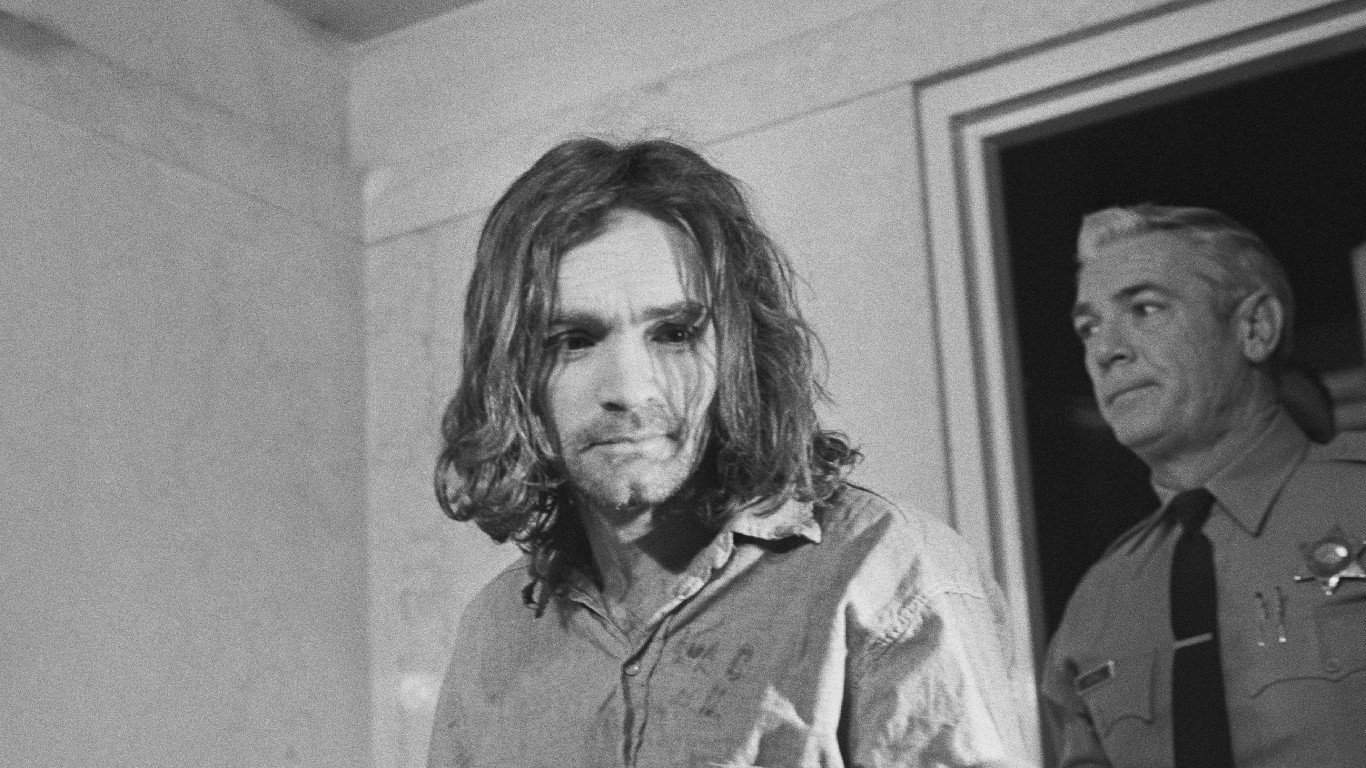
Bettmann / Contributor / Bettmann / Getty Images

Hulton Archive / Archive Photos via Getty Images
Stephanie Keith / Getty Images

bryankemp / Flickr

Hulton Archive / Archive Photos via Getty Images

Public Domain / Wikimedia Commons

Getty Images

Public Domain / Wikimedia Commons

Public Domain / Wikimedia Commons

Public Domain / Wikimedia Commons

Public Domain / Wikimedia Commons

Hulton Archive / Getty Images

Public Domain / Wikimedia Commons

Photo By Kevin Moloney / Getty Images

Chip Somodevilla / Staff / Getty Images

Public Domain / Wikimedia Commons

ooocha / Flickr

Getty Images / Hulton Archive via Getty Images

Public Domain / Wikimedia Commons


24 Notorious Figures in American History
American history has no shortage of people who became famous for all the wrong reasons. Some committed terrible crimes. Others deceived the public, betrayed their country, or used positions of power in ways that still generate controversy. And then there are those whose reputations depend heavily on which side of history you ask.
Not everyone on this list belongs in the same category. A convicted murderer is hardly comparable to a military leader whose tactics remain controversial or a political commentator who divided public opinion. But each of these figures became associated with actions, decisions, or scandals that shaped how Americans remember them.
From the Revolutionary War and the Civil War to Cold War espionage, political scandals, and modern financial fraud, these 24 people left behind reputations that have proven difficult to shake. Some cases are straightforward. Others are still debated by historians. All offer a look at the darker and more complicated chapters of American history.
Bernie Madoff (1938-2021)
For years, Bernie Madoff appeared to be one of Wall Street's most successful investors. In reality, he was running an enormous Ponzi scheme, using money from newer investors to pay earlier clients while fabricating investment returns. When the scheme collapsed in 2008, thousands of people, charities, and retirement funds suffered devastating losses. The often-repeated $65 billion figure represented fictitious account balances, not actual money stolen. Investors had lost roughly $20 billion in principal. Madoff was sentenced to 150 years in prison in 2009 and died behind bars in 2021.
John Wilkes Booth (1838-1865)
John Wilkes Booth was a successful stage actor before becoming one of the most infamous assassins in American history. A committed Confederate sympathizer, Booth initially participated in a plot to kidnap President Abraham Lincoln. When that plan fell apart, he turned to murder. On April 14, 1865, Booth shot Lincoln during a performance at Ford's Theatre in Washington, D.C. The president died the following morning. Booth escaped but was tracked down and killed by Union soldiers 12 days later. His assassination of Lincoln remains one of the defining tragedies of American history.
Jim Jones (1931-1978)
Jim Jones founded the Peoples Temple, a religious movement that initially promoted racial integration and social justice. Behind that public image, however, former members described manipulation, abuse, and increasingly authoritarian control. Jones eventually relocated hundreds of followers to a remote settlement in Guyana. In November 1978, after members of his group killed Congressman Leo Ryan and four others at a nearby airstrip, Jones ordered the deaths of those at the settlement. A total of 909 people died at Jonestown, including 304 children and minors. Many victims were coerced or too young to consent.
Andrew Jackson (1767-1845)
Andrew Jackson remains one of America's most debated presidents. Supporters credit the seventh president with challenging established political elites and expanding political participation among white men. His treatment of Native Americans and his ownership of enslaved people form a much darker part of his legacy. Jackson signed the Indian Removal Act in 1830, laying the groundwork for the forced relocation of tens of thousands of Native Americans from their ancestral lands. Thousands died during these removals, including an estimated 4,000 Cherokee people associated with the Trail of Tears. His policies continue to shape assessments of his presidency.
Robert Hanssen (1944-2023)
Robert Hanssen was supposed to be protecting America's secrets. Instead, the FBI agent spent years selling classified information to the Soviet Union and later Russia. Beginning in 1985, Hanssen passed along sensitive intelligence, including information that compromised American sources and counterintelligence operations. He received more than $1.4 million in cash, bank funds, and diamonds for his activities. Investigators finally arrested him in February 2001 after tracking his communications and secret exchanges with Russian handlers. Hanssen pleaded guilty to espionage and received a life sentence without parole. He died in federal prison in 2023.
Charles Manson (1934-2017)
Charles Manson never became the successful musician he hoped to be. Instead, he gained notoriety as the manipulative leader of a cult-like group known as the Manson Family. Through psychological control, drug use, and apocalyptic beliefs, Manson persuaded followers to carry out a series of murders in California in 1969. Among the victims was actress Sharon Tate, who was eight months pregnant. Although Manson did not personally carry out the Tate-LaBianca killings, prosecutors established his role in directing the crimes. He was convicted in 1971 and remained imprisoned until his death in 2017.
Aaron Burr (1756-1836)
Aaron Burr managed to make enemies in some remarkably high places. The former vice president is best remembered for fatally shooting Alexander Hamilton during an 1804 duel, but his troubles didn't end there. Burr later became involved in a mysterious expedition in the western territories that led President Thomas Jefferson's administration to accuse him of plotting to break away territory and establish an independent nation. Burr was tried for treason in 1807 but acquitted because prosecutors failed to establish the constitutionally required evidence. His precise ambitions remain debated, although the scandal permanently damaged his political reputation.
Jeffrey Epstein (1953-2019)
Jeffrey Epstein cultivated relationships with wealthy and influential people while exploiting underage girls. Investigations revealed a pattern of sexual abuse involving vulnerable teenagers, including victims recruited through promises of money. In 2008, Epstein pleaded guilty to Florida state charges involving solicitation of prostitution and procuring a minor for prostitution. The controversial agreement allowed him to avoid federal prosecution at that time. Federal authorities arrested him again in 2019 on charges of sex trafficking minors and conspiracy. He died in a New York jail before trial, with his death officially ruled a suicide. His crimes and the failures surrounding their investigation continue to face scrutiny.
Nathan Bedford Forrest (1821-1877)
Nathan Bedford Forrest was a skilled Confederate cavalry commander whose military reputation has long been overshadowed by his role in the defense of slavery and subsequent racial violence. His forces were responsible for the 1864 Fort Pillow Massacre, in which large numbers of Black Union soldiers were killed. Accounts of the fighting and the surrender remain disputed, but survivor testimony described the killing of soldiers attempting to surrender. After the Civil War, Forrest became associated with the newly formed Ku Klux Klan and is widely identified as its first grand wizard. Although he later called for the group's dissolution, his legacy remains closely connected to white supremacy and Reconstruction-era violence.
Richard Nixon (1913-1994)
Richard Nixon won reelection in 1972 by an overwhelming margin, but less than two years later, he became the first American president to resign from office. The Watergate scandal began with a burglary at Democratic National Committee headquarters and grew into an investigation of illegal political activities and efforts to obstruct justice. White House recordings revealed Nixon's involvement in the cover-up, although they did not establish that he personally ordered the original break-in. Facing almost certain impeachment, Nixon resigned on August 9, 1974. His foreign-policy achievements remain part of his legacy, but Watergate fundamentally changed how Americans viewed presidential accountability.
Mildred Gillars (1900-1988)
During World War II, American-born Mildred Gillars became known to Allied troops as "Axis Sally." Working for German radio, she broadcast Nazi propaganda designed to frighten and demoralize American soldiers. Her programs mixed music and familiar American themes with messages suggesting that servicemen would die overseas or return home to unfaithful partners. Gillars also delivered antisemitic propaganda and attacks on American leaders. After the war, she was arrested, returned to the United States, and convicted of treason in 1949. She received a prison sentence of 10 to 30 years and was paroled in 1961.
Timothy McVeigh (1968-2001)
On April 19, 1995, Timothy McVeigh carried out the Oklahoma City bombing, killing 168 people, including 19 children. The former Army soldier parked a truck containing explosives outside the Alfred P. Murrah Federal Building and detonated the device, destroying much of the structure and damaging surrounding buildings. McVeigh held extreme anti-government beliefs and cited the federal government's handling of the 1993 Waco siege as a major motivation. The attack remains the deadliest act of domestic terrorism carried out by a homegrown extremist in American history. McVeigh was convicted of federal crimes and executed in 2001.
Jay Gould (1836-1892)
Long before modern Wall Street scandals, Jay Gould had earned a reputation as one of America's most ruthless financial operators. The 19th-century railroad magnate accumulated enormous wealth through aggressive acquisitions, financial maneuvering, and political connections. In 1869, Gould and fellow speculator James Fisk attempted to corner the gold market, contributing to the financial panic known as Black Friday. His business methods attracted intense criticism and helped establish the popular image of the wealthy, unscrupulous robber baron. Gould was undeniably successful at making money, but his methods made him a symbol of the excesses of the Gilded Age.
J. Edgar Hoover (1895-1972)
J. Edgar Hoover helped build the FBI into one of the world's most prominent law enforcement agencies. He directed the bureau and its predecessor for nearly five decades, overseeing major investigations and improvements in crime-fighting techniques. But Hoover's record also includes extensive surveillance and efforts to undermine political organizations and civil rights activists. Under his leadership, the FBI conducted COINTELPRO, a series of secret operations that sometimes involved infiltrating groups, spreading disinformation, and attempting to discredit individuals. His extraordinary influence and abuses of investigative power remain central to debates over his legacy.
John Chivington (1821-1894)
Army Colonel John Chivington led one of the most notorious attacks on Native Americans in U.S. history. On November 29, 1864, his troops assaulted a Cheyenne and Arapaho village along Sand Creek in what is now Colorado. More than 230 people were killed, including approximately 150 women, children, and elderly people. Many of the victims were members of a community that believed it was under military protection. Soldiers also mutilated some of the dead. The Sand Creek Massacre prompted investigations and widespread condemnation, but Chivington was never criminally prosecuted for his role.
Rush Limbaugh (1951-2021)
Few figures in American talk radio generated the kind of political reaction associated with Rush Limbaugh. The conservative commentator attracted millions of loyal listeners and helped reshape political broadcasting through his confrontational style. Supporters praised his willingness to challenge political opponents and the mainstream media. Critics condemned remarks about women, race, LGBTQ people, and people living with AIDS. Some of his statements sparked major public controversies, while his enormous audience demonstrated his influence on conservative politics. Unlike the convicted criminals on this list, Limbaugh's controversial reputation stems primarily from his public commentary and its impact on political discourse.
Benedict Arnold (1741-1801)
Benedict Arnold started the Revolutionary War as an accomplished American military commander. He fought bravely, suffered serious injuries, and contributed to important Continental Army victories. Yet financial difficulties, personal resentments, and disputes over recognition helped push him toward betraying the American cause. In 1780, Arnold secretly negotiated with the British to surrender the strategically important fort at West Point. The plot was discovered before it could succeed, and Arnold escaped to British-controlled territory. He subsequently served in the British Army. More than two centuries later, his name remains practically synonymous with treason in American culture.
Charles Davenport (1866-1944)
Charles Davenport was an influential American biologist who helped give scientific credibility to ideas that are now recognized as deeply flawed and discriminatory. In 1910, he established the Eugenics Record Office at Cold Spring Harbor, promoting the belief that human society could be improved by controlling reproduction. His work reinforced racist ideas about heredity and supported policies that included immigration restrictions and involuntary sterilization. American eugenics research also influenced aspects of Nazi racial policy. Davenport's career illustrates how scientific authority can be misused to justify discrimination and violations of basic human rights.
Fred Phelps (1929-2014)
Fred Phelps founded the Westboro Baptist Church, a small religious organization that became nationally notorious for its aggressive anti-LGBTQ rhetoric and public demonstrations. The group picketed funerals, including those of American service members, using inflammatory messages that caused anguish for grieving families. The Southern Poverty Law Center classified the organization as a hate group. Phelps and his followers defended their actions as religious expression, while critics viewed the demonstrations as deliberate harassment. His activities also helped generate major legal debates over free speech and the rights of funeral attendees. Phelps died in 2014.
Henry Kissinger (1923-2023)
Henry Kissinger served as national security adviser and secretary of state during the Nixon and Ford administrations, helping shape American foreign policy during the Cold War. His diplomatic achievements included improving relations with China and pursuing agreements with the Soviet Union. But his involvement in the Vietnam War, the bombing of Cambodia, and U.S. policy toward authoritarian governments generated lasting criticism. Scholars continue to debate the human consequences of his decisions and the extent of his personal responsibility for controversial American interventions. Kissinger received the Nobel Peace Prize in 1973, yet remained a deeply divisive figure until his death at age 100.
Lee Harvey Oswald (1939-1963)
Lee Harvey Oswald became one of the most recognizable names in American criminal history following the assassination of President John F. Kennedy on November 22, 1963. The Warren Commission concluded that Oswald fired the shots that killed Kennedy and acted alone, although its findings have been challenged and debated for decades. Oswald was arrested in Dallas and accused of killing both Kennedy and police officer J. D. Tippit. Two days later, nightclub owner Jack Ruby shot and killed Oswald while he was being transferred by police. Because Oswald never stood trial, questions about the assassination continue to attract public interest.
William Tecumseh Sherman (1820-1891)
Union General William Tecumseh Sherman played a major role in defeating the Confederacy during the Civil War. His 1864 March to the Sea devastated railroads, supply networks, agricultural resources, and other infrastructure across Georgia. The strategy weakened the Confederate war effort but also brought enormous suffering and property destruction to civilians. Sherman is remembered by many as an effective military commander whose campaigns helped bring the war to an end. Others, particularly in parts of the South, have condemned the destruction associated with his tactics. His reputation remains a striking example of how historical perspectives can differ.
Joseph McCarthy (1908-1957)
Senator Joseph McCarthy became one of the most controversial American politicians of the 1950s by alleging widespread communist infiltration of the federal government. His accusations frequently went beyond the evidence he presented, damaging reputations and contributing to a climate of political fear. McCarthy's aggressive tactics eventually attracted increased scrutiny, particularly during the nationally televised Army-McCarthy hearings in 1954. Later that year, the U.S. Senate formally censured him for his conduct toward Senate committees. The term "McCarthyism" remains associated with reckless accusations and attacks on political opponents without adequate supporting evidence.
John Walker, Jr. (1937-2014)
John Anthony Walker Jr. betrayed some of the U.S. Navy's most sensitive communications secrets over nearly two decades. The former warrant officer began spying for the Soviet Union in 1967, providing classified cryptographic material that allowed Soviet intelligence to decipher American naval communications. Walker also recruited family members and an associate into his espionage operation. His activities exposed critical information about American military capabilities and operations before FBI investigators uncovered the spy ring in 1985. Walker pleaded guilty and received a life sentence. He died in prison in 2014, leaving behind one of the most damaging espionage cases of the Cold War.