Public Domain / Library of Congress

Public Domain / Wikimedia Commons

Public Domain / Wikimedia Commons

Public Domain / Wikimedia Commons

Public Domain / Wikimedia Commons

Public Domain / Wikimedia Commons

Public Domain / Wikimedia Commons

Public Domain / Wikimedia Commons

Public Domain / Wikimedia Commons

Public Domain / Wikimedia Commons

Public Domain / Wikimedia Commons

Public Domain / Wikimedia Commons

Public Domain / Wikimedia Commons

Public Domain / Wikimedia Commons

Public Domain / Wikimedia Commons

Public Domain / Wikimedia Commons

Public Domain / Wikimedia Commons

Public Domain / Wikimedia Commons

Public Domain / Wikimedia Commons

Public Domain / Wikimedia Commons

Public Domain / Wikimedia Commons

Public Domain / Wikimedia Commons

Public Domain / Wikimedia Commons

Public Domain / Wikimedia Commons

Public Domain / Wikimedia Commons

Public Domain / Wikimedia Commons

German Federal Archive / Wikimedia Commons

Public Domain / Wikimedia Commons

Public Domain / Wikimedia Commons


28 Massive Warships That Once Ruled the Seas
For more than a century, the biggest warships afloat were also some of the most intimidating machines ever built. Their massive guns, heavy armor, and enormous crews made them symbols of national power, even when they never fired a shot in anger. A few became famous for battlefield victories. Others are remembered for disasters, narrow escapes, and the sailors who served aboard them.
The battleship era reached its peak in the first half of the 20th century, when countries raced to build bigger guns and thicker armor. The 1922 Washington Naval Treaty tried to put limits on that competition, but the arms race resumed in the years leading up to World War II. Japan's Yamato class eventually dwarfed everything else, while America's Iowa class combined impressive firepower with speed.
This countdown looks at 28 enormous surface warships, from the early dreadnoughts to the last great battleships. A few are technically battlecruisers or, in the case of the Soviet Kirov class, a guided-missile cruiser. Displacement is an approximate measure of weight, and published figures change with ammunition, fuel, and refits, so the order is a useful comparison rather than a perfectly standardized scientific ranking.
28. Florida Class
- Approx. displacement: 23,033 tons
- Nation: United States
- Lead ship commissioned: 1911
- Ship type: Dreadnought battleship
Florida and Utah represented another step in America's rapid pre-World War I battleship buildup. Each carried ten 12-inch guns in five twin turrets, and both served during an era when the Navy was still figuring out how to use fleets of all-big-gun ships. Florida joined the British Grand Fleet during World War I, while Utah was later converted into a target and training vessel. Utah was sunk at Pearl Harbor on December 7, 1941, and her remains are still there. One important correction: the original figure of 25,400 tons was too high for their original full-load displacement. At roughly 23,000 long tons loaded, the Florida class belongs near the beginning of this countdown.
27. Moltke Class
- Approx. displacement: 25,400 tons
- Nation: Germany
- Lead ship commissioned: 1911
- Ship type: Battlecruiser
Germany's Moltke and Goeben were battlecruisers, built to combine the guns of a capital ship with the speed needed to scout or pursue an enemy fleet. Moltke fought at the Battle of Jutland in 1916, where the North Sea turned into one of World War I's defining naval encounters. Goeben had an even stranger career. After reaching Ottoman waters in 1914, she became Yavuz Sultan Selim and spent decades in Turkish service. That longevity is what really separates this class from the pack. These ships weren't designed to absorb punishment like a full battleship, but they could deliver plenty of it while moving considerably faster than most early dreadnoughts.
26. Wyoming Class
- Approx. displacement: 27,243 tons
- Nation: United States
- Lead ship commissioned: 1912
- Ship type: Dreadnought battleship
The Wyoming class consisted of Wyoming and Arkansas, both commissioned in 1912. They carried twelve 12-inch guns, more barrels than the preceding American classes, and were built for the kind of fleet engagement naval planners thought would decide a major war. Their later careers went in different directions. Wyoming became a gunnery training ship, helping prepare sailors for combat, while Arkansas survived long enough to bombard enemy positions during the Normandy invasion in 1944. Arkansas was eventually sunk as a target during the 1946 nuclear tests at Bikini Atoll. The pair show how ships designed before World War I could still find useful roles decades later.
25. New York Class
- Approx. displacement: 27,435 tons
- Nation: United States
- Lead ship commissioned: 1914
- Ship type: Dreadnought battleship
The New York class introduced 14-inch guns to American battleships, a notable jump from the 12-inch weapons carried by the earlier dreadnoughts. New York and Texas were commissioned in 1914, just as Europe was sliding into World War I. Both ships had long careers, but Texas may be the better-known survivor: she provided gunfire support off Normandy in June 1944 and later fought in the Pacific. Today, Texas is preserved as a museum ship, making the class more than a footnote in naval history. For visitors, her towering gun turrets and tightly packed compartments show just how far shipbuilding had come in the few years after HMS Dreadnought changed naval warfare.
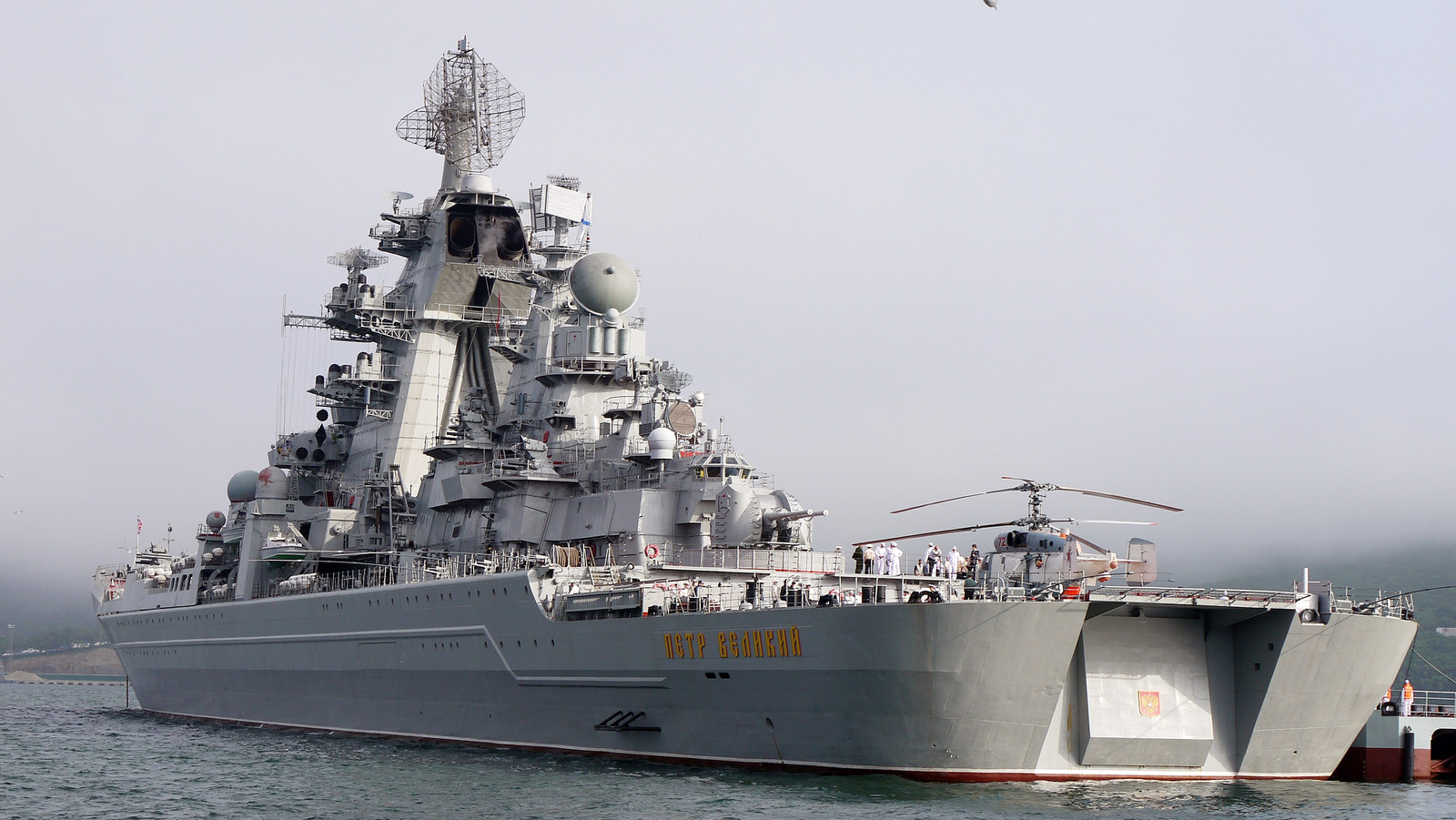
24. Kirov Class
- Approx. displacement: 28,000 tons
- Nation: Soviet Union (later Russia)
- Lead ship commissioned: 1980
- Ship type: Nuclear-powered guided-missile cruiser
The Soviet Union's Kirov-class ships were not battleships in the traditional sense. They were nuclear-powered guided-missile cruisers, so large and heavily armed that Western observers often called them battlecruisers. Lead ship Kirov entered service in 1980, decades after battleship construction had largely ended. Instead of big turrets firing shells over the horizon, these ships relied on long-range missiles, air defenses, and sophisticated sensors. They make an interesting bookend to the battleship era: the same idea of an imposing surface warship, but with a completely different way of fighting. Their displacement also varies by ship and modernization.
23. Nevada Class
- Approx. displacement: 29,000 tons
- Nation: United States
- Lead ship commissioned: 1916
- Ship type: Dreadnought battleship
Nevada and Oklahoma helped change American battleship design with the "all-or-nothing" armor scheme. Instead of spreading protection evenly around the hull, designers concentrated heavy armor around the most vital spaces. The two ships were at Pearl Harbor when Japan attacked in 1941, and their stories took very different turns. Oklahoma capsized after multiple torpedo hits, killing hundreds of sailors. Nevada managed to get underway during the attack, was deliberately grounded to avoid blocking the harbor, and eventually returned to combat. She supported the Normandy landings and other operations before becoming a target in postwar tests. It was a remarkably long service life for a ship launched before World War I.
22. Iron Duke Super Dreadnought Class
- Approx. displacement: 29,560 tons
- Nation: United Kingdom
- Lead ship commissioned: 1914
- Ship type: Super-dreadnought battleship
The Iron Duke class was built for the Royal Navy just before World War I, when bigger guns and heavier armor seemed to arrive with every new design. Its four battleships carried ten 13.5-inch guns, and the lead ship served as Admiral John Jellicoe's flagship at Jutland in 1916. The class was formidable in its day but did not displace as much as the original article claimed. The lead ship's full-load figure was around 29,560 long tons, not 32,635. Later treaties and changing naval priorities brought the era of these early super-dreadnoughts to a close. Iron Duke herself survived for years in secondary and training roles, outliving the frontline career for which she had been built.
21. Rivadavia Class
- Approx. displacement: 30,600 tons
- Nation: Argentina
- Lead ship commissioned: 1914
- Ship type: Dreadnought battleship
Argentina's Rivadavia and Moreno were products of South America's early-20th-century naval arms race, when Brazil, Argentina, and Chile competed to field impressive new battleships. Both Argentine ships were built in the United States, a reminder that the race for sea power also meant big business for foreign shipyards. With twelve 12-inch guns, the pair were formidable by regional standards, though they never fought the kind of dramatic fleet battle their builders anticipated. Rivadavia entered service in 1914 and Moreno followed in 1915. Both remained symbols of Argentine naval prestige for decades before being retired in the 1950s. Their inclusion also adds a welcome reminder that dreadnought fever extended well beyond Europe and the United States.
20. HMS Agincourt Dreadnought
- Approx. displacement: 31,360 tons
- Nation: United Kingdom
- Lead ship commissioned: 1914
- Ship type: Dreadnought battleship
HMS Agincourt had a career that sounds almost made up. Ordered for Brazil, sold to the Ottoman Empire, and then taken over by Britain in 1914, she ended up fighting for the Royal Navy in World War I. Her most obvious selling point was firepower: fourteen 12-inch guns mounted in seven twin turrets, an unusually large main battery even by dreadnought standards. Agincourt fought at Jutland in 1916, where she joined the immense British battle line. Despite that imposing silhouette, she did not enjoy a particularly long career, and postwar naval arms limitations helped seal her fate. She was eventually broken up, leaving behind one of the more unusual design stories of the battleship age.
19. Revenge Class
- Approx. displacement: 31,630 tons
- Nation: United Kingdom
- Lead ship commissioned: 1916
- Ship type: Dreadnought battleship
The Revenge class was Britain's attempt to build heavily armored battleships without the expense or speed of the famous Queen Elizabeth class. The five completed ships carried eight 15-inch guns apiece and served through World War I and into World War II. Their names included Revenge, Royal Sovereign, Royal Oak, Resolution, and Ramillies. Royal Oak was torpedoed in Scapa Flow in 1939, a devastating early wartime loss that exposed the danger submarines posed even to powerful battleships. The surviving sisters continued in convoy escort, bombardment, and other jobs as the war changed around them. They were sturdy ships, but their relatively modest speed increasingly limited what they could do beside fast carrier groups.
18. Ise Class
- Approx. displacement: 31,760 tons
- Nation: Japan
- Lead ship commissioned: 1917
- Ship type: Battleship; later hybrid battleship-carrier
Japan's Ise and Hyuga are remembered as battleships that became part-aircraft carriers, an unusual solution to Japan's growing shortage of naval aviation capacity in World War II. Built with twelve 14-inch guns, they entered service before the end of World War I. In 1943, their aft gun turrets were removed and flight decks were added, creating hybrid warships intended to carry aircraft while retaining much of their heavy artillery. The experiment never produced the powerful air groups Japan had hoped for, partly because trained aircraft and crews were in short supply. Both ships survived the war's major carrier battles only to be sunk in Japanese waters by American air attacks in 1945.
17. Pennsylvania Class
- Approx. displacement: 32,429 tons
- Nation: United States
- Lead ship commissioned: 1916
- Ship type: Dreadnought battleship
The Pennsylvania class included Pennsylvania and Arizona, two American battleships whose names are forever tied to Pearl Harbor. Arizona was destroyed during the attack on December 7, 1941, with the loss of 1,177 officers and crewmen. Pennsylvania, in dry dock that morning, survived and later returned to combat in the Pacific. Both ships were built around twelve 14-inch guns in four triple turrets, a layout that packed considerable firepower into an efficient arrangement. Pennsylvania supported several amphibious campaigns before a torpedo damaged her near the war's end. Arizona's wreck became one of the country's most solemn memorials, giving this class a place in American history far beyond displacement numbers.
16. New Mexico Class
- Approx. displacement: 33,350 tons
- Nation: United States
- Lead ship commissioned: 1918
- Ship type: Dreadnought battleship
New Mexico, Mississippi, and Idaho were among the U.S. Navy's powerful "standard-type" battleships, designed to operate together in a relatively uniform battle line. They carried twelve 14-inch guns, heavy armor, and a top speed of about 21 knots. That was entirely respectable when the class entered service, but World War II brought very different expectations. All three ships supported American campaigns across the Pacific, using their huge guns against shore defenses rather than enemy battle lines. Mississippi later became a weapons test ship and helped the Navy move toward the missile era. It's a good example of a battleship platform finding one more job after the world had largely moved on from battleship-versus-battleship fighting.
15. Queen Elizabeth Class Super Dreadnought
- Approx. displacement: 33,790 tons
- Nation: United Kingdom
- Lead ship commissioned: 1915
- Ship type: Fast battleship
The Queen Elizabeth class was a major leap for the Royal Navy. Its five ships combined eight 15-inch guns with oil-fired machinery intended to deliver more speed than most contemporary battleships. Queen Elizabeth, Warspite, Valiant, Barham, and Malaya saw service across two world wars, and several were repeatedly modernized along the way. Warspite became one of Britain's best-known warships, fighting at Jutland and later supporting operations in the Mediterranean and off Normandy. Barham was sunk by a submarine in 1941, showing again that armor and big guns could not guarantee survival. The class endured because its core design was strong enough to remain useful well beyond the war for which it was built.
14. Bayern Class
- Approx. displacement: 35,500 tons
- Nation: Germany
- Lead ship commissioned: 1916
- Ship type: Dreadnought battleship
Germany's Bayern class brought 15-inch guns to the Imperial German Navy. Only Bayern and Baden were completed, arriving too late to take part in the great clash at Jutland in 1916. Bayern instead participated in operations in the Baltic, while Baden entered service in 1917. The ships were heavily armed and well protected, but the end of World War I cut their careers short. Bayern was scuttled with much of the German fleet at Scapa Flow in 1919. Baden was handed over to Britain and later sunk as a target during weapons trials. Their story is a reminder that even an impressive battleship can become obsolete almost overnight when the political world around it changes.
13. Kongō Class Battlecruiser
- Approx. displacement: 36,500 tons
- Nation: Japan
- Lead ship commissioned: 1913
- Ship type: Battlecruiser; later fast battleship
The four Kongō-class ships started life as battlecruisers, trading some armor protection for impressive speed. Japan rebuilt them extensively during the interwar period, and they were subsequently classified as fast battleships. That extra speed proved useful in World War II, when they could accompany major fleet formations that older, slower dreadnoughts could not easily match. The class included Kongō, Hiei, Haruna, and Kirishima. All four were lost during the war, including Kirishima, which was disabled by the American battleship Washington during the naval battles around Guadalcanal. Their careers show how much a ship's role could change between its original launch and its final deployment.
12. Fusō Dreadnought Class
- Approx. displacement: 37,187 tons
- Nation: Japan
- Lead ship commissioned: 1915
- Ship type: Dreadnought battleship
The Fusō-class battleships, Fusō and Yamashiro, were built around twelve 14-inch guns in six twin turrets. The arrangement gave them an unmistakable profile but also demanded plenty of space along the hull. Their extensive interwar rebuilds added armor and anti-aircraft defenses, yet both were aging warships when World War II reached its final stages. In October 1944, they took part in the Battle of Surigao Strait, where Allied forces caught the Japanese advance in a carefully prepared night action. Both ships were sunk in the fighting. Their loss is often discussed alongside the last major battleship-against-battleship engagements, marking the fading of an era dominated by big-gun surface fleets.
11. King George V Class
- Approx. displacement: 45,360 tons
- Nation: United Kingdom
- Lead ship commissioned: 1940
- Ship type: Fast battleship
Britain's five King George V-class battleships were modern wartime designs armed with ten 14-inch guns. The lead ship entered service in 1940, not 1942 as the original article stated. In May 1941, King George V helped bring down the German battleship Bismarck, while Prince of Wales fought in the same campaign before being sunk by Japanese aircraft off Malaya later that year. The class was built under treaty limits that shaped its size and armament, with speed and protection balanced against the realities of modern warfare. These ships were important escorts for carrier forces as well as heavy gunnery platforms. Their story shows why even large battleships increasingly needed strong aircraft support.
10. Littorio Class
- Approx. displacement: 45,485 tons
- Nation: Italy
- Lead ship commissioned: 1940
- Ship type: Fast battleship
Italy's Littorio class was one of Europe's most ambitious late battleship designs. Littorio and Vittorio Veneto both entered service in 1940, with Roma joining in 1942. Their nine 15-inch guns and high speed made them formidable opponents, but fuel shortages and the constant threat of Allied air power restricted their operational freedom. Roma's end was especially striking: after Italy's 1943 armistice, German aircraft attacked her with guided bombs, sinking the battleship. Littorio, renamed Italia, survived the war, but the new naval order offered little room for these costly giants. The class is a useful example of impressive engineering running into strategic realities that even a heavily armored ship could not solve.
9. Nagato Class
- Approx. displacement: 45,950 tons
- Nation: Japan
- Lead ship commissioned: 1920
- Ship type: Dreadnought battleship
Nagato and Mutsu were Japan's first battleships armed with 16-inch guns, and their size made an enormous impression when they entered service in the early 1920s. Nagato later served as a flagship, including during the period leading up to Japan's attack on Pearl Harbor. Both ships underwent major modernization, but their fates diverged sharply. Mutsu was destroyed by an internal magazine explosion in Japan in 1943. Nagato survived World War II, only to be used as a target during the American atomic bomb tests at Bikini Atoll in 1946. Her final chapter was a stark symbol of how quickly the weapons that defined naval power had changed during the first half of the 20th century.
8. South Dakota Class
- Approx. displacement: 46,200 tons
- Nation: United States
- Lead ship commissioned: 1942
- Ship type: Fast battleship
The South Dakota class included South Dakota, Indiana, Massachusetts, and Alabama, four compact but heavily armed American battleships commissioned during World War II. Their nine 16-inch guns offered serious firepower, while sophisticated defenses gave them an important role protecting aircraft carriers from enemy planes. South Dakota fought in the naval battles off Guadalcanal, and Massachusetts participated in the 1942 landings in North Africa. The class remained useful throughout the Pacific war, even as air power increasingly drove strategy. Two of the ships, Massachusetts and Alabama, survive as museum attractions. They are reminders that the battleship's final wartime role often involved protecting and supporting other forces, not charging into a duel with another giant.
7. HMS Hood
- Approx. displacement: 46,680 tons
- Nation: United Kingdom
- Lead ship commissioned: 1920
- Ship type: Battlecruiser
HMS Hood was the Royal Navy's most famous battlecruiser between the world wars and, for years, one of the most recognizable warships afloat. She was fast, long, and armed with eight 15-inch guns, but she was not technically a battleship. Her distinction mattered because a battlecruiser's balance of speed, armor, and firepower came with compromises. On May 24, 1941, Hood confronted Germany's Bismarck in the Denmark Strait and exploded after being hit. Only three of the more than 1,400 men aboard survived. The shock of her sinking spread across Britain and intensified the hunt for Bismarck. Few naval losses better illustrate how quickly a celebrated ship could disappear in a single engagement.
6. North Carolina Class
- Approx. displacement: 46,700 tons
- Nation: United States
- Lead ship commissioned: 1941
- Ship type: Fast battleship
North Carolina and Washington were the first new American battleships completed after the long treaty-era pause in construction. Their nine 16-inch guns made them formidable, but their ability to support faster fleet operations was just as important. Washington famously defeated the Japanese battleship Kirishima during the naval campaign around Guadalcanal in November 1942. North Carolina also served extensively in the Pacific, protecting carriers and bombarding shore positions. After the war, North Carolina was preserved in Wilmington, where visitors can still walk through her enormous interior spaces. The pair mark an important transition between the slower battleships of World War I and the fast capital ships that fought alongside carriers in World War II.
5. Richelieu Class
- Approx. displacement: 48,100 tons
- Nation: France
- Lead ship commissioned: 1940
- Ship type: Fast battleship
France's Richelieu-class battleships had a distinctive arrangement: all eight 15-inch main guns sat in two quadruple turrets forward. That left the stern clear of heavy-gun turrets and gave these ships a recognizable profile. Richelieu entered service in 1940, although completing her equipment and bringing her fully into Allied operations took additional years. Her sister Jean Bart escaped to Casablanca while unfinished, fought from a harbor berth in 1942, and was not finally commissioned until 1955. That makes Jean Bart an important correction to claims that Britain's Vanguard was the last battleship commissioned anywhere. The class lived through the rapid shift from battleship power to aircraft carriers and missiles.
4. HMS Vanguard
- Approx. displacement: 51,420 tons
- Nation: United Kingdom
- Lead ship commissioned: 1946
- Ship type: Fast battleship
HMS Vanguard was Britain's last completed battleship, commissioned in 1946 after World War II had already ended. By then, the strategic problem she had been built to solve was largely disappearing. Vanguard carried eight 15-inch guns in four twin turrets and benefited from lessons learned during years of naval fighting, including the importance of anti-aircraft protection. She went on diplomatic and ceremonial cruises rather than major battles, including carrying the royal family on a voyage to South Africa. She was eventually sent for scrap in 1960. Vanguard is often called the last battleship, but that needs a qualification: she was the last British battleship, while France's Jean Bart was completed and commissioned later.
3. Bismarck Class
- Approx. displacement: 51,800 tons
- Nation: Germany
- Lead ship commissioned: 1940
- Ship type: Battleship
Bismarck and Tirpitz were Germany's largest completed battleships and two of the most feared warships in the Atlantic theater. Bismarck entered service in 1940, and her brief combat career included the destruction of HMS Hood before British forces hunted her down and sank her in May 1941. Tirpitz spent much of the war in Norwegian waters, where her very presence forced the Allies to devote resources to containing her. British aircraft finally sank Tirpitz in 1944. The ships carried eight 15-inch guns and heavy armor, but their careers showed that massive surface ships were vulnerable to air attacks, torpedoes, and the simple difficulty of operating without secure support at sea.
2. Iowa Class
- Approx. displacement: 57,540 tons
- Nation: United States
- Lead ship commissioned: 1943
- Ship type: Fast battleship
The four completed Iowa-class battleships were the biggest ever commissioned by the United States Navy. Iowa, New Jersey, Missouri, and Wisconsin could travel at more than 30 knots while carrying nine 16-inch guns, making them far faster than most earlier battleships. They fought in World War II, and several returned for service in Korea, Vietnam, or the 1991 Gulf War. Missouri became especially famous as the ship on which Japan formally surrendered in Tokyo Bay on September 2, 1945. All four survive today as museum ships. There is something fitting about that: these enormous vessels outlasted the age of battleship combat and became places where visitors can see the scale of naval history for themselves.
1. Yamato Class
- Approx. displacement: 71,659 tons
- Nation: Japan
- Lead ship commissioned: 1941
- Ship type: Battleship
Nothing on this list quite matches the Japanese Yamato class. Yamato and Musashi were the largest battleships ever completed, each carrying nine enormous 18.1-inch guns and displacing more than 70,000 tons at full load. Yamato entered service in 1941, followed by Musashi in 1942. Yet the two giants never fought the decisive big-gun duel their designers envisioned. American carrier aircraft sank Musashi during the Battle of Leyte Gulf in October 1944 and Yamato during her final mission toward Okinawa in April 1945. Their fate was a dramatic demonstration that the aircraft carrier had displaced the battleship as the dominant offensive weapon at sea. In pure size and gun caliber, however, they remain unmatched.