The United States population, as of 2024, is roughly 342 million people. That is a far cry from the 31 million people who inhabited this nation during the Civil War. However, the country was still comprised of only 36 states and territories. It wasn't until 1959, with the addition of Hawaii, that the U.S. became a nation of 50 states. While the nationwide population has increased exponentially, so have the individual states.
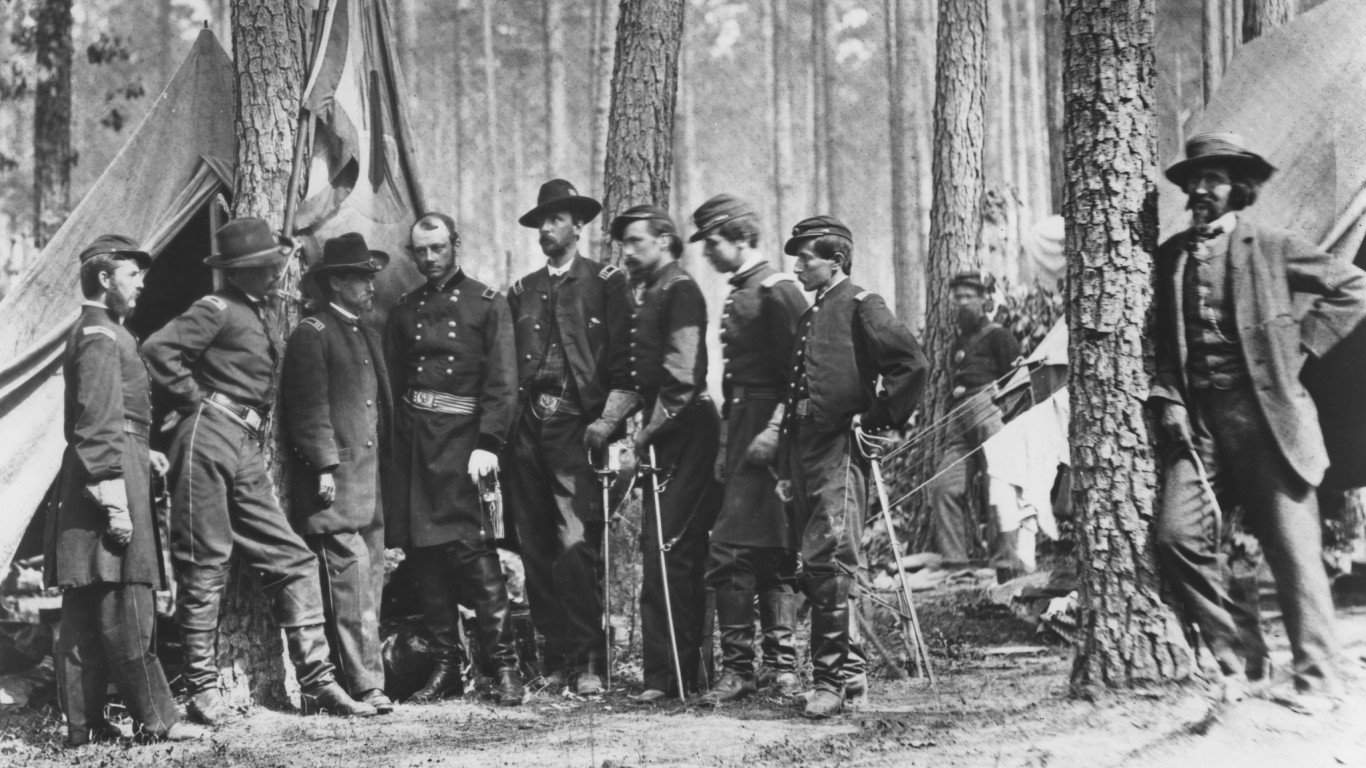
The American Civil War, which lasted from April 1861 to April 1865, cost the lives of approximately 620,000 soldiers, or about 2% of the country’s population at the time. Adjusted for population, this would be equivalent to six million U.S. fighters dying in battle over four years. The Civil War took place as the country was expanding geographically and demographically. People were heading out west in droves, toward states like Missouri and Illinois where many settled while others continued onward to lands Mexico ceded to the United States in 1848.
The population of the country grew from 31.2 million to 38.1 million between 1860 and 1870. By 1870, state populations ranged from 4.4 million in New York to just 42,000 in Nevada (up considerably from the mere 7,000 residents it had in 1860 before it became a state). Washington, D.C., had only 132,000 people. California had just over a half million people, while the population of Texas was barely more than 800,000.
24/7 Tempo reviewed the U.S. Census Bureau’s “Bicentennial Edition: Historical Statistics of the United States, Colonial Times to 1970” to find the population of the District of Columbia and all 33 states that were part of the country in 1860, then compared those numbers with similar data from 1870 to compile a list of the population of every U.S. pre and post Civil War. (These are the largest battles of the Civil War.)
New York, Pennsylvania, Ohio, and Illinois were the top four most populated states that remained unchanged from 1860 to 1870 and are still among the top 10 today. Among the top 10 most populated states in 1860 and 1870, Missouri moved from eighth to fifth place over that decade as its population grew by nearly 46%. Virginia, home to the Confederate capital of Richmond, dropped from seventh to tenth place, with almost no change in population.
New Hampshire, Maine, and South Carolina were three other states with populations that were also virtually unchanged. At the same time, the number of states with more than a million residents increased from 11 to 15 over the ten years. (Can you answer these real “Jeopardy!” questions about the U.S. population?)