Some of history’s most important cultural treasures survived centuries of political change, natural disasters, and social upheaval, only to be lost in war. Temples, libraries, archives, monuments, religious sites, museums, and ancient cities have all been damaged or destroyed during military campaigns, bombings, occupations, and deliberate acts of cultural erasure. These losses are not just about buildings or artifacts. They represent missing chapters of human history.
24/7 Tempo looks at 25 priceless pieces of history that were destroyed by war, from landmark sites and ancient collections to archives that preserved the identity of entire communities. Some were lost in the chaos of battle, while others were intentionally targeted to weaken an enemy’s culture and memory. UNESCO notes that the 1954 Hague Convention was created after the widespread destruction of World War II to protect cultural property during armed conflict.
One of the most devastating examples came in April 1941, when Nazi Germany bombed Belgrade and the National Library of Serbia burned to the ground. The destruction wiped out hundreds of thousands of books, manuscripts, maps, and rare works, making it one of the major cultural losses of World War II.
These examples show how war can erase far more than territory or infrastructure. When cultural heritage is destroyed, future generations lose access to the art, records, architecture, and stories that help explain who people were and how they lived. That is why the destruction of cultural treasures remains one of war’s most lasting consequences.
1. The Porcelain Tower, Nanjing, China

War/conflict: The Taiping Rebellion, 1856
The Porcelain Tower of Nanjing was once one of the most admired structures in the world, a Ming Dynasty pagoda so famous that travelers and writers in Europe described it as one of the great wonders of the medieval age. Commissioned by the Yongle Emperor in the early 15th century, the tower was built with glazed white porcelain bricks that reportedly caught the sunlight and reflected it in brilliant colors. It was not only a religious monument, but also a symbol of imperial power, craftsmanship, and the global reputation of Chinese architecture. During the Taiping Rebellion in 1856, rebels destroyed the tower while fighting the Qing Dynasty. Its loss erased one of the most recognizable landmarks of old Nanjing and left later generations with only drawings, descriptions, fragments, and modern reconstructions to imagine its scale.
2. The Old Summer Palace, Beijing, China

War/conflict: Second Opium War, 1860
The Old Summer Palace, also known as Yuanmingyuan, was far more than a royal residence. Built and expanded during the Qing Dynasty, it combined elaborate gardens, lakes, pavilions, libraries, religious buildings, and collections of art and antiquities into one of the most celebrated imperial complexes in Asia. Its beauty was so widely admired that it was sometimes called the “Versailles of the East,” though that comparison only hints at how unusual the site was. It blended Chinese garden design with Western-style buildings, fountains, and decorative features. In 1860, during the Second Opium War, British and French forces looted and burned the palace complex. The destruction scattered countless treasures and turned a functioning center of imperial culture into ruins. Today, the surviving stones and parkland serve as a powerful reminder of colonial violence and cultural loss.
3. Old Town of Warsaw, Warsaw, Poland

War/conflict: WWII, 1939-1944
Warsaw’s Old Town was one of the historic hearts of Poland, with its market square, churches, townhouses, defensive walls, and narrow streets preserving centuries of urban life. During World War II, that heritage was nearly wiped away. Nazi Germany occupied Warsaw after the 1939 invasion of Poland, and the city suffered repeated destruction throughout the war. The most devastating blow came after the Warsaw Uprising in 1944, when German forces deliberately demolished large parts of the city in retaliation. Historic buildings were burned, blown apart, or reduced to rubble, and the Old Town was left almost unrecognizable. After the war, Poles rebuilt it with extraordinary care using paintings, photographs, architectural records, and salvaged fragments. Its reconstruction became a symbol of national survival, but the original fabric of the old city was largely lost.
4. Christchurch Greyfriars, London, England

War/conflict: WWII, 1940
Christchurch Greyfriars had already survived one great disaster before war finished what fire had begun. The site dated back to a Franciscan church founded in the 13th century, and the original medieval building was destroyed during the Great Fire of London in 1666. It was later rebuilt by Sir Christopher Wren, the architect behind St. Paul’s Cathedral and many of London’s post-fire churches. For centuries, the rebuilt church stood as part of London’s religious and architectural landscape. Then, during the Blitz in 1940, German bombing destroyed much of the building, leaving only the tower and portions of the walls standing. Rather than fully rebuild it after the war, the ruins were preserved and transformed into a garden. The site now has a quiet beauty, but it also marks the loss of a church tied to both medieval London and Wren’s rebuilding of the city.
5. St. Michael’s Old Cathedral, Coventry, England

War/conflict: WWII, 1940
St. Michael’s Old Cathedral was one of Coventry’s great Gothic landmarks, with a soaring spire, medieval stonework, and a long history at the center of the city’s religious life. Coventry became a major target during World War II because of its industrial importance, and on the night of Nov. 14, 1940, German bombers devastated the city in one of the most destructive raids of the Blitz. The cathedral was hit and burned, leaving its roof, interior, and much of its structure in ruins. Rather than erase the damage, Coventry chose to preserve the ruined shell beside a new cathedral built after the war. That decision turned the site into a powerful memorial. The remains of St. Michael’s are no longer simply evidence of destruction; they also stand for reconciliation, remembrance, and the resilience of a city that refused to let war define its future.
6. Leuven University Library, Leuven, Belgium

War/conflict: WWII, 1940
The Leuven University Library became one of the most painful symbols of cultural loss in both world wars. Its earlier collections were destroyed by German forces in 1914 during World War I, an event that shocked scholars around the world and became a rallying point for the protection of cultural property. The library was rebuilt with international support, only to be devastated again in 1940 during World War II. Fire and bombardment destroyed hundreds of thousands of books, manuscripts, and scholarly materials. The repeated destruction showed how vulnerable libraries are during war, since they contain not only printed objects, but also accumulated memory, research, and intellectual labor. Each loss at Leuven represented far more than a building burning. It meant the disappearance of rare works that could not simply be replaced, even after shelves and walls were rebuilt.
7. The National Library of Serbia, Belgrade, Serbia

War/conflict: WWII, April 6, 1941
The National Library of Serbia was one of the most catastrophic cultural losses of World War II. Founded in the 19th century, the library held manuscripts, rare books, maps, newspapers, letters, and archival materials that documented Serbian history and the broader cultural life of the Balkans. On April 6, 1941, Nazi Germany bombed Belgrade, and the library was destroyed by fire. The loss was especially devastating because many of the materials were unique. Once they burned, entire historical records disappeared with them. The destruction did not merely damage a national institution; it tore away part of Serbia’s written memory. Scholars lost sources, families lost traces of the past, and future generations were left with gaps that can never be fully repaired. It remains one of the clearest examples of how bombing a city can destroy a people’s cultural inheritance.
8. Royal Opera House, Valletta, Malta

War/conflict: WWII, April 27, 1942
The Royal Opera House in Valletta was one of Malta’s most elegant 19th-century landmarks, a grand cultural venue designed by British architect Edward Middleton Barry. It opened in the 1860s and quickly became a focal point for music, performance, and public life in the capital. Malta’s strategic position in the Mediterranean made it a crucial British base during World War II, and that also made the island a frequent target for Axis bombing. On April 7, 1942, an air raid destroyed the opera house, leaving its neoclassical shell shattered. For decades, the ruins remained in the center of Valletta, a visible reminder of the war’s impact on civilian culture. The site was eventually reimagined as an open-air theater, but the original opera house, with its ornate interior and old social world, was lost to wartime bombing.
9. Kaiser Wilhelm Memorial Church, Berlin, Germany

War/conflict: WWII, 1943
The Kaiser Wilhelm Memorial Church was built in the late 19th century as a monument to Germany’s first emperor, Wilhelm I, and it became one of Berlin’s most recognizable churches. Its tower, mosaics, and neo-Romanesque design reflected the confidence and nationalism of imperial Germany. During World War II, Allied bombing badly damaged the church, and much of the structure was left in ruins. After the war, Berliners debated whether to demolish what remained or preserve it. The damaged tower was ultimately kept and incorporated into a modern church complex, creating one of the city’s most striking memorials. The ruined spire is often called the “hollow tooth,” and it stands as a reminder of both the destruction Germany brought on Europe and the devastation that later came to German cities. The original church was never restored to its former state.
10. The Frauenkirche, Dresden, Germany

War/conflict: WWII, 1945
The Frauenkirche was one of Dresden’s defining landmarks, a magnificent Lutheran church whose stone dome dominated the city’s skyline. Built in the 18th century, it was a masterpiece of Baroque architecture and a symbol of Dresden’s reputation as a center of art and culture. In February 1945, Allied bombing raids caused firestorms that devastated the city. The Frauenkirche initially survived the blasts, but the heat weakened the stone structure, and it collapsed soon after. For decades, its blackened ruins were left as a war memorial in East Germany. After German reunification, the church was painstakingly reconstructed using surviving stones wherever possible, with darker original blocks visible among the newer material. The rebuilt Frauenkirche is now a symbol of reconciliation, but the original structure and much of the old Dresden around it were destroyed in the war.
11. Historic Tokyo, Tokyo, Japan

War/conflict: WWII, 1945
Historic Tokyo suffered immense destruction during World War II, especially during the American firebombing campaign of 1945. The city had already lost many older buildings in the Great Kanto Earthquake of 1923, but wartime bombing erased even more of its prewar urban fabric. Incendiary raids set off firestorms in densely built neighborhoods where many homes and shops were made of wood. The March 1945 bombing alone killed an estimated 100,000 people and leveled large sections of the city. Along with the human toll came the destruction of temples, traditional streetscapes, family archives, neighborhood landmarks, and everyday architecture that had carried the memory of Edo and early modern Tokyo. Postwar rebuilding created a new city, but much of the older capital’s physical character vanished in flames, leaving only fragments of the world that existed before the raids.
12. Vijećnica (City Hall) of Sarajevo, Sarajevo, Bosnia

War/conflict: Bosnian War, 1992
Sarajevo’s Vijećnica was one of the city’s most important architectural and cultural landmarks. Opened in 1896 as City Hall, it later became the National and University Library of Bosnia and Herzegovina. Its striking pseudo-Moorish design reflected Sarajevo’s layered history under Ottoman, Austro-Hungarian, and South Slavic influence. During the Bosnian War, the building was shelled and set on fire in August 1992. The flames destroyed vast parts of the library’s holdings, including books, periodicals, manuscripts, and documents connected to Bosnia’s diverse communities. Residents and librarians reportedly tried to save what they could while the building burned, but the losses were enormous. Vijećnica has since been restored, but the destruction of its collections remains a cultural tragedy. The attack showed how a library could become a target not just for military reasons, but because it represented a shared civic memory.
13. Mehmed Pasha Kukavica Mosque, Foča, Bosnia and Herzegovina

War/conflict: Bosnian War, 1993
The Mehmed Pasha Kukavica Mosque in Foča was an 18th-century Ottoman-era mosque that represented the long Islamic and architectural history of eastern Bosnia. Foča had been a place where different religious and cultural communities lived side by side, but the Bosnian War brought campaigns of violence, forced displacement, and cultural destruction. The mosque was demolished during the war, along with many other Islamic religious buildings in the area. Its destruction was not simply collateral damage from fighting. It was part of a broader assault on the visible signs of Bosniak presence and history. When mosques, cemeteries, schools, and archives are destroyed, the goal is often to make a community’s roots appear weaker or less real. The loss of this mosque therefore represents both an architectural wound and a deeper attempt to erase memory from the landscape.
14. Ferhat Pasha Mosque, Banja Luka, Bosnia and Herzegovina

War/conflict: Bosnian War, 1992
The Ferhat Pasha Mosque, often called Ferhadija, was one of the finest examples of Ottoman Islamic architecture in Bosnia and Herzegovina. Built in the 16th century, it was known for its elegant proportions, stonework, and role as a central religious and cultural site in Banja Luka. During the Bosnian War, the mosque was blown up in 1993, even though the city was not a major front-line battlefield at that moment. Its destruction was widely understood as part of a campaign to remove the cultural and religious markers of the Bosniak Muslim community. The demolition of Ferhadija caused international outrage because it targeted heritage, identity, and memory. The mosque was later reconstructed using recovered stones and traditional methods, but the original building was gone. Its story shows how cultural landmarks can become targets precisely because they symbolize a people’s history.
15. Buddhas of Bamiyan, Bamiyan, Afghanistan

War/conflict: War in Afghanistan, 2001
The Buddhas of Bamiyan were among the most famous Buddhist monuments in the world, carved into sandstone cliffs in central Afghanistan during the sixth century. Standing along ancient trade routes, the statues reflected the region’s role as a meeting place for cultures, religions, merchants, and pilgrims. For centuries, they survived changes in empire, religion, and political rule, remaining monumental witnesses to Afghanistan’s diverse past. In 2001, the Taliban destroyed the statues with explosives after declaring them idols. The destruction shocked the world because the Buddhas were not only religious works, but also irreplaceable examples of ancient art and Central Asian history. Their empty niches remain in the cliff face today, marking both absence and survival. The site is now a reminder of how quickly ideological violence can erase heritage that had endured for nearly 1,500 years.
16. National Library, Baghdad, Iraq

War/conflict: Iraq War, 2003
The National Library and Archives in Baghdad held materials that connected modern Iraq to some of the oldest written civilizations in the world. Its collections included books, government records, manuscripts, newspapers, maps, and documents that helped preserve the history of Iraq and the wider region. During the chaos surrounding the 2003 Iraq War and the fall of Saddam Hussein’s regime, the library and archives were looted and burned. The destruction wiped out or damaged countless materials, including records that were essential for historians, legal researchers, families, and cultural institutions. Some items were later recovered, and Iraqi librarians and archivists worked to rebuild, but many losses were permanent. The tragedy showed that cultural institutions can be destroyed not only by bombs, but also by the collapse of public order during war. When archives burn, a society loses evidence of itself.
16. Sidi Sha’ab Mosque, Tripoli, Libya

War/conflict: Islamic sectarian violence, 2014
The Sidi Sha’ab Mosque in Tripoli was associated with a revered Sufi scholar whose tomb made the site important to Libya’s Sufi Muslim community. Sufi shrines and mosques often serve as places of worship, pilgrimage, teaching, and local memory, tying religious practice to particular neighborhoods and families. During the instability that followed Libya’s 2011 revolution, sectarian extremists targeted several Sufi sites. The Sidi Sha’ab Mosque and shrine were attacked and destroyed in 2012, reflecting a broader hostility toward Sufi traditions among some hard-line groups. The loss was not only architectural. It severed a connection between the community and a spiritual figure remembered for generations. Sites like this carry layers of devotion, oral history, and ritual practice that cannot be fully rebuilt once the original shrine is gone and its sacred atmosphere is violently interrupted.
17. Apamea Historical Sites, Apamea, Syria

War/conflict: Syrian Civil War, 2011-2016
Apamea was once one of the great cities of the ancient world, with connections to the Seleucid Empire, Roman rule, and later Byzantine history. Its long colonnaded street, ruins, mosaics, and archaeological remains made it one of Syria’s most important heritage sites before the civil war. When conflict spread across the country after 2011, Apamea suffered from looting, military activity, and damage to its fragile archaeological landscape. Satellite images revealed widespread illegal digging, with the ground scarred by thousands of pits as looters searched for saleable antiquities. This kind of destruction is especially devastating because it removes objects from their context, which is often what gives them historical meaning. A coin, statue, or mosaic fragment torn from the ground may survive as an object, but the information it carried about the city’s layout, economy, religion, and daily life can be lost forever.
18. Omari Mosque, Daraa, Syria

War/conflict: Syrian Civil War, 2013
The Omari Mosque in Daraa is one of Syria’s historically important Islamic sites, with roots traditionally linked to the early centuries of Islam. It also became deeply connected to the modern Syrian uprising. In 2011, Daraa was one of the places where protests against the government began, and the mosque served as a gathering point, shelter, and symbol of resistance. During the Syrian Civil War, the mosque was damaged, and its historic minaret was destroyed in 2013. The loss carried meaning beyond the physical structure. A minaret is a visual landmark, a religious feature, and a marker of continuity in a city’s skyline. Its destruction signaled how the war was tearing through both civic life and sacred space. The damaged mosque became one more example of how Syria’s conflict has harmed not only people and neighborhoods, but also places central to communal identity.
19. Museum of Islamic Art, Cairo, Egypt

War/conflict: Car bomb, Jan. 24, 2014
Cairo’s Museum of Islamic Art housed one of the world’s most significant collections of Islamic art, with objects spanning centuries of craftsmanship, scholarship, religion, and daily life. Its holdings included ceramics, metalwork, woodwork, glass, textiles, manuscripts, and architectural fragments from across the Islamic world. In January 2014, a car bomb targeting a nearby police headquarters severely damaged the museum. Ceilings collapsed, windows shattered, display cases broke, and hundreds of objects were damaged. Although the museum itself was not completely destroyed, the blast showed how vulnerable cultural collections are to political violence even when they are not the intended target. Conservation teams later worked to restore damaged objects and reopen the museum, but the event remains a reminder that a single explosion can threaten centuries of artistic achievement gathered under one roof.
20. Lions of Hadatu, Ar-Raqqah, Syria

War/conflict: ISIS conquest, 2014
The Lions of Hadatu were ancient basalt sculptures connected to the Neo-Hittite and Assyrian world of northern Syria. These monumental lion figures once guarded the entrance to a palace, serving both decorative and symbolic purposes. Lions were often associated with power, protection, kingship, and divine authority in the ancient Near East, so the sculptures were more than architectural ornaments. They were fragments of a political and artistic world that existed nearly three thousand years ago. During ISIS control of parts of Syria, ancient sculptures and archaeological objects were deliberately targeted as part of a campaign against pre-Islamic heritage and as a source of propaganda. The destruction of the Lions of Hadatu removed rare surviving evidence of an ancient city’s visual culture. Their loss made the distant past harder to study, imagine, and share with future generations.
21. The historic district of Sana’a, Sana’a, Yemen

War/conflict: War in Yemen, 2015
The old city of Sana’a is one of the most extraordinary historic urban landscapes in the Middle East. Inhabited for roughly 2,500 years, it is famous for its tower houses decorated with white gypsum patterns, dense lanes, mosques, bathhouses, markets, and a skyline unlike almost any other city. The district was designated a UNESCO World Heritage Site because of its architectural unity and long continuity of urban life. During the war in Yemen, airstrikes and fighting damaged parts of the old city, killing residents and destroying historic buildings. The damage was especially painful because Sana’a’s architecture is not just monumental. It is lived-in heritage, made up of homes, neighborhoods, and community spaces that remain part of daily life. When those buildings collapse, families lose shelter and the world loses a rare example of an ancient city still functioning as a living place.
22. Great Mosque of Aleppo, Aleppo, Syria

War/conflict: ISIS conquest, 2015
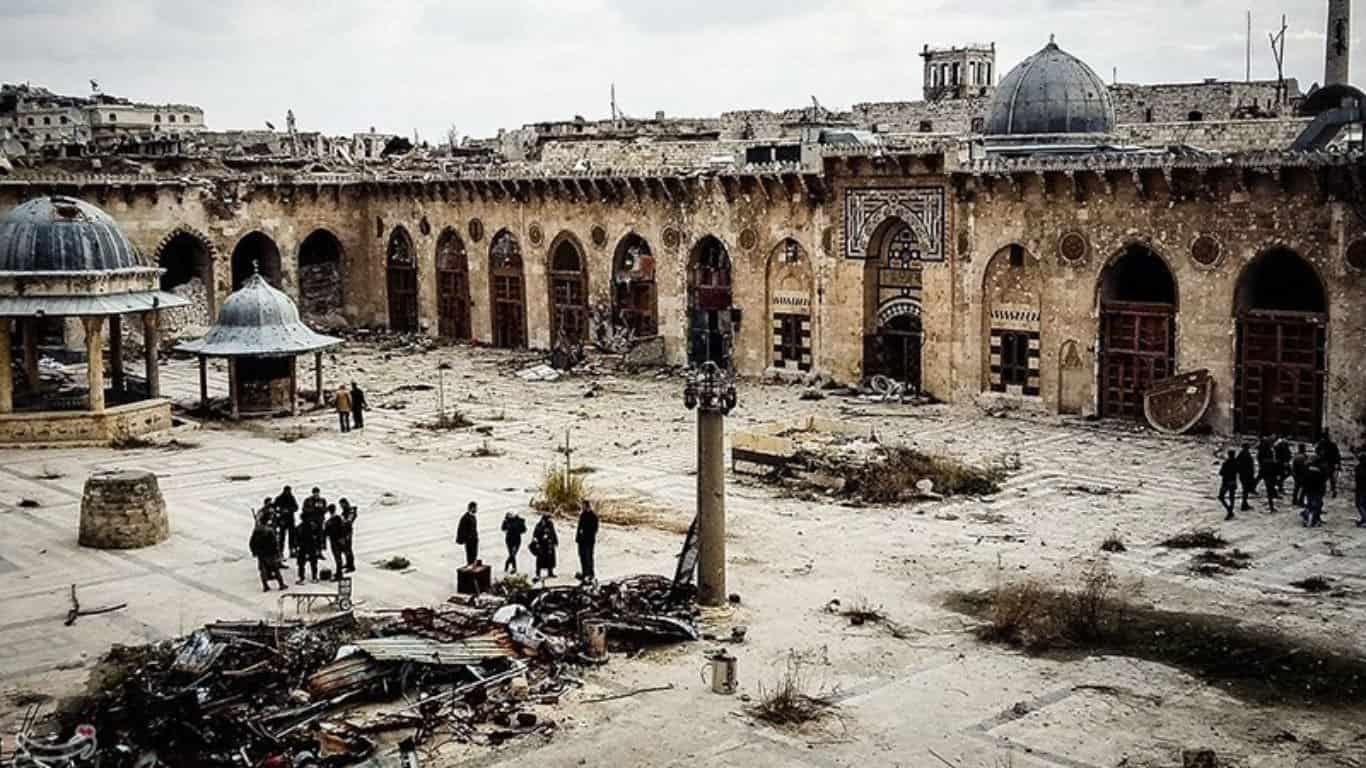
The Great Mosque of Aleppo was one of Syria’s most important Islamic landmarks, located within the ancient city of Aleppo, a UNESCO World Heritage Site. The mosque had been rebuilt and altered over centuries, carrying traces of different dynasties and periods of Syrian history. It was especially known for its large courtyard, arcades, and historic minaret, which had stood for nearly a thousand years. During the Syrian Civil War, Aleppo became one of the most fiercely contested cities in the country, and the old city suffered catastrophic damage. In 2013, the mosque’s minaret collapsed amid fighting, and the site was badly damaged. The loss of the minaret was a symbolic blow because it had long defined Aleppo’s skyline and religious identity. Although restoration efforts have continued, the original fabric of one of the city’s greatest monuments was deeply scarred by war.
23. Al-Mahdi Mosque, Sana’a, Yemen

Destroyed: War in Yemen, 2015
The Al-Mahdi Mosque in Sana’a was another casualty of Yemen’s devastating war and the broader damage inflicted on the capital’s historic fabric. Known for its bright white dome and refined decorative details, the mosque belonged to the architectural and religious landscape that made old Sana’a internationally significant. Historic mosques in Yemen are not only places of prayer. They are also centers of neighborhood identity, education, memory, and craftsmanship, often connected to centuries of local building traditions. Damage to such a site therefore affects more than a single structure. It weakens the visual and spiritual continuity of the city. In a war that has harmed homes, markets, schools, and monuments, the loss or damage of religious heritage adds another layer to the human crisis. It leaves communities mourning sacred places alongside the people and neighborhoods they have lost.
24. Temple of Bel, Palmyra, Syria

War/conflict: ISIS conquest, 2015
The Temple of Bel was one of the greatest monuments of Palmyra, the ancient Syrian city that flourished as a caravan hub between the Roman and Persian worlds. Built in the first century, the temple blended Greco-Roman, Mesopotamian, and local Syrian influences, making it a remarkable example of cultural exchange in the ancient Near East. For centuries, its columns, sanctuary, and surrounding courtyard stood as evidence of Palmyra’s wealth and cosmopolitan character. In 2015, ISIS destroyed much of the temple with explosives after taking control of the site. The attack shocked archaeologists and heritage experts because Palmyra was among the world’s most important ancient cities. The Temple of Bel was not simply an old ruin. It was a key to understanding religion, trade, art, and urban life in a place where civilizations met. Its destruction left an enormous gap in the physical record of antiquity.
25. The Gates of Nineveh, Nineveh, Iraq

War/conflict: ISIS conquest, 2016
The gates of Nineveh once marked the entrances to one of the greatest cities of the ancient Assyrian Empire. Nineveh, near modern Mosul, was a major imperial capital in the seventh century B.C., famous for its walls, palaces, sculptures, and royal inscriptions. Gates such as Mashki and Adad were reconstructed in modern times on ancient foundations, helping visitors visualize the scale of Assyrian power and urban planning. In 2016, ISIS destroyed parts of the gates and other heritage sites around Mosul as part of a campaign against ancient monuments. The damage was a severe blow to Iraq’s pre-Islamic heritage and to the study of Assyrian civilization. Even when reconstructions are involved, these sites sit on real archaeological ground and connect modern viewers to an ancient city that shaped the history of the Near East. Their destruction turned a surviving gateway to the past into another wartime ruin.