Kevin Winter / Getty Images

Parilov / Shutterstock.com
KirylV / Shutterstock.com

PeopleImages / Shutterstock.com

Viktor Vanovski / Shutterstock.com

TiffanyBurke / Shutterstock.com
MillaF / Shutterstock.com

Gergitek Gergi tavan / Shutterstock.com

aiva / Flickr

Unai Huizi Photography / Shutterstock.com

Ugis Bralens / Shutterstock.com











10 Hit Songs You Probably Didn’t Know Were Written by Someone Else
A lot of the biggest songs in history didn't start with the artist who made them famous. Some had already been recorded by someone else, while others were demos or ideas passed around until the right singer finally got hold of them. Songwriters rarely get to bask in the same spotlight as the performers who turn their words and melodies into hits. Some eventually get their recognition, although usually not nearly as much.
Here are 10 hit songs that were written by someone other than the artist who made them famous.
"Respect" by Aretha Franklin
Otis Redding, one of the defining voices of 1960s soul music, wrote and recorded "Respect" in 1965. His version came from a working man's point of view: he's out earning money and wants respect from his partner when he comes home.
Aretha Franklin got hold of the song two years later and rebuilt it into something else entirely. Working with her sisters Carolyn and Erma Franklin on the backing vocals, she added the "sock it to me" refrain and the now-famous R-E-S-P-E-C-T spelling section, turning Redding's plea into something much more forceful.
Redding heard Franklin's version and famously remarked, "Well, she took my song from me." He was right in a way. Franklin's version went to number one on the Billboard Hot 100 and grew far beyond its original relationship-song roots, becoming closely associated with both the civil rights movement and women's equality.
"I Will Always Love You" by Whitney Houston
Dolly Parton wrote "I Will Always Love You" as a goodbye to her mentor and longtime business partner, Porter Wagoner, when she was preparing to leave his television show and strike out on her own. Parton's original recording topped the country chart in 1974, and a new recording of the song took her back to number one on the country chart again in 1982.
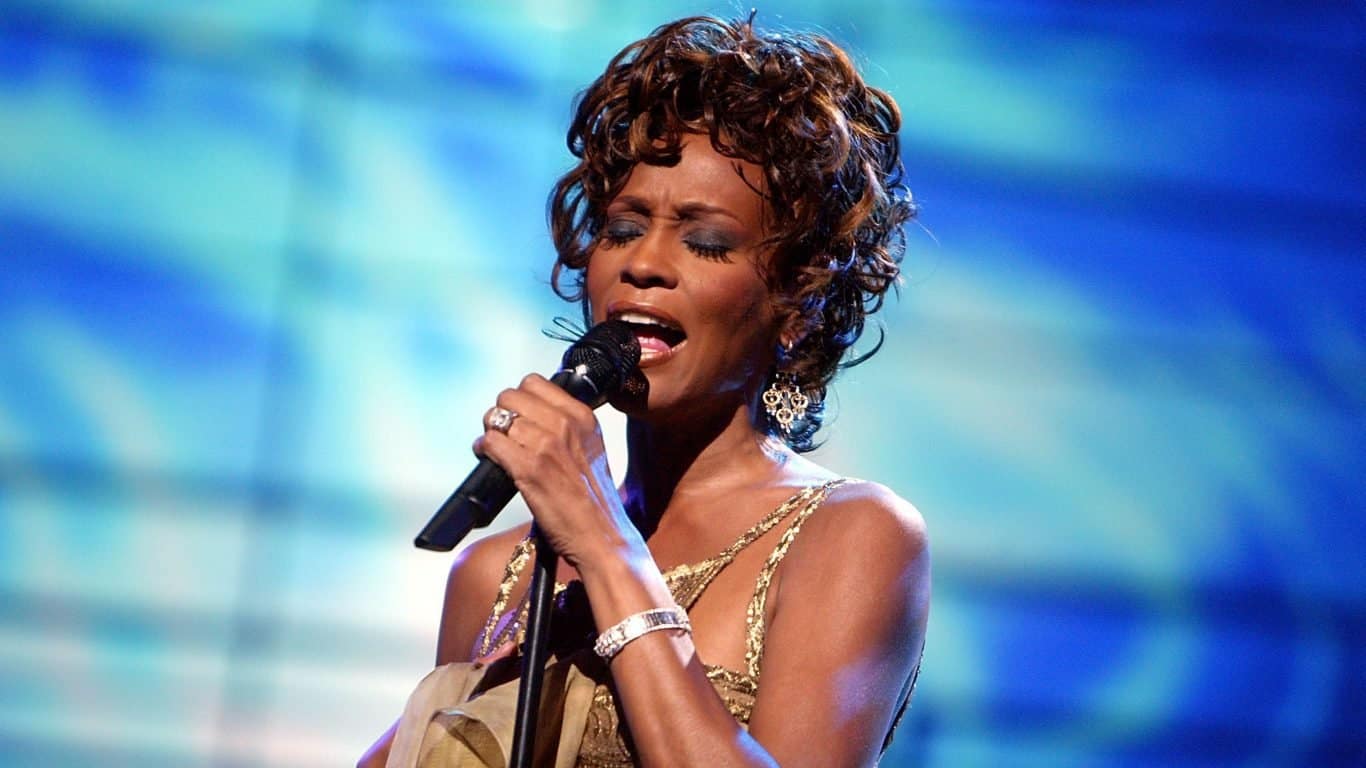
Then Whitney Houston recorded it for The Bodyguard, the 1992 movie starring her as a pop-music diva and Kevin Costner as her bodyguard. Houston's version opens a cappella, without the instrumental introduction heard on Parton's recording, and that stark opening became one of the most recognizable parts of the song.
Houston's version dwarfed the earlier recordings as a pop hit, spending 14 weeks at number one on the Billboard Hot 100. It also won Record of the Year at the 1994 Grammy Awards and helped turn a song that had already been a country classic into one of Houston's signature recordings.
"Nothing Compares 2 U" by Sinéad O'Connor
Prince wrote "Nothing Compares 2 U" in 1984 and gave it to The Family, a group he put together for his Paisley Park label. The band released it on its only album in 1985, where it attracted little attention at the time.
Five years later, Sinéad O'Connor picked it up, and her version turned it into a global number one. The music video, built mostly around a close-up of O'Connor's face, became just as famous as the song itself. The tears on screen were real. O'Connor later said she was thinking about her mother, who had died in a car accident years earlier. The clip won Video of the Year at the 1990 MTV Video Music Awards.
Prince later performed the song himself and released versions of his own, but by then O'Connor's recording had already become the version most listeners recognized. It is one of those rare covers that became so definitive that people can easily forget who wrote the song in the first place.
"Tainted Love" by Soft Cell
Songwriter and producer Ed Cobb wrote "Tainted Love," and soul singer Gloria Jones first recorded it in 1964. The single went nowhere in the U.S. at the time, but it was rediscovered years later by the U.K.'s Northern Soul scene, a subculture built around obscure American soul records that had never become big hits at home. That is how the song stayed alive long enough for Soft Cell to find it.
Soft Cell's synth-driven cover, released in 1981, turned a song most people had never heard into one of the defining tracks of the new wave era. It reached number one in the U.K. and, in the U.S., spent an unusually long 43 weeks on the Billboard Hot 100 while peaking at number eight.
What's perhaps more interesting about "Tainted Love" is how far it traveled before becoming famous: an obscure American soul single, then a Northern Soul favorite, then an international synth-pop hit. Marilyn Manson gave it another high-profile makeover in 2001, but Soft Cell's version is the recording that turned the song into a mainstream standard.
"...Baby One More Time" by Britney Spears
Max Martin originally wrote this under the working title "Hit Me Baby (One More Time)" and first shopped it to TLC, but the group turned it down. Fellow Swedish singer Robyn was also offered the song and did not record it. By the time it reached a then-16-year-old Britney Spears, the title had been shortened to "...Baby One More Time," avoiding the much more literal and uncomfortable reading of the phrase "hit me." It became Spears' debut single in 1998.
That is at least two major near misses before the song found a home. It's worth wondering how different late-1990s pop music, and Spears' career, might have looked if one of those other artists had said yes instead.
"Man in the Mirror" by Michael Jackson
Singer Siedah Garrett wrote "Man in the Mirror" with songwriter Glen Ballard after producer Quincy Jones asked writers around him for more material for Michael Jackson's Bad. Ballard later remembered the basic song coming together in about an hour.
Garrett brought the central idea and Ballard built the music around it. The finished song became one of only two tracks on the original 1987 Bad album that Jackson did not write himself. Garrett also sang on the recording and, on the same album, shared lead vocals with Jackson on "I Just Can't Stop Loving You."
When Jackson heard the demo, Garrett remembered his first reaction being simple: "I love this song." He asked for a few changes, then made it unmistakably his once he got into the studio, especially in the ad-libs and vocal runs that take over the final stretch.
"Total Eclipse of the Heart" by Bonnie Tyler
Composer Jim Steinman, the same songwriter behind Meat Loaf's Bat Out of Hell, wrote "Total Eclipse of the Heart" out of the same over-the-top theatrical world. Parts of the song grew out of ideas Steinman had been developing for years, including a vampire-themed musical project inspired by Nosferatu. That explains why the finished song feels more like a gothic stage production than an ordinary pop ballad.
Bonnie Tyler recorded it in 1983 after specifically seeking out Steinman because she loved his work with Meat Loaf. He played the song for her at the piano, and she immediately knew she wanted it. The record went to number one in both the U.S. and U.K., turning it into a true global hit. Meat Loaf later joked that the song should have been his, but Tyler was the singer who made it famous.
Tyler's raspy voice, the sound that defines the track, was not simply a studio affectation. She had undergone surgery for vocal-cord nodules in the 1970s, and her voice came back noticeably huskier afterward. The song's music video, packed with wind machines, glowing eyes, dancers, and a boarding-school setting, became nearly as famous as the recording because of how gloriously strange it was.
"Diamonds" by Rihanna
Sia wrote the topline for "Diamonds" at remarkable speed, coming up with the melody, lyrics, and harmonies in roughly the time it took for a cab to arrive. Accounts vary between about 14 and 15 minutes, but the basic story holds: she was finishing up a session with producers Stargate and Benny Blanco and wrote the song almost on the way out the door. Blanco has said the production team had earlier imagined the track going to Kanye West or Eminem.
Rihanna recorded it in 2012, and the finished song became her 12th number one single on the Billboard Hot 100, where it spent three weeks at the top. It is one of the better examples of how much of a modern pop hit can exist before the superstar who makes it famous ever steps up to the microphone.
"Girls Just Want to Have Fun" by Cyndi Lauper
Songwriter and musician Robert Hazard wrote and recorded "Girls Just Want to Have Fun" first in 1979. His demo came from a man's point of view and carried a much more sexual, male-centered meaning than the song most people know today. Cyndi Lauper heard something completely different in it.
Lauper did not find the song herself. Her producer, Rick Chertoff, brought it to her while they were working on her debut album. She resisted the song as originally written, then changed parts of the lyrics, the point of view, and the entire feel until it sounded like something she could actually believe in.
The changes turned it from a song built around a male fantasy into a joyful statement about women having the freedom to go out, have fun, and live on their own terms. Lauper's version became one of the defining songs of the 1980s, and its video won Best Female Video at the first MTV Video Music Awards in 1984.
"Hurt" by Johnny Cash
Trent Reznor, the man behind Nine Inch Nails, wrote and recorded "Hurt" for the band's 1994 album The Downward Spiral. It came out of the same bleak world of isolation, addiction, and self-destruction that runs through the album, set against the damaged, industrial sound Nine Inch Nails was known for.
The original version is about as far from country music as a song can get. Even so, producer Rick Rubin convinced Johnny Cash to cover it for 2002's American IV: The Man Comes Around. Cash's version strips away most of the industrial abrasion and rebuilds the song around his weathered voice, acoustic instrumentation, and a stark piano part.
Reznor was uneasy when he first heard Cash's recording. Then he saw Mark Romanek's music video, shot at Cash's home and the aging House of Cash museum in Tennessee, and his reaction changed completely. Reznor later compared the feeling to losing a girlfriend, saying the song did not feel like his anymore. Cash had not changed who wrote "Hurt," but he had changed who many people heard when they thought of it.