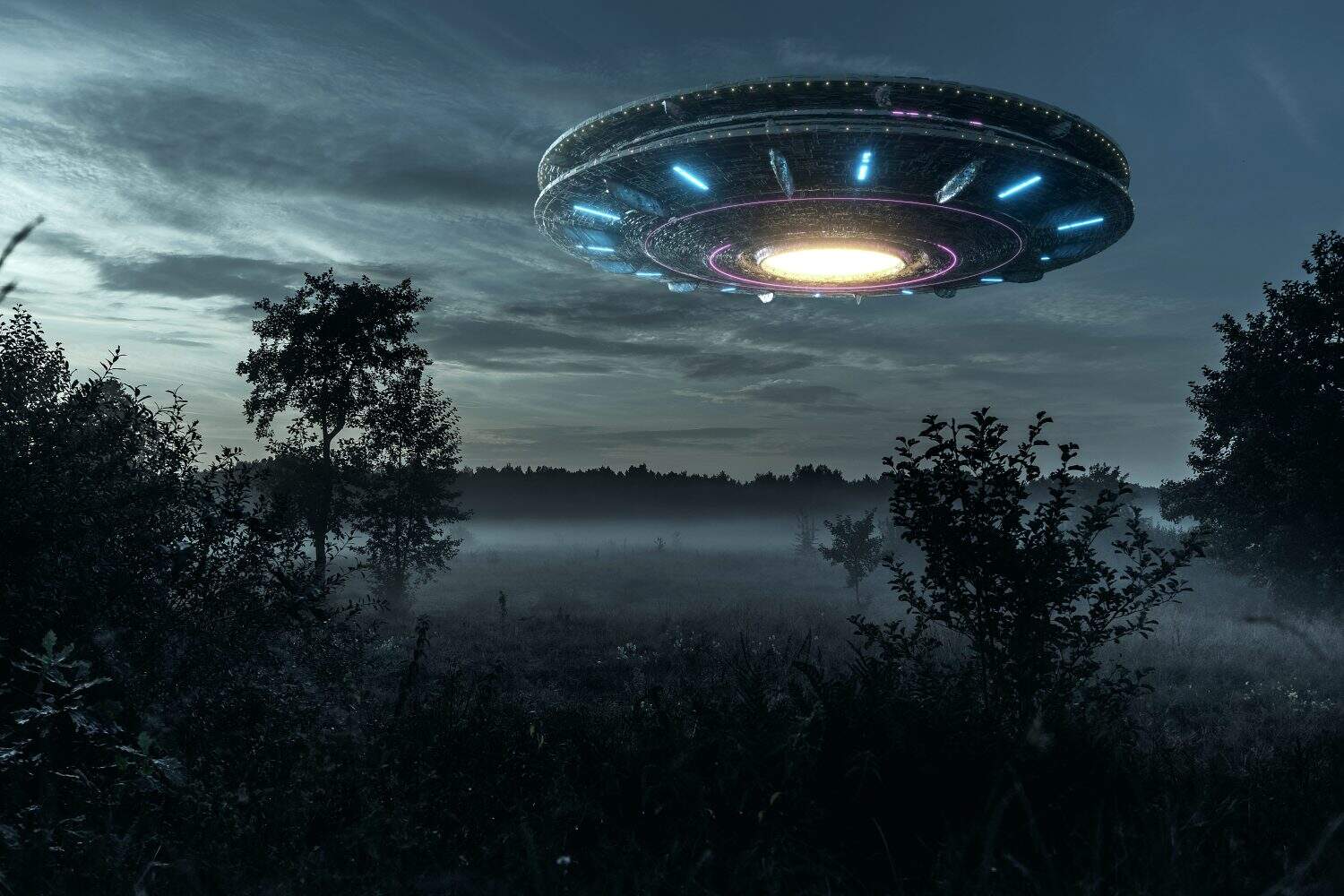
Marko Aliaksandr / Shutterstock.com

Jetlinerimages / Getty Images
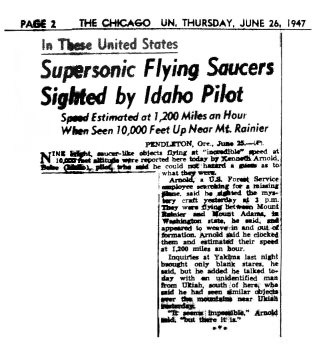
UPI, Public domain, via Wikimedia Commons

PeopleImages.com - Yuri A / Shutterstock.com

PeopleImages.com - Yuri A / Shutterstock.com

New Africa / Shutterstock.com

Marko Aliaksandr / Shutterstock.com

Everett Collection / Shutterstock.com

Roswell Daily Record., Public domain, via Wikimedia Commons

Jabberocky, Public domain, via Wikimedia Commons

New Africa / Shutterstock.com








The 1947 UFO Sighting That Helped Launch America’s Flying Saucer Craze
People have reported strange things in the sky for centuries, but one flight over Washington state helped launch the modern American UFO craze. On June 24, 1947, private pilot Kenneth Arnold reported seeing nine unusual objects moving at tremendous speed near Mount Rainier. Newspapers picked up the story almost immediately, and the phrase “flying saucer” soon became part of the national vocabulary. So who was Arnold, what did he actually say he saw, and why did one flight have such a lasting impact? Click through the slideshow to find out.
Who Was Kenneth Arnold?
Kenneth Albert Arnold was born on March 29, 1915, in Sebeka, Minnesota. He became a businessman and experienced private pilot based in Boise, Idaho, and had logged thousands of hours in the air by 1947. Arnold became nationally famous that summer after reporting one of the first widely publicized UFO sightings of the modern era. He died on January 16, 1984, in Bellevue, Washington, at age 68.
The Kenneth Arnold UFO Sighting
On June 24, 1947, Arnold took off from Chehalis, Washington, on his way to an air show in Pendleton, Oregon, with a planned fuel stop in Yakima. Near Mount Rainier, he made a detour to search for a U.S. Marine Corps Curtiss C-46 Commando transport that had crashed with 32 Marines aboard. Shortly before 3 p.m., Arnold said he spotted nine bright objects moving together in formation. He timed their movement between Mount Rainier and Mount Adams and calculated that they were traveling at roughly 1,200 mph. Arnold described the objects as extremely bright in the sunlight and moving in an unusual, weaving fashion.
How “Flying Saucer” Entered the Language
Arnold's report helped turn “flying saucer” into a national catchphrase, but exactly how the wording originated is a little messy. Contemporary reports credited Arnold with using words such as saucer, disc, and pie-pan while describing what he had seen. Arnold later insisted that his best-known saucer comparison referred to the objects' motion, which he said reminded him of a saucer skipping across water, rather than their exact shape. Newspapers nevertheless began describing the objects as “saucer-like,” and the phrase “flying saucer” spread across the country within days.
More Sightings Followed Almost Immediately
Arnold's story arrived just as reports of mysterious objects began pouring in from around the Pacific Northwest and then the rest of the country. On July 4, 1947, residents and police officers in parts of Oregon and Washington reported seeing disc-like objects overhead, while witnesses around Boise, Idaho, reported another formation.
One of the best-documented reports came from United Air Lines Flight 105 that same evening. Captain Emil J. Smith, First Officer Ralph Stevens, and flight attendant Marty Morrow reported seeing formations of unusual objects shortly after the DC-3 left Boise, while flying near Emmett, Idaho. The crew watched them for several minutes before losing sight of them. The incident later appeared in government UFO records. Like Arnold's sighting, the report documented something the witnesses could not identify; it did not establish that the objects were extraterrestrial.
UFO Does Not Mean Alien
The terms UFO and UAP describe something that has not yet been identified. They do not automatically mean an alien spacecraft. The federal government now generally uses UAP, or “unidentified anomalous phenomena.” Some reports remain unresolved because there is not enough reliable information to determine what was observed. A 2024 review by the government's All-domain Anomaly Resolution Office found no evidence that any official U.S. investigation had confirmed a UAP sighting as extraterrestrial technology.
Most Americans Say Alien Life Probably or Definitely Exists
Believing that life exists somewhere beyond Earth is not the same thing as believing every unexplained object is an alien spacecraft. In a September 2022 YouGov survey of 1,000 U.S. adult citizens, 57% said aliens either definitely exist or probably exist. That broke down to 24% who said they definitely exist and 33% who said they probably do. In a separate question from the same survey, only 34% said UFOs were probably alien ships or alien life forms.
The Air Force Investigated UFO Reports for Decades
The U.S. Air Force spent decades formally investigating UFO reports through programs including Project Sign, Project Grudge, and Project Blue Book. Across the Air Force's investigations from 1947 through 1969, officials cataloged 12,618 reported sightings, 701 of which remained classified as unidentified when Project Blue Book ended. The Air Force concluded that its investigations found no evidence that the unidentified cases represented a threat to national security or technology beyond known scientific capabilities. Today, U.S. government work involving UAP is coordinated through the All-domain Anomaly Resolution Office, or AARO.
The Roswell Incident
Only weeks after Arnold's sighting, Roswell, New Mexico, became the setting for the most famous UFO story in American history. In July 1947, debris was recovered from a ranch near Roswell Army Air Field. The military briefly announced that it had recovered a “flying disc” before identifying the wreckage as balloon equipment. Decades later, an extensive Air Force review concluded that the debris came from Project MOGUL, a classified balloon-borne research program designed in part to detect evidence of Soviet nuclear tests. That explanation has not stopped Roswell from becoming a cornerstone of UFO conspiracy culture.
Doug Bower and Dave Chorley Helped Create the Modern Crop-Circle Craze
Crop circles existed in stories and scattered reports long before the modern UFO era, but two Englishmen helped turn them into a phenomenon. In 1976, Doug Bower and Dave Chorley created what they intended to look like a “flying saucer nest” in a field in Wiltshire, England. They continued making formations in secret and came forward publicly in 1991. Other circle-makers followed, eventually producing increasingly elaborate geometric patterns. Their confession demonstrated that famous-looking crop formations could be made by people, although reports of circular patterns in fields predated Bower and Chorley.
UFO Culture Has Its Own Festivals and Conferences
The fascination that exploded after Arnold's 1947 report never really went away. UFO and UAP enthusiasts now gather at conferences and festivals devoted to everything from historical sightings and government investigations to much more speculative ideas about extraterrestrial life. Recurring events include Contact in the Desert in California and the Roswell UFO Festival in New Mexico. Whether visitors come as committed believers, skeptics, researchers, or just people who enjoy a good alien costume, modern UFO culture has grown far beyond one pilot's strange afternoon over Washington.