
Associated Press, photographer uncredited, Public domain, via Wikimedia Commons


Harry Trask, Public domain, via Wikimedia Commons

Angelo Cozzi (Mondadori Publishers), Public domain, via Wikimedia Commons


Jamelle Bouie, CC BY 2.0


When Sports Go Political On Purpose, This Is What Happens
Politics affects all parts of our lives, even if it doesn't seem like it. This includes the sports world! Even if it's unintentional, sports can become political.
This dates back to pre-Civil Rights and the feminist movements. For the longest time in the United States, people of color and women were excluded from sports. When they were allowed, the teams were segregated and didn't have access to the same funding or power.
There are more examples of politics in sports, which we'll discuss with specific examples in this slideshow. For this slideshow, 24/7 Tempo consulted both history and sports resources online, like the Ohio State University, ESPN, and the Illinois News Bureau. Click through the slideshow for eight times sports got political on purpose.
Jackie Robinson: The First Person of Color To Play in the MLB (1947)
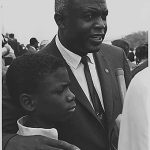
Politics isn't just protesting; it's also making changes and breaking through barriers. An example of this is Jackie Robinson, who was the first person of color to play in the MLB. He was the start of the end of segregation in sports, mainly baseball. Robinson began playing on April 15, 1947, for the Brooklyn Dodgers. During his career, he was an All-Star 6 times and an NL batting champion in 1949.
Kathrine Switzer as the First Woman To Run the Boston Marathon (1967)
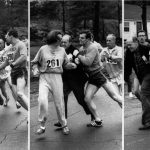
It's crazy to think just how fast life changed for women and people of color. During the 1960s, it wasn't common for women to run in races. Kathrine Switzer, in 1967, became the first woman to run the Boston Marathon as an officially registered runner. She did this by signing up with her initials, as women were not allowed at the time. Jock Semple, the race co-director, attempted to take her out of the race by pulling her number and grabbing at her as she ran. He was unsuccessful and received help from other races, including her boyfriend, Tom Miller. She finished the race, but the Boston Marathon didn't allow women to race until 1972.
Mexico Olympics (1968)
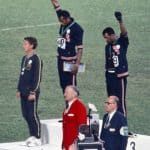
Protesting is a great way to let your voice be heard while trying your best to motivate change. What better way to do so when millions of people are watching? During the Olympics in 1968, Tommie Smith and John Carlos, after winning Gold and Silver, went to the podium for their awards barefoot, but wearing black socks. They then did the Black Power salute while facing the U.S. flag to protest against racial inequality. The two were banned from the U.S. team and the Olympic Village, but are regarded as heroes.
The Battle of the Sexes (1973)
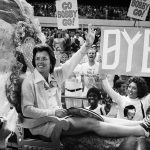
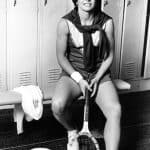
Women in sports were still relatively new when the Battle of the Sexes in 1973 was held. During this event, 55-year-old Bobby Riggs went against 29-year-old Billie Jean King. It was televised, and King won in three sets! During the same year, King started the Women's Tennis Association.
Mahmoud Abdul-Rauf Not Standing For the National Anthem (1996)
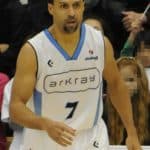
Mahmoud Abdul-Rauf, previously known as Chris Wayne Jackson, is a former professional basketball player. He's best known for his protests against the U.S. government and its anti-Islamic views. He did this by not standing for the anthem before games. Because of this, he was suspended shortly. He came to an agreement, though, with the NBA and stood for the anthem, but didn't recite it. Instead, he bowed his head and whispered an Islamic prayer.
"Hands up, don't shoot" (2014)
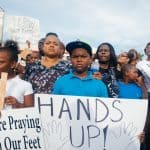
Protests were more common during the 2010s in sports spaces, specifically about police brutality and injustices. In 2014, after Officer Darren Wilson killed Michael Brown, a Black man in Ferguson, Missouri, five St. Louis Rams players protested at a game. They did this by running into the field with their hands up. The five players were Tavon Austin, Stedman Bailey, Kenny Britt, Jared Cook, and Chris Givens.
Colin Kaepernick Taking a Knee
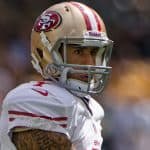
Although not the most recent protest in sports, it's one of the more well-known instances. In 2016, Colin Kaepernick took a knee during the national anthem, which sparked a lot of outcry and support. Even before he took a knee, he sat during "The Star-Spangled Banner." These silent protests were against police brutality and called for the U.S. to improve. After his silent protest, he donated $1 million to organizations working with marginalized communities.
Nezza's Spanish Version of the Star Spangled Banner (2025)
One of the more recent times sports got political was when Nezza, a singer, was invited to sing the national anthem at an LA Dodgers game, and sang it in Spanish. Why was this political? Well, before the game, they asked her not to do so. She reasoned that it was a protest against ICE Raids in the city, a city filled with immigrants.